Search Header Logo
Earth's Processes

Earth's Processes

Assessment

Presentation

Science

5th Grade

Hard

Created by

Joseph Anderson

FREE Resource

13 Slides • 25 Questions

1

media

Energy and Earth Processes Review

2

EARTH LAYERS REVIEW

media

3

4

Crust

The crust is the Earth’s thinnest layer.

Our home and schools are built on top of the crust.

Powerful forces deep inside the

Earth have broken the crust into many pieces called tectonic plates.

media

5

Mantle

Below the crust is Earth’s thickest layer, the mantle.

The mantle is mostly made of rocky material, heat causes it to move like a thick liquid. This movement breaks the crust up into the tectonic plates.

media

6

Outer Core

The outer crust lies beneath the mantle and is made mostly of the elements iron and nickel.

This liquid layer is even hotter than the mantle. It is so hot, these metals have melted.

media

7

Inner Core

It´s at the center of the earth.

It´s a dense ball of solid metal (iron and nickel). This due to very high temperature and pressure.

It is the hottest layer in the Earth.

media

8

Dropdown

An engineer wants to design a machine that is able to travel to the center of the Earth. Complete the sentence below to make it true.


To travel toward the center of the Earth, the machine must be strong enough to handle

very ​
temperatures and very ​​
pressure.

9

Labelling

Use the word bank below to label the Earth’s layers

Drag labels to their correct position on the image

mantle

inner core

outer core

crust

10

Multiple Choice

Which statement is true?

1

The Earth never changes.

2

The Earth is constantly changing.

3

The Earth is changing but only on its surface

4

The Earth is changing only beneath its surface.

11

media

Plate Tectonics Review

12

13

Multiple Choice

Which event is most likely caused by the movement of the Earth's crust along transform boundaries?

1

earthquakes

2

formation of mountains

3

solar eclipses

4

formation of trenches

14

Multiple Choice

Question image

Look at the model. According to the theory of plate tectonics, what caused the change in the location of the continents over time?

1

thermal energy of the Earth

2

light energy of the Sun

3

electrical energy of lightning

4

mechanical energy of earthquakes

15

Multiple Choice

Question image

What caused the formation of trenches on the ocean floor?

1

movement of air currents

2

movement of tectonic plates

3

movement of glaciers

4

movement of ocean waves and currents

16

Multiple Choice

The movement of the Earth's plates caused the formation of the Appalachian Mountains about 480 million years ago. Which statement explains how this might have happened?

1

plates moved away from each other

2

plates collided with each other

3

plates broke into smaller pieces

4

plates stayed in one place

17

media

Weathering, Erosion, and Deposition Review

18

19

Drag and Drop

Question image
Changes of the beach area are most likely caused by ​
.
Drag these tiles and drop them in the correct blank above
water
wind
air

20

Drag and Drop

Question image
On the school playground arrow 1 represents ​


and arrow 2 shows ​
.

Drag these tiles and drop them in the correct blank above
erosion
deposition

21

Multiple Choice

Question image

Look at the picture of a school playground. What could be done to reduce erosion on the hill?

1

Add mulch at the bottom of the hill.

2

Cover the playground with sand.

3

Plant more grass on the side of the hill.

4

Plant bushes all over the playground.

22

Multiple Choice

Question image
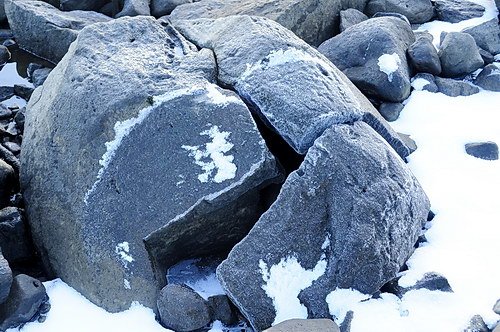
How does freezing water cause the weathering of rocks?  The freezing water—
1
keeps the rocks in place.
2
makes the rocks last longer.
3
expands cracks and breaks rocks.
4
causes rocks to fall in landslides.

23

media

Rock Cycle Review

24

25

Multiple Choice

Rocks that have formed due to layers of sediment cemented together are called:

1

Igneous rocks

2

Sedimentary rocks

3

Metamorphic rocks

4

All of the above

26

Multiple Choice

Rocks that have formed due to heat and pressure are called:

1

Igneous rocks

2

Sedimentary rocks

3

Metamorphic rocks

4

All of the above

27

Multiple Choice

Rocks that have formed due to melting and cooling are called:

1

Igneous rocks

2

Sedimentary rocks

3

Metamorphic rocks

4

All of the above

28

Multiple Choice

All statements below are true except –

1

Igneous rocks are formed through cooling and solidification

2

Metamorphic rocks are formed through weathering and erosion

3

Sedimentary rocks are formed through sedimentation and compaction

4

Sedimentary rocks can contain fossils.

29

Labelling

Using the word bank, label each type of rock in the diagram.

Drag labels to their correct position on the image

igneous rock

metamorphic rock

sedimentary rock

30

Multiple Choice

Question image
This rock formed when bits of other rocks became pressed into a solid. What type of rock is it?
1
Sedimentary Rock
2
Metamorphic Rock
3
Igneous Rock

31

Multiple Select

Question image

Identify the processes that most likely created the fossil formations.

1

sedimentation and compaction

2

weathering and erosion

3

heat and pressure

4

cooling and solidification

32

Multiple Choice

What evidence has been discovered that leads scientists to conclude that parts of Virginia were once covered by the ocean?

1

Salinity levels in Virginia's soil have been tested.

2

Satellite pictures of an ocean covering Virginia have been studied.

3

Fossils of ocean animals have been found in Virginia.

4

Special minerals made from salt have been discovered in Virginia.

33

Multiple Choice

Why are fossils most commonly found in sedimentary rock?

1

Sedimentary rock is formed when rocks are melted in lava.

2

Sedimentary rock is formed when layers of material are pressed together.

3

Sedimentary rock is formed from weathering and erosion.

34

Multiple Choice

What information do scientists learn from fossils?

1

to understand life and conditions from the past

2

to recognize future climate change

3

provide information about how people traveled in the past.

4
  1. to harness the sun’s radiant energy​

35

Multiple Choice

Question image

Using the Dichotomous key, identify rock D.

1

Slate

2

Gneiss

3

Granite

4

Obsidian

5

Conglomerate

36

Multiple Choice

Question image

Using the Dichotomous key, identify rock B.

1

Slate

2

Gneiss

3

Granite

4

Obsidian

5

Conglomerate

37

Multiple Choice

Question image

Using the Dichotomous key, identify rock C.

1

Slate

2

Gneiss

3

Granite

4

Obsidian

5

Conglomerate

38

Multiple Choice

Question image

Using the Dichotomous key, identify rock A.

1

Slate

2

Gneiss

3

Granite

4

Obsidian

5

Conglomerate

media

Energy and Earth Processes Review

Show answer

Auto Play

Slide 1 / 38

SLIDE