Search Header Logo
  1. Resource Library
  2. Math
  3. Probability And Statistics
  4. Median Of Grouped Data
  5. Mean, Mode, Median, And Range Of Ungrouped And Grouped Data
Mean, Mode, Median, and Range of Ungrouped and Grouped Data

Mean, Mode, Median, and Range of Ungrouped and Grouped Data

Assessment

Presentation

Mathematics

10th Grade

Hard

Created by

Joseph Anderson

FREE Resource

10 Slides • 11 Questions

1

Grouped Distributions

2

Multiple Choice

What does "mean" mean?
1
average
2
middle
3
repeats the most
4
variation

3

Multiple Choice

Question image

What is Xm and n in the formula of the mean for grouped data?

1

frequency of the mean class

2

Midpoint and total frequency

3

Classmark and frequency

4

Midpoint and total cumulative frequency

4

Multiple Choice

Question image

What column do we need in calculating the mean for grouped data?

1

Class Interval

2

Frequency

3

Cumulative Frequency

4

Midpoint/Classmark

5

Multiple Choice

After constructing the classmark, what is the next step?

1

Add the frequency and the classmark.

2

Subtract the frequency and the classmark.

3

Multiply the frequency and the classmark then add all of them together.

4

Divide the frequency and the classmark then add all of them together.

6

Fill in the Blanks

media image

Type answer...

7

Fill in the Blanks

media image

8

Fill in the Blanks

media image

9

media

10

Grouped vs Ungrouped Data

An ungrouped frequency distribution is simply each data item listed in a table next to the frequency of the occurrence of that value. 

Ungrouped Frequency Distributions - used for data that can be enumerated and when the range of values in the data set is not large.

A grouped distribution is a way of organising a large set of data into smaller, more manageable groups.

A Grouped Frequency Distribution is used when the range of data values in the data set is large.

11

Example

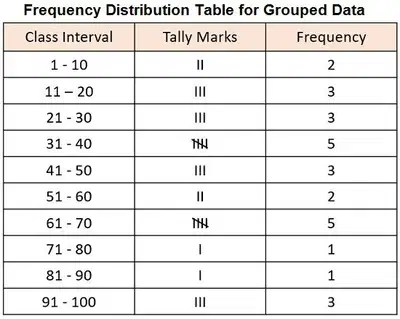
Consider the marks obtained by students in an examination where the maximum marks of the exam are 100.

22, 65, 32, 36, 28, 17, 15, 64, 86, 52, 36, 55, 9, 48, 65, 96, 14, 6, 37, 69, 76, 49, 37, 46, 21, 67, 92, 98

If we create a frequency distribution table for each and every data item, then it will form a large table with one row for each data item

So for easy understanding, we can make a table with groups of data items

media

12

Class Intervals

  • The data is grouped into classes. The table shown contains 10 classes

  • Each class is recorded as a class interval so for example the 3rd class interval is 21-30

  • Note that the class intervals do not overlap when working with discrete data

media

13

Class Limits

  • The smallest and largest values of a class are called the class limits.

  • Class limits are actual data values. 

  • 21 and 30 are the class limits of the 3rd class interval

media

14

Class Boundaries

  • Class boundaries provide values that eliminate gaps between the class intervals

  • Class boundaries are not actual data values

  • To find a class boundary, average the upper class limit of one class and the lower class limit of the next class

  • the class boundaries of the 3rd class are 20.5 and 30.5

media

15

Class width

  • Each class interval has a class width

  • The class width is the difference between the class boundaries

  • The width of the class in the table shown is 30.5-20.5 = 10

media

16

Class Midpoint

  • The class midpoint is calculated by finding the mean of the upper and lower class limits (or boundaries). 

media
media

17

Mean, Median, and Mode of Grouped Data & Frequency Distribution Tables Statistics

18

Multiple Choice

Question image

Calculate mean for the above given data.

1

1.6

2

1.4

3

1.3

4

1.8

19

Multiple Choice

Question image

Find the mean.

1

10

2

20

3

30

4

40

20

Multiple Choice

Question image

Find the estimated mean from the following table...


You may need to copy the table out and add columns...

1

28.5

2

31.5

3

30.5

4

29.5

21

Multiple Choice

Question image
1

53.75

2

54.375

3

55.575

4

56.45

Grouped Distributions

Show answer

Auto Play

Slide 1 / 21

SLIDE