Plate Tectonics and Plate Boundaries Lessons
Presentation
•
Science
•
9th - 12th Grade
•
Hard

Joseph Anderson
FREE Resource
18 Slides • 23 Questions
1
Plate Tectonics and Plate Boundaries
Year 10 EES
2
What we will cover:
continental drift --> plate tectonics
convection currents
divergent, convergent, and transform plate boundaries
drawing plate boundaries
intro on earthquakes
3
Multiple Choice
Which of these phenomenon is not directly caused by plate tectonics
Volcanic eruptions
Earthquakes
Tsunamis
Landslides
4
Open Ended
What are the types of plate boundaries?
5
Multiple Choice
6
Multiple Choice
7
Multiple Choice
Boundary between two plates that are sliding past each other
transform
divergent
convergent
strike-slip
8
Multiple Choice
The scientist who developed the big idea called "sea-floor spreading"
Alfred Wedgener
Harry Hess
Edward Dutton
Ortelius
9
Multiple Choice
The idea that the continents were once part of a single landmass that broke apart and
moved is
Continental Drift
Tectonic Plates
Transform
10
Multiple Choice
Why did no one believe Wegener's thoery that the continents were once together?
He could not explain HOW the continents moved
He didn't have evidence
His data was wrong
He didn't use the right technology to gather data
11
Multiple Choice
The movement of the tectonic plates is caused by______.
convection currents
rotation of the Earth
movement of materials in the outer core
revolution of the Earth
12
The shift from continental drift to plate tectonics
Continental drift provided a theory for how the continents used to fit together, and must have moved over time
Evidence: matching coastlines, fossils found on now separate continents, matching geological evidence, glacial striations
However, he could not propose HOW this actually happened
Plate tectonics was able to do this
13
Plate tectonics:
The crust and upper mantle make up the lithosphere
The lithosphere is broken into 10 major and many minor plates
These plates float on a layer of magma in the asthenosphere
The magma moves due to convection currents
The plates move only a few centimetres a year
There is either continental or oceanic crust that makes up the plates
14
Types of crust:
Oceanic crust
thinner (6km)
denser - due to chemical make up
younger
formed by diverging plates
under the oceans
Continental crust
thicker (30-70km)
less dense
older
formed by converging plates
makes up the continents
15
Multiple Choice
Which is more dense?
Continental Crust
Oceanic Crust
16
Multiple Choice
The fact that similar fossils are found on both sides of the ocean is evidence of____.
magnetic reversal
continental drift
seafloor spreading
oceanic drift
17
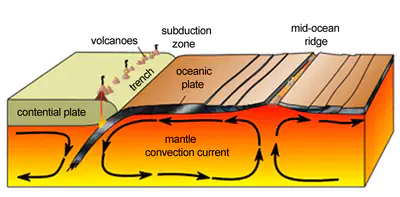
Convection currents
Plates float on magma in the asthenosphere
More of a solid than a liquid layer due to the pressure it's under
But it is constantly moving
As the magma heats up it becomes less dense and spreads out, once it hits the tectonic plate on top it cools, becomes more dense and sinks
18
19
Plate Boundaries
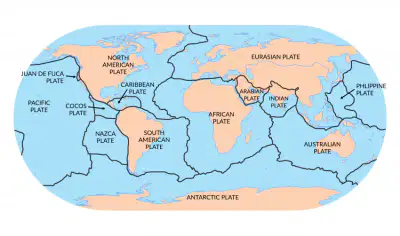
Tectonic plates meet at boundaries
Convergent, divergent, and transform boundaries exist
You will need to know the details of these plate boundaries, where they occur on Earth, and what tectonic processes they form
20
Divergent boundaries
If plates are moving away from each other
When plates move apart, magma from the mantle comes to the Earth's surface
As the magma cools, new oceanic crust is formed
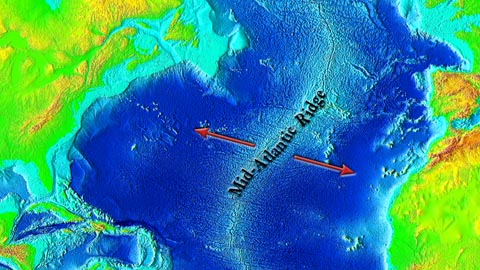
Often form Mid Ocean Ridges (MORs)
E.g. Mid Atlantic Ridge
Rock further from the MOR is older
21
Tectonic processes = earthquakes, convection, magma rising
Examples:
22
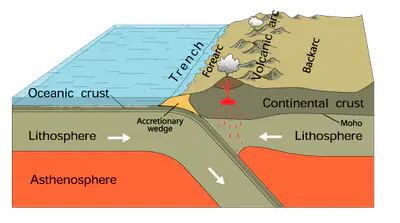
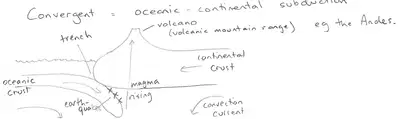
Convergent boundaries:
Plates that collide with each other
There are 2 types (dependent on the composition of the plates):
Oceanic-Continental
Causes subduction, as the oceanic crust (more dense) sinks under the continental crust
Deep ocean trenches form
Earthquakes and volcanic activity - due to heat and friction released
E.g. Andes mountain ranges
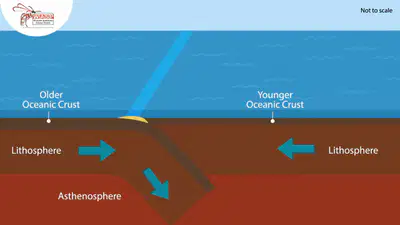
Oceanic-oceanic also does the same --> the older/colder plate will subduct beneath the other
Continental-Continental
Nothing subducts, so they go up
Forms mountain ranges and earthquake activity
E.g. Himalayas
23
24
25
26
Transform boundaries
Two plates slide against each other in opposite directions
Pressure builds up and can release in the form of earthquakes
E.g. San Andreas fault in California
27
28
Earthquakes:
When pressure builds up due to plate movement, suddenly, the pressure can become too much and the plates will 'jump' to a new position
This jump causes rocks to break and energy to be released - some of this energy is released in the form of seismic waves
Seismic waves cause earthquakes
Most earthquakes will occur at plate boundaries or on fault lines
29
Multiple Choice
What kind of boundary is shown in this image?
Divergent
Convergent: Subduction
Convergent: Collision
Transform
30
Multiple Choice
The San Andréas fault in California is one example of a...
Divergent boundary
Convergent boundary
Transform boundary
All of the above
31
Multiple Choice
32
Multiple Choice
33
Multiple Choice
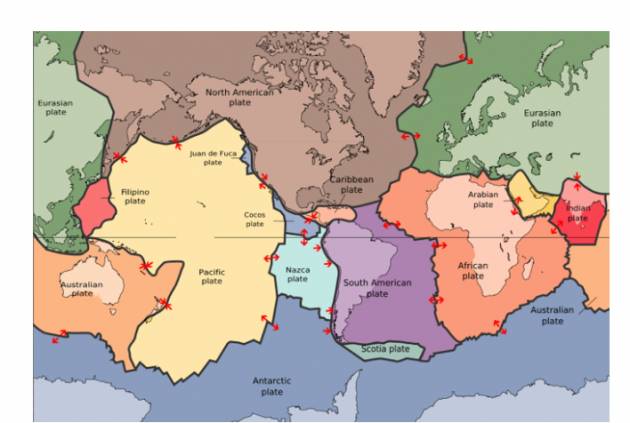
Where are earthquakes MOST LIKELY to occur?
close to the equator
close to the center of tectonic plates
at divergent or convergent plate boundaries
at transform plate boundaries
34
Multiple Choice
The process by which oceanic crust sinks beneath a deep-ocean trench and back into the mantle at a convergent plate boundary.
stressing
seafloor spreading
subduction
shearing
35
Multiple Select
What is happening in this image? Select all correct answers.
Oceanic-Continental convergent boundary
The more buoyant plate is subducting under the other
Pressure build up causes volcanic eruptions
The denser plate subducts under the other
36
Multiple Choice
The image shows the Mid Atlantic Ridge. Which type of boundary occurs at this ridge where the ocean floor is spreading apart?
convergent
divergent
transform fault
reverse fault
37
Multiple Choice
38
Multiple Choice
Thinner, more dense, younger crust, primarily basaltic, making ocean floor
mantle
continental crust
oceanic crust
asthenosphere
39
Multiple Choice
The portion of the earth's crust that primarily contains granite, is less dense than oceanic crust, and is 20-50 km thick
mantle
continental crust
oceanic crust
asthenosphere
40
Multiple Choice
The process that creates new seafloor as plates move away from each other at the mid-ocean ridges
stressing
seafloor spreading
subduction
shearing
41
Up next?
Earthquakes
Tsunamis
Volcanoes
Plate Tectonics and Plate Boundaries
Year 10 EES
Show answer
Auto Play
Slide 1 / 41
SLIDE

Similar Resources on Wayground
32 questions
P Waves
Presentation
•
9th - 12th Grade
37 questions
Circle
Presentation
•
9th - 12th Grade
39 questions
INTERNAL STRUCTURE OF THE EARTH
Presentation
•
8th - 10th Grade
31 questions
5.2 World Climates
Presentation
•
9th - 12th Grade
31 questions
Environmental Impacts
Presentation
•
9th - 12th Grade
35 questions
Unit 6 Part 1: The Structure of Earth
Presentation
•
9th - 12th Grade
34 questions
Types of Energy
Presentation
•
9th - 12th Grade
39 questions
Earthquakes and Faults
Presentation
•
9th - 12th Grade
Popular Resources on Wayground
11 questions
Hallway & Bathroom Expectations
Quiz
•
6th - 8th Grade
10 questions
HCS SCI 03 Summer School Assessment 2
Quiz
•
3rd Grade
11 questions
Home Scope
Quiz
•
7th - 8th Grade
12 questions
2026 TAP Technology in the Classroom
Presentation
•
Professional Development
15 questions
HCS SCI 05 Summer School Assessment 2 Review
Quiz
•
5th Grade
15 questions
HCS SCI 04 Summer School Review 2
Quiz
•
4th Grade
59 questions
Geometry Unit 3 Review
Quiz
•
9th - 12th Grade
14 questions
FAST ELA READING SMAPLE TEST MATERIALS
Passage
•
3rd Grade