
Unit 6 Part 1: The Structure of Earth

Presentation
•
Science
•
9th - 12th Grade
•
Practice Problem
•
Medium
+13
Standards-aligned

Abby Fancsali
Used 22+ times
FREE Resource
21 Slides • 15 Questions
1
DO NOW: Write what you think the example words mean in your lab manual.
Extra Credit: Find three additional words that use this root and write them and their definition in your lab manual (6 Points Max)

2
3

4

Describe the basic chemical composition of the Earth's Compositional Layers
Crust
Mantle
Core
Name and Describe the Earth's Functional layers
5
Word Cloud
What do you Know about the Earth's Structure?
6
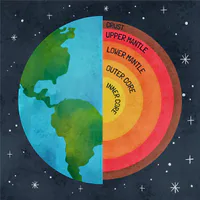
Introduction-The Main layers of the Earth
Earth can be divided up into three concentric layers based on their chemical composition
Concentric: two or more circles with a common center
As you go deeper into the Earth, the temperature and the pressure increase

7
The Crust
The Crust: Earth's Surface Layer
The Thinnest layer
Ranges between 7 and 50 km thick
Only about 0.3% of the planet's volume
Made of rocks that contain minerals rich in silicon and Oxygen
Over time, shifts and move positions of rocks
Divided into two parts
Continental Crust
Oceanic Crust

8
Continental Crust
Continental Crust: Crust that makes up landmasses
About 40 km thick
Made up of mostly light, low-density rock called granite
It can be eroded over time and wind up in the ocean


9
Oceanic Crust
Oceanic Crust: Crust that sits under the ocean
About 7 km thick on average
Made of mostly a dense dark gray rock called Basalt
Contains more iron and magnesium than the continental crust


10
Multiple Choice
How many layers of the Earth are there if when we look at chemical composition?
1
2
3
4
11
Drag and Drop
12
Drag and Drop
13
Multiple Select
What are the two most abundant elements in the Earth's Crust
Oxygen
Silicon
Nitrogen
Iron
Magnesium
14
Categorize
Granite
basalt
more iron
more magnesium
thinner
is eroded
thicker
15
The Mantle
The Mantle is a thick layer of hot rock
Exists in a semi-solid state
The Largest layer of the Earth, ~82% of its mass
2900 Km Thick

16
How Do Geologists Learn about Earth's Interior?
Scientists don't know much about the Mantle
It is hard to see
We can't drill into it
Geologist: A scientist who specializes in studying the Earth, Rocks, and Minerals
Practice two methods to study the Earth
Looking at Rock Samples
Studying the behavior of seismic waves

17
Evidence from Rock Samples
Geologists drill holes into the Earth to Collect Samples
Some as deep as 12.3 Kilometers
The plugs show the different layers of rocks
Rocks are also blasted to the surface by volcanoes
Scientists attempt to recreate the conditions inside the Earth to test how rocks behave
Shoot the rocks with lasers

18
19
Evidence from Seismic Waves
Seismic Waves: an elastic wave in the Earth produced by an earthquake or other means
Geologists record and study how seismic waves travel throughout the Earth
The speed and direction can indicate how waves move around different masses

20
Properties of The Mantle
Rock Samples show that the mantle is made up of mainly silicon and oxygen, just like the crust
The Mantle has larger amounts of Magnesium, iron, and calcium
These denser elements make the mantle denser than the crust
21
The Core
The Center of the Earth
Has a radius of about 3500 km
Mainly made up of iron with smaller amounts of nickel
Mainly studied through Seismic Waves
22
Multiple Choice
What sort of scientist studies the rocks and minerals that make up the Earth?
23
Multiple Choice
True or False: The Mantle is the thickest later of the Earth
True
False
24
Multiple Select
How have scientists learned about the Mantle of the Earth?
Drilling a Hole to it
Looking at Rock Samples
Studying Seismic waves
Shining a light into the ground
25
Multiple Select
Which elements are more prominent in the mantle than in the crust
Magnesium
Iron
Calcium
Copper
Nitrogen
26
The Structural Layers
The three main layers of the Earth only focus on the chemical composition in the layers and not their properties
When we look at the physical properties of the different parts of the Earth, we can divide it into 5 layers.
Physical properties studied:
temperature
pressure
strength
ability to flow
27
The Lithosphere
Made up of the crust and the upper portion of the mantle
Also known as the "rock sphere."
A shell of cool, rigid rock that ranges from 15 km to 300 km deep
Thicker below the continents than the oceans
Broken up into pieces called tectonic plates

28
The Asthenosphere
Lies under the lithosphere
Made up of mantle rock that is soft and flows extremely slowly
Caries the pieces of the lithosphere on top of it

29
The Lower Mantle
Sits between the aesthenosphere and outer core
Hotter than the Aesthenosphere, but more solid and rigid

30
The Outer Core
A shell of hot, liquid, metal
Mostly iron, but also some nickel
Creates The Earth's Magnetic Field that shields the Earth from solar wind particles
Spins and flows as the Earth rotates

31
The Inner Core
A solid sphere of hot metal
Almost pure iron
Temperature of 7000°C
High Pressure from all other layers keeps it solid.
32
Multiple Select
What does the iron in the outer core do for the Earth?
Create the Earth's Magnetic Field
Keep the Layers from collapsing in
Protect the Earth from Solar Winds
Attract the other layers together
33
Multiple Select
Which structural layer(s) of the Earth flow and move?
Lithosphere
Asthenosphere
Lower Mantle
Outer Core
Inner Core
34
Multiple Choice
How are the five structural layers of the Earth categorized?
By Chemical Properties
By Size
By Physical Properties
By Age
35
Multiple Choice
Which layer of the Earth do we live on?
Lithosphere
Asthenosphere
Lower Mantle
Outer Core
Inner Core
36
Labeling
Label the structural layers of the Earth
Outer Core
Lower Mantle
Lithosphere
Asthenosphere
Inner Core
DO NOW: Write what you think the example words mean in your lab manual.
Extra Credit: Find three additional words that use this root and write them and their definition in your lab manual (6 Points Max)
Show answer
Auto Play
Slide 1 / 36
SLIDE
Similar Resources on Wayground

31 questions
Characteristics of Life & Biological Levels of Organization
Presentation
•
9th - 12th Grade
30 questions
Cell Membrane
Presentation
•
9th - 12th Grade
32 questions
Forensic Toxicology and Drugs
Presentation
•
9th - 12th Grade
27 questions
Forensic Ballistics
Presentation
•
9th - 12th Grade
31 questions
Ecosystems
Presentation
•
8th - 12th Grade
34 questions
Ionic and Covalent Bonding
Presentation
•
9th - 12th Grade
33 questions
Snapshot 1 Lobo Review
Presentation
•
9th - 12th Grade
Popular Resources on Wayground
10 questions
How much do you know about our Portrait of an Eagle?

Quiz
•
10th Grade
10 questions
Fast Food Slogans
Quiz
•
6th - 8th Grade
21 questions
Continents and Oceans
Quiz
•
6th Grade
20 questions
Parts of Speech
Quiz
•
5th Grade
16 questions
Subject & Predicate
Quiz
•
5th Grade
25 questions
Multiplication Facts
Quiz
•
5th Grade
12 questions
Map Skills
Quiz
•
3rd Grade
22 questions
Continents and Oceans
Quiz
•
5th Grade
Discover more resources for Science
10 questions
Exploring Chemical and Physical Changes

Interactive video
•
6th - 10th Grade
20 questions
Atomic Structure
Quiz
•
9th Grade
10 questions
Decoding the Periodic Table of Elements
Interactive video
•
6th - 10th Grade
10 questions
Exploring the Periodic Table
Interactive video
•
6th - 10th Grade
14 questions
Physical and Chemical Changes
Quiz
•
10th Grade
22 questions
Periodic Table Review
Quiz
•
9th - 12th Grade
20 questions
Observation vs. Inference
Quiz
•
7th - 9th Grade
14 questions
Periodic Trends
Interactive video
•
11th Grade