Trophic Levels and Energy Pyramids
Presentation
•
Biology
•
9th Grade
•
Hard

Joseph Anderson
FREE Resource
10 Slides • 19 Questions
1
Energy Pyramids and Biomass
E.Q: How can an energy Pyramid be used to explain the relationship between amount of energy and population size?
2
In this lesson we will
Review food chains and food webs
Define biodiversity
Explore energy transfer among trophic levels
Define biomass
Understand why pyramids are used to show both energy transfer and biomass
3
Vocabulary: Trophic Level
Recall that trophic levels are used to group organisms according to their nutritional role in an ecosystem.
For example, in Yellowstone National Park, willow trees, aspen trees, and berry bushes are producers. Elk, beavers, and bees are herbivores.
4
Vocabulary: Apex predator
An apex predator is a carnivore that is at the top of a food chain, for example, wolves, wildcats, eagles, sharks, and toothed whales.
5
6
Multiple Choice
How much of a plant's energy is transferred to the insects that eat it?
1%
10%
50%
100%
7
Multiple Choice
Which of these is an apex predator?
elephant
elk
eagle
8
Multiple Choice
If an apex predator is removed from an ecosystem, which organisms are affected?
the predator's prey, only
primary and secondary consumers
it is possible that all organisms in the ecosystem will be affected in some way
9
Vocabulary: Biodiversity
Biodiversity is the degree of variety of plant and animal life in an area. Deserts have low biodiversity due to the limited water supply. Rainforests have high biodiversity thanks to a moist environment.
10
11
Multiple Select
Which factors are most likely to affect biodiversity in an area? Choose all that apply.
climate
size of the area
time of day
human activity
12
Multiple Choice
Biodiversity in an ecosystem affects a species' ability to recover from a problem in the ecosystem.
True
False
13
14
Multiple Choice
The reason only 10% of energy is transferred up to the next trophic level is that 90% is lost as
food
heat
nutrition
15
Multiple Choice
In healthy ecosystems
there are many more producers than consumers
thee are an equal number of producers and consumers
consumers outnumber producers
16
Multiple Choice
In a healthy ecosystem, the organism with the smallest population would be
plants
grasshoppers
eagles
sparrows
17
Vocabulary: Biomass
Biomass is the mass of living organisms, in total, or at each level of the energy pyramid.
Notice that in this energy pyramid there are many plants shown at the producer level, 4 rabbits, 2 snakes, and 1 eagle. This illustrates that at as we go up the energy pyramid, fewer individuals, or total mass for a species, can be supported.
18
Biomass example
Elephants are herbivores. They eat only plants, placing them on the second trophic level in an ecosystem. Since each adult African bush elephant weighs about 13,000 pounds (huge biomass!), they require a large amount of plant life in a large area to sustain the species. When studying the amount of biomass an ecosystem can support, we must consider both the number of individuals and their size.
19
Multiple Choice
What will you always find at the first level (bottom) of an energy pyramid?
plants
animials
decomposers
20
Multiple Choice
The top of a biomass pyramid is small because only a few apex predators can be supported in an ecosystem.
True
False
21
Multiple Choice
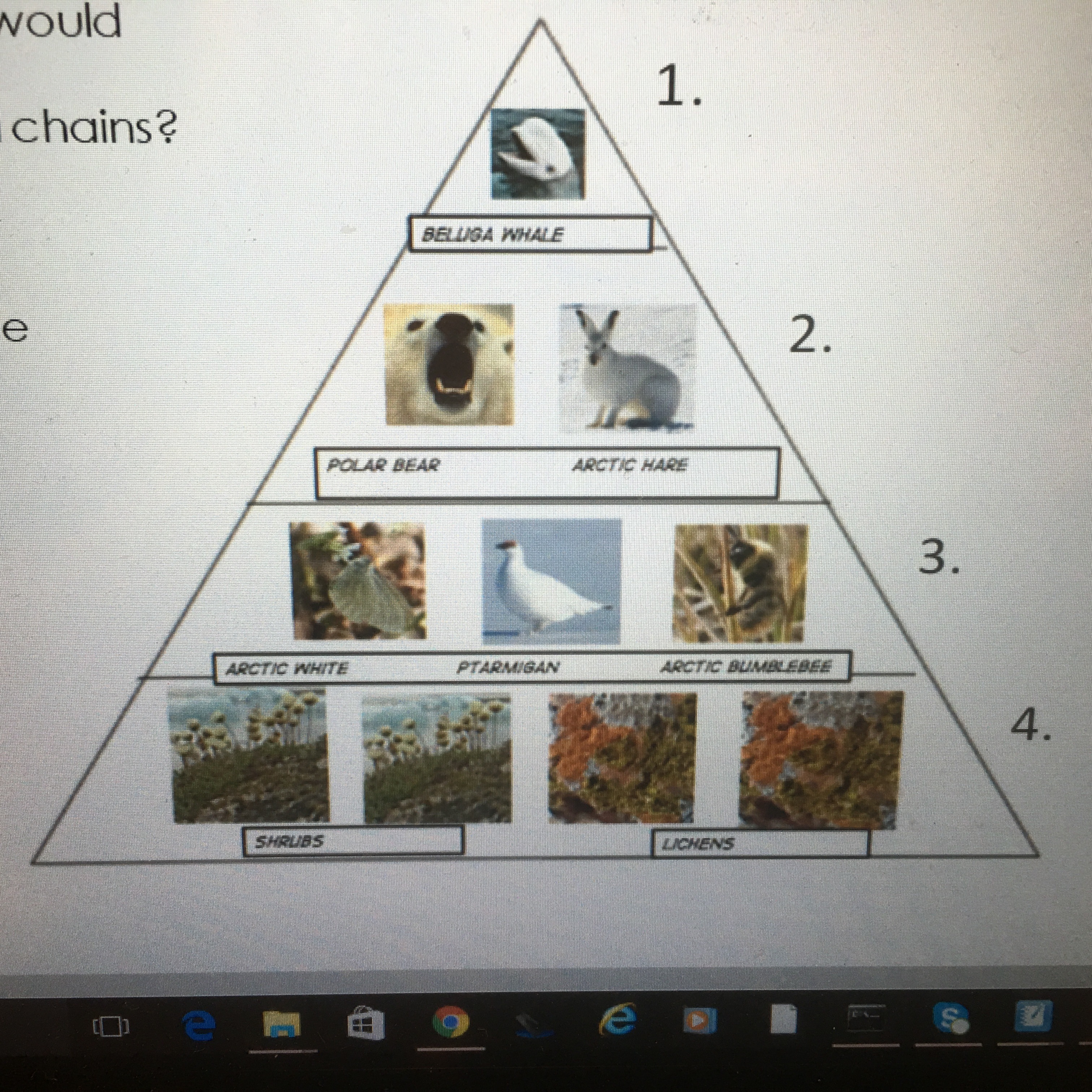
Beluga Whale
Polar Bear and Arctic Hare
Ptarmigan and Arctic Bumble
Lichens and Shrubs
22
Multiple Choice
decomposers
consumers
producers
omnivores
23
Multiple Choice
Producers
Carnivores
Herbivores
Top Predator
24
Multiple Choice
80%
90%
10%
20%
25
Multiple Choice
coyote
insect
lizard
shrub
26
Multiple Choice
10%
20%
80%
90%
27
Multiple Choice
A
B
C
D
28
Multiple Choice
More organisms die at higher levels than at lower levels, resulting in less mass at higher levels.
Energy is lost to the environment at each level, so less mass can be supported at each higher level.
When organisms die at higher levels, their remains sink to lower levels, increasing the mass of lower levels.
Organisms decay at each level, and thus less mass can be supported at higher levels
29
Multiple Choice
energy decreases as you go up the food chain, just like the pyramid shape gets smaller as you go up.
energy increases up the food chain just like the pyramid shape gets smaller as you go up.
energy amounts are the same at each trophic level
Energy Pyramids and Biomass
E.Q: How can an energy Pyramid be used to explain the relationship between amount of energy and population size?
Show answer
Auto Play
Slide 1 / 29
SLIDE

Similar Resources on Wayground
23 questions
Cell Cycle, Mitosis & Meiosis Review
Presentation
•
9th Grade
22 questions
Cell Cycle and Cancer Review
Presentation
•
9th - 10th Grade
24 questions
Asexual and sexual reproduction
Presentation
•
9th - 10th Grade
20 questions
Cell Cycle & Cancer
Presentation
•
9th - 10th Grade
19 questions
Africa District Assessment Review
Presentation
•
9th Grade
26 questions
Mitosis
Presentation
•
9th Grade
25 questions
Mutations
Presentation
•
9th - 10th Grade
23 questions
Representing Data in Science
Presentation
•
9th Grade
Popular Resources on Wayground
20 questions
Math Review
Quiz
•
3rd Grade
15 questions
Fast food
Quiz
•
7th Grade
20 questions
Context Clues
Quiz
•
6th Grade
20 questions
Inferences
Quiz
•
4th Grade
19 questions
Classifying Quadrilaterals
Quiz
•
3rd Grade
20 questions
Figurative Language Review
Quiz
•
6th Grade
20 questions
Equivalent Fractions
Quiz
•
3rd Grade
10 questions
Identify Fractions, Mixed Numbers & Improper Fractions
Quiz
•
3rd - 4th Grade
Discover more resources for Biology
33 questions
Sustainability Unit Review
Quiz
•
9th Grade
36 questions
Biology Regents Review
Quiz
•
9th - 10th Grade
50 questions
NC EOC Biology Review part 1
Quiz
•
9th - 12th Grade
144 questions
Bio 2nd Semester Final Review
Quiz
•
9th Grade
60 questions
Biology Regents Review
Quiz
•
9th Grade
12 questions
Biology EOC Review #3
Quiz
•
9th - 10th Grade
25 questions
Cladograms and Phylogenetic Trees
Quiz
•
9th Grade
17 questions
Communicable and Chronic Diseases Slidedeck
Presentation
•
9th - 12th Grade