Search Header Logo
Wave and Wave Motion

Wave and Wave Motion

Assessment

Presentation

Physics

9th - 12th Grade

Hard

Created by

Joseph Anderson

FREE Resource

12 Slides • 17 Questions

1

Wave Motion

EQ. Why do waves happen and how do they behave?

EQ. How can we quantify their behavior?


H.P.3F.4 Use mathematical and computational thinking to analyze problems that relate the frequency, period, amplitude, wavelength, velocity, and energy of light.

Slide image

2

Multiple Choice

Question image
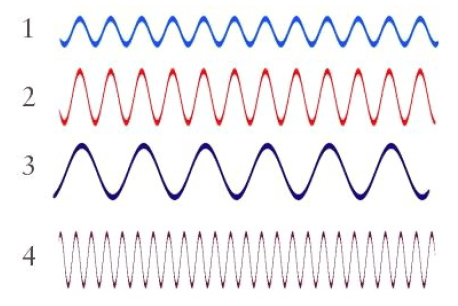
Which wave in the diagram has the greatest frequency?
1
1
2
2
3
3
4
4

3

Multiple Choice

The highest point on a wave is:
1
the crest
2
the trough
3
the top
4
the coast 

4

Multiple Choice

Question image

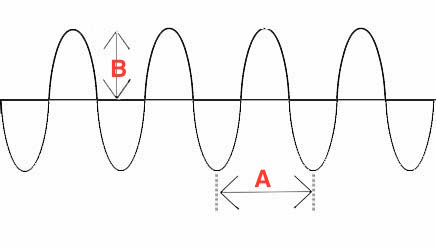
What property of this wave is represented by the letter "A"

1

amplitude

2

crest

3

trough

4

wavelength

5

Open Ended

What's your good thing for today? How are you feeling on a scale of 1-10? Anything new going on for you?

6

Slide image

7

Slide image

8

Slide image

9

Slide image

10

Slide image

11

Slide image

12

Multiple Choice

What is the wave speed if the period of a wave is

4.0 seconds and the wavelength is 1.8 m?

1

0.45 m/s

2

0.90 m/s

3

2.2 m/s

4

3.7 m/s

13

Multiple Choice

A fisherman noticed that a float makes 30 oscillations

in 15 seconds. The distance between two consecutive

crests in 2.0 m. What is the wave speed?

1

2.0 m/s

2

4.0 m/s

3

7.0 m/s

4

15 m/s

14

Multiple Choice

What is the wavelength of a wave traveling with a

speed of 6.0 m/s and a period of 3.0 s?

1

2.0 m

2

3.0 m

3

9.0 m

4

18 m

15

Slide image

16

Multiple Choice

What happens to the speed of a wave on a string if the

tension of the string is increased by a factor of nine?

1

It is decreased by a factor of 3.

2

It is decreased by a factor of 9.

3

It is increased by a factor of 3.

4

It is increased by a factor of 9.

17

Multiple Choice

What happens to the speed of a wave on a string if the

mass per unit length of the string is increased by a

factor of nine?

1

It is decreased by a factor of 3.

2

It is decreased by a factor of 9.

3

It is increased by a factor of 3.

4

It is increased by a factor of 9.

18

Slide image

19

Slide image

20

Slide image

21

How waves travel...

  • Transverse waves (Up & Down Waves, Perpendicular to medium) are waves that travel in a vacuum or without air or a medium

  • Longitudinal waves (Back & Forth Waves, Parallels) are waves that travel through a medium

  • - Sound travels through air longitudinally

  • - Seismic waves that travel through the ground travel longitudinally

  • - Photon or Light waves travel through the vacuum of space transversely

22

Multiple Choice

Which wave travels parallel in relation to a medium?
1
Transverse
2
Longitudinal
3
Both
4
Neither

23

Multiple Choice

Which wave travels perpendicular in relation to a medium?
1
Transverse
2
Longitudinal
3
Both
4
Neither

24

Multiple Choice

Which wave can only travel using a medium?
1
Transverse
2
Longitudinal
3
Both
4
Neither

25

Multiple Choice

Which wave can travel in both a medium and a vacuum?
1
Transverse
2
Longitudinal
3
Both
4
Neither

26

Multiple Choice

Light is an example of which type of wave?
1
Transverse
2
Longitudinal
3
Both
4
Neither

27

Multiple Choice

Sound is an example of which type of wave?
1
Transverse
2
Longitudinal
3
Both
4
Neither

28

Multiple Choice

How would you describe the movement of a transverse wave?
1
Up and down
2
Back and forth
3
In zigzags
4
Linear

29

Multiple Choice

How would you describe the movement of a longitudinal wave?
1
Up and down
2
Back and forth
3
In zigzags
4
Linear

Wave Motion

EQ. Why do waves happen and how do they behave?

EQ. How can we quantify their behavior?


H.P.3F.4 Use mathematical and computational thinking to analyze problems that relate the frequency, period, amplitude, wavelength, velocity, and energy of light.


Slide image

Show answer

Auto Play

Slide 1 / 29

SLIDE