

Two-Dimensional Slicing

Presentation
•
Mathematics
•
7th Grade
•
Hard

Joseph Anderson
FREE Resource
15 Slides • 6 Questions
1
Cross Section Study
Describe the two-dimensional figures (cross sections) that result from slicing three-dimensional figures, as in plane sections of right rectangular prisms, right rectangular pyramids, cones, cylinders, and spheres.
2
Cross Sections
•What are cross sections?
•What plane figures can I make by slicing a cube by planes?
What about when I slice cones, prisms, cylinders, and pyramids instead of cubes

3
Multiple Choice
4
3 types of slices you will see
A left to right slice is parallel to the base.
An up and down slice is perpendicular to the base.
A diagonal slice is at an angle.

5
Horizontal (Parallel) to the base
This will always give you the shape of the base!

6
Vertical (Perpendicular)
This will always give you the shape of the face

7
Multiple Choice
8
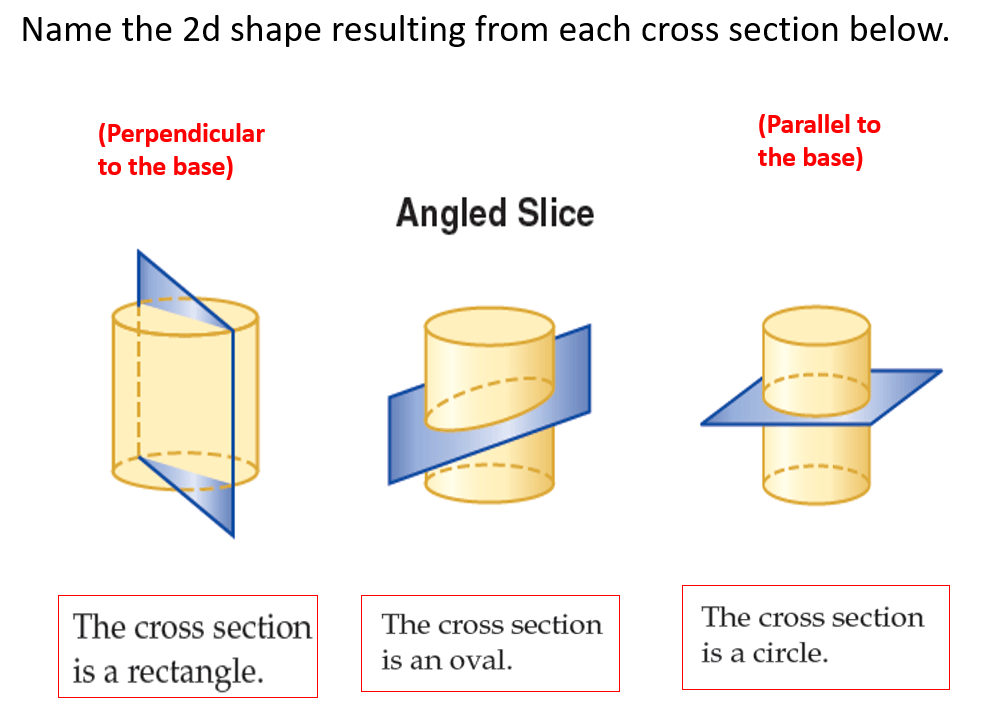
Cylinders
A parallel cross section gives you a circle
A perpendicular cross section gives you a rectangle

9
Multiple Choice
10
Multiple Choice

When you make a cut perpendicular to the base of a cone and starting at the vertex, the shape will be a ....
11
Rectangular Pyramids
perpendicular (vertical) cuts give you a triangle
parallel (horizontal) cuts give you a rectangle

12
Multiple Choice

What is the shape of the cross section that is parallel to the base of this figure?
13
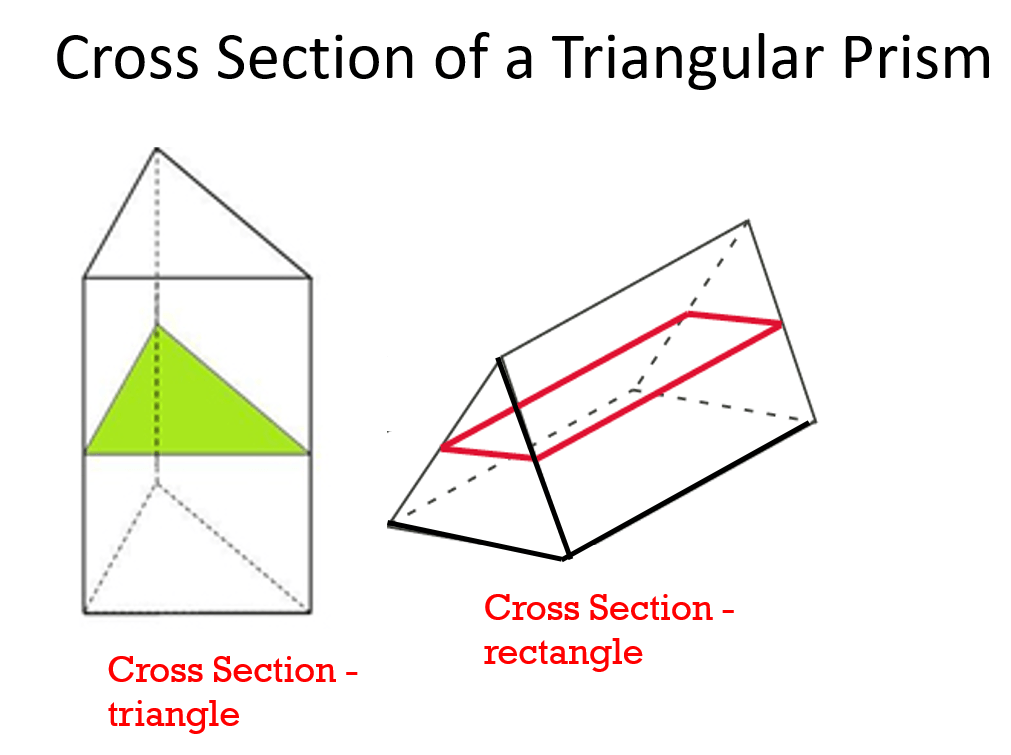
Triangular Prisms
Parallel cross sections give you the shape of the base, which is a triangle
Perpendicular cross sections to the base would give you a rectangle
14
Multiple Choice

What shape is the cross section that is parallel to it's base in this figure?
15
Cones
parallel=circle
perpendicular=triangle

16
Spheres
The cross section is a Circle no matter how you slice it.

17
Special
If you slice a square pyramid without going through the top (Vertex) you will get a trapezoid

18
Diagonal Slices (also known as Angled Slices)
will give you a stretched out base which is an Ellipse (also known as an oval)
19
Practice
Answer the questions in your head, then check your answers on the next slide.

20
Answers

21
Cross Section Study
Describe the two-dimensional figures (cross sections) that result from slicing three-dimensional figures, as in plane sections of right rectangular prisms, right rectangular pyramids, cones, cylinders, and spheres.
Show answer
Auto Play
Slide 1 / 21
SLIDE

