


Physical Science
Presentation
•
Science
•
6th - 8th Grade
•
Hard

Joseph Anderson
FREE Resource
18 Slides • 8 Questions
1
States of Matter 8TH grade Physical Science
Most matter on earth is either in the form of a solid, a liquid, or a gas.
2
Introduction
Take a look at this picture. What solids do you see? There's a canoe, a kayak, a paddle, maybe even the trees. And what liquids do you see?This river or lake, and a gas? Well, the air that these people are breathing is a mixture of different gasses. We know that matter exists in different states. In this lesson we'll stay focused on the three main states of matter
3
Solids
What is it that makes all of those things solids? In order to answer that question, we have to look at the arrangement and the movement of atoms within those solids. Atoms in a solid stay in a fixed position. In other words, they don't move around very much. They have limited freedom to move, and they don't change position much.
4
Two different types of Solids.
Solids can be divided into two categories-- crystalline solids, and noncrystalline solids. Atoms in a crystalline solid are found in a repealing pattern called crystals. You can see that here in the diagram. All of these atoms are in a repeating pattern. And you can see how that shows up in the actual crystal with definite edges and smooth, flat surfaces.
5
Multiple Choice
The atoms in a solid......
Move about freely
Remain in a fixed position
6
Multiple Choice
The arrangement of atoms in a solid causes it to have a definite......
Shape only
Volume only
Shape and Volume
7
Multiple Choice
Solids in which the atoms have no particular order or pattern are called............. solids.
crystalline
noncrystalline
definite
8
Section 2
You just looked at the characteristics of a solid like these ice cubes found in this cup. Now in this glass, you'll also see that there is a liquid-- water. Now you know that water and ice are made out of the same atoms. So how is it possible that the same atoms are forming a solid and a liquid? We'll compare solids and liquids by looking at the characteristics of liquids.
9
Liquids
What are some liquids that you're already familiar with? You may have even come in contact with some liquids today. Maybe orange juice, water, shampoo-- those are all different liquids.
And again, we'll look at the arrangement and the movement of those atoms. So here's a nice diagram of atoms in a liquid. And as you can see, they are still fairly closely packed
10
Understanding
The atoms in liquids move more quickly than in a solid. And this allows them to overcome the force of attraction between the atoms. So they're not in a fixed position. This is why liquid can flow so smoothly or flow freely.And you can see this in the picture here. It was originally in this shape, and now, as it's filling the cup, it's taking this new shape. Liquids also have a definite volume but not a define shape.
11
Multiple Choice
Michaela is baking a dessert. She measures 100 mL of vegetable oil by pouring it from the bottle into a measuring cup. Then she pours the vegetable oil into a bowl with the other ingredients.
Which best describes what happened to the vegetable oil during this process?
The volume of the vegetable oil changed, but the shape did not.
The shape of the vegetable oil changed but the volume did not.
Both the volume and the shape of the vegetable oil changed.
Both the volume and the shape of the vegetable oil remained the same.
12
Characteristics
Have you ever heard the term, slow as molasses? molasses means that something's moving very slow.Now, if I were to do this same thing and fill up a spoon full with water, the water would probably pour out much faster. But molasses, and honey, like you see here in this picture, they move much slower. They flow slower. And that's because they have a different viscosity.
13
Information
Have you ever seen a bug skate on the top of a surface of water like this? It's as if the bug is riding on top of the water. It's almost like the water is a solid, and yet it's not. It's a liquid. How is that possible? That's because of something called surface tension. Surface tension is what happens when molecules, water molecules, pull inward towards each other. They create a very strong attractive force, and the surface molecules pull together, as well as attract the water molecules from below. Now, since there's no water molecules above the surface, that creates an even force, and the result is surface tension. And that's why this bug is able to skate or skim across the top of the water without actually falling in.
14
Multiple Choice
Orange juice has a......... viscosity than chocolate syrup.
Lower
Higher
15
Multiple Choice
There are....... attractive forces between atoms of liquids with a high viscosity.
Weak
Strong
16
Multiple Choice
Surface tension is the result of water molecules ........ with strong force.
Pulling inwards
Pulling outwards
17
Information
You just learned the characteristics of liquids like water. And you know that water can be either a solid or liquid. It can also be a gas called water vapor, which is found in the Earth's atmosphere. Water vapor is important in weather and climate because without it, you wouldn't have rain or snow or clouds.It is invisible. Now how is a gas like water vapor similar or different to solids and liquids? That's what we'll take a look at next.
18
Gas
the atoms inside of the gases are arranged and move much differently than that in solids and liquids. Atoms in gases are much farther apart from each other. In this diagram, you can see how much space is found between all of the atoms. They also move constantly at high speeds, and they move freely in all different directions.
19
Characteristics
So these atoms are moving in different directions. They will spread to fill all of the available space. In fact, they'll spread evenly as far as possible. And the density, as you remember, is the amount of mass in a given volume. If this is our given volume, you can see that a gas is much less dense than the solid or the liquid was. Another characteristic of a gas is that, because the atoms are moving rapidly and freely in any available space
20
Multiple Select
Which statements best describe gases? Check all that apply.
The atoms in a gas move at high speeds.
The atoms in a gas often get stuck together.
The atoms in a gas spread in all directions.
Gases have a definite shape.
Gases have a definite volume.
21
Check Understanding
Remember the arrangement of atoms in solids is fixed and they will vibrate in place. It does have a definite shape and solids do have a definite volume. Liquids are closely packed but they can move enough to slide past each other.They do not have a definite shape, because they can fill whatever container they're put into, but they do have a definite volume. Gases move freely.y do not have a definite volume.
22
Check Understanding
23
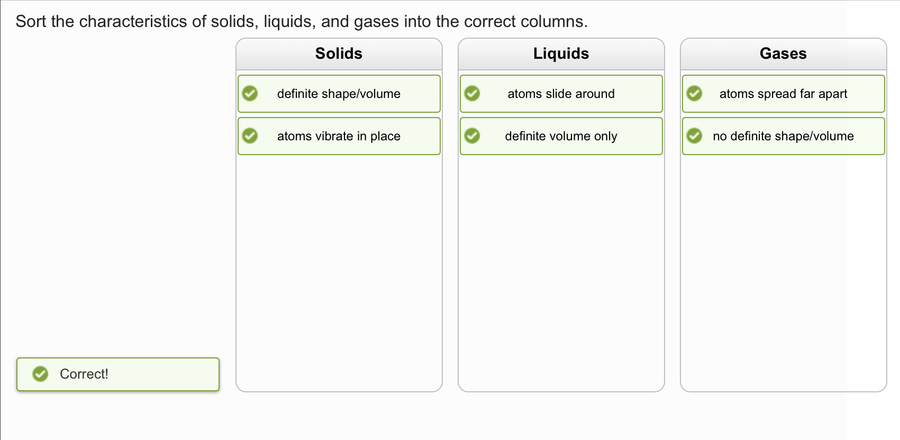
Review correct answers.
24
25
Summary
The world around you is made up of matter and that matter can be found in three different states. It can be found in solids, like the mountains; liquid, like the lake; and gas, like the atmosphere. Let's review the characteristics of the three states of matter and how they help us identify those different states of matter.In order to compare solids, liquids, and gases, you must be able to discuss the arrangement of atoms in different states of matter, describe the motion of atoms in different states of matter, and identify the characteristics of solids, liquids, and gases. You'll remember that the atoms in solids are fixed. They can vibrate in place, but they're fixed.
26
Summary 2
They're not going to move around. They have a definite shape and a definite volume. You'll remember that water can be found in all three states. And water in its solid form is an ice cube. Do you remember? An ice cube taken out of an ice cube tray keeps its same shape and the same amount of volume. Liquids the atoms in liquids are closely packed together, although they can slide past each other. They do not have a definite shape, because they will take whatever shape they're being poured into, the shape of the container. And they do have a definite volume. As you remember, the liquid being poured from the picture into the glass.
States of Matter 8TH grade Physical Science
Most matter on earth is either in the form of a solid, a liquid, or a gas.

Show answer
Auto Play
Slide 1 / 26
SLIDE

Similar Resources on Wayground
20 questions
Plate Tectonics
Presentation
•
6th - 8th Grade
20 questions
Punnett Square Review
Presentation
•
6th - 8th Grade
21 questions
Recognizing Newton's 3 Laws
Presentation
•
6th - 8th Grade
21 questions
Scientific theory vs Law
Presentation
•
6th - 8th Grade
19 questions
Cell Organelles and Functions Review
Presentation
•
6th - 8th Grade
19 questions
Endo & Exo Reactions Mini-Lesson
Presentation
•
6th - 8th Grade
20 questions
Layers of the Atmosphere
Presentation
•
6th - 8th Grade
20 questions
Solar System
Presentation
•
6th - 8th Grade
Popular Resources on Wayground
21 questions
Continents and Oceans
Quiz
•
6th Grade
20 questions
Parts of Speech
Quiz
•
5th Grade
16 questions
Subject & Predicate
Quiz
•
5th Grade
25 questions
Multiplication Facts
Quiz
•
5th Grade
12 questions
Map Skills
Quiz
•
3rd Grade
22 questions
Continents and Oceans
Quiz
•
5th Grade
15 questions
Rounding Decimals
Quiz
•
5th Grade
20 questions
Brand Labels
Quiz
•
5th - 12th Grade
Discover more resources for Science
20 questions
Newton's Laws of Motion
Quiz
•
8th Grade
20 questions
Elements, compounds, and mixtures
Quiz
•
6th Grade
17 questions
7.6D Aqueous Solutions
Quiz
•
7th Grade
20 questions
Scientific Method and Variables
Quiz
•
8th Grade
20 questions
Scientific method and variables
Quiz
•
8th Grade
10 questions
6.6D - Relative Density Review
Quiz
•
6th Grade
20 questions
Claim, Evidence and Reasoning (CER)
Quiz
•
6th - 8th Grade
21 questions
Newton's Laws of Motion
Quiz
•
8th Grade