

Adverbs and Infinitives

Presentation
•
English
•
9th - 11th Grade
•
Hard

Joseph Anderson
FREE Resource
11 Slides • 18 Questions
1
INFINITIVES AND INFINITIVE PHRASES
ENGLISH LANGUAGE ARTS

2
What is an Infinitive?
An infinitive is a verb that functions as a noun, adjective, or adverb in order to express an opinion, purpose of an object or action, or answer the questions who, what, or why.
An infinitive usually begins with the word “to” and is followed by the base form of a verb (the simple form of the verb that you would find in the dictionary).
Keep in mind that although infinitives are verbs, they do not function as verbs!
3
Examples of infinitives
I need to run every day. (The infinitive form with the word "to" is called the "full infinitive" or "to-infinitive".)
I must run every day. (After certain verbs, the "to" is dropped. The word "to" is not a preposition. It is the "sign of infinitive.")
I run every day. (This is not the infinitive form. This is a "finite verb", i.e., a verb functioning as the main verb in a sentence.)
4
Multiple Choice
Find the correct infinitive in the sentence:
Laurie said that the best place to go on Friday is the roller rink.
is
said
to go
5
Multiple Choice
Find the correct infinitive in the sentence:
The neatly chopped tomatoes were ready to go into the salad.
chopped
to go
were ready
6
Multiple Select
Determine whether the sentence has an infinitive or not. Check on the correct option.
The clerk gave the sack of groceries to him.
Has an infinitive
No infinitive
7
Infinitive as nouns
Remember that a noun is a person, place, or thing. When an infinitive is used as the subject or direct object in a sentence, it functions as a noun.
The sentence’s subject performs the verb, while the sentence’s direct object receives the verb.
Example 1: I love to sleep. (In this sentence, the verb is “love.”)
Who or what receives the action of being loved? The infinitive “to sleep.” This makes “to sleep” the direct object of the sentence.
In this case, the infinitive functions as a noun that expresses an opinion. It could be replaced with a person, place, or thing, as in, “I love pizza.”
8
Infinitive as nouns
Example 2: I really need to eat something.
In this sentence, the verb is "need."
Who or what do I need? The infinitive "to eat", hence, the infinitive is being used as a noun.
Remember, "to eat" is the direct object of "need" because it receives the action.
9
Infinitive as adjectives
An adjective is a word that modifies (adds to or describes) a noun. So infinitives function as adjectives when they modify or describe nouns in a sentence.
An infinitive that acts as an adjective usually appears immediately after the noun it is modifying.
Example 1: Joel wants a book to read. (In this sentence, the verb is “wants” and the subject is the noun “book.” We also see the infinitive “to read.”)
What is the purpose of “to read” in this sentence? It describes the book; Joel isn’t looking for just any book, he’s looking for a book to read.
10
Infinitive as adjectives
Example 2: Give him an ornament to polish.
In this sentence, the infinite modifies "ornament." This means it is functioning as an adjective.
Now let's compare:
Give him an ornament that he can polish.
The clause "that he can polish" is an adjective clause. This proves that the infinitive "to polish" is being used as an adjective.
11
Infinitive as adverbs
Adverbs modify or describe adjectives, verbs, or other adverbs. They provide additional information about what, where, how, and to what extent or degree. Sometimes adverbs also answer the question, “Why?”
Infinitives function as adverbs when they are used to give more information about adjectives, verbs, or other adverbs in the sentence.
Example 1:The students were excited to go on a field trip.
In this sentence, the infinitive is “to go.” What is the purpose of “to go” in this sentence? The infinitive “to go” gives us more information about the adjective “excited”; it tells us what the students were excited about (going on a field trip).
12
Infinitive as adverbs
Example 2: Mom is going to the store to buy dinner.
In this sentence, the infinitive is “to buy.”
What’s the purpose of “to buy” in this example? The infinitive “to buy” gives us more information about the verb “going”; it tells us why Mom is going to the store (to buy dinner).
13
Multiple Choice
Determine what kind of infinitive is being used in the sentence:
I have always wanted to visit the Egyptian pyramids.
Infinitive as a noun
Infinitive as a adjective
Infinitive as a adverb
14
Multiple Choice
Determine what kind of infinitive is being used in the sentence:
I may soon have the opportunity to visit the Egyptian pyramids.
Infinitive as a noun
Infinitive as a adjective
Infinitive as a adverb
15
Multiple Choice
Determine what kind of infinitive is being used in the sentence:
I may travel to Egypt next summer to visit the pyramids.
Infinitive as a noun
Infinitive as a adjective
Infinitive as a adverb
16
What is an infinitive phrase?
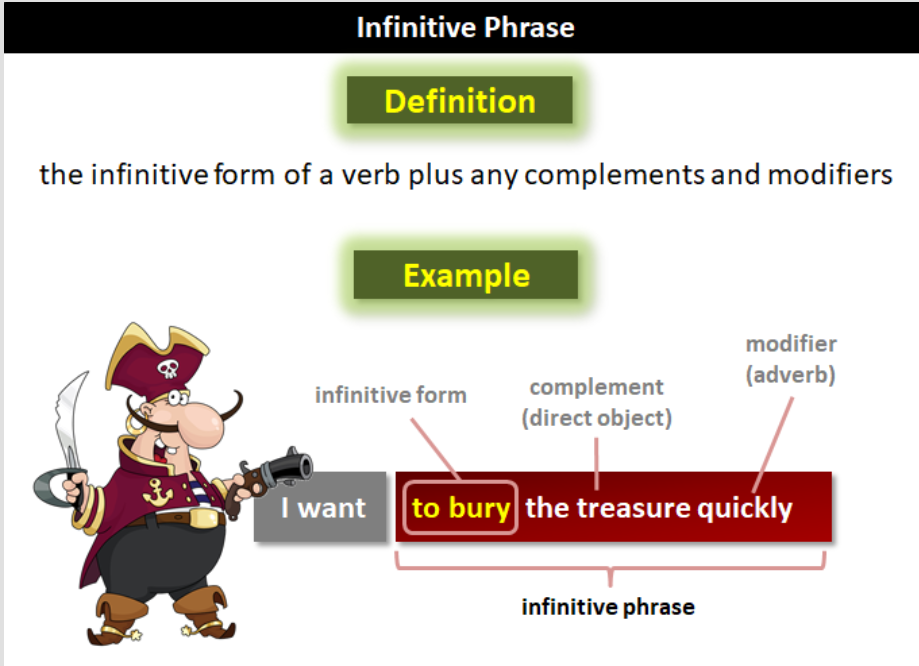
An infinitive phrase is the infinitive form of a verb plus any complements and modifiers.
The entire phrase may be used as a noun, an adjective, or an adverb.
The complement of an infinitive verb will often be its direct object, and the modifier will often be an adverb.
17
More examples of Infinitive Phrases
He likes to knead the dough slowly.
The infinitive verb is "to knead." The complement is its direct object ("the dough"). The modifier is the adverb ("slowly"). They all make up the infinitive phrase that has been underlined.
Analyze the following:
He helped to build the roof.
The officer returned to help the inspectors.
Let me show you the best way to fit a door quickly.
18
Multiple Choice
What type of infinitive phrase is being used? If the sentence does not have an infinitive phrase, choose NONE.
Alex was ready to begin his class on Monday.
Infinitive phrase as a noun
Infinitive phrase as an adjective
Infinitive phrase as an adverb
None
19
Multiple Choice
What type of infinitive phrase is being used? If the sentence does not have an infinitive phrase, choose NONE.
To fix a flat bicycle tire you may need a tire patch and some glue.
Infinitive phrase as a noun
Infinitive phrase as an adjective
Infinitive phrase as an adverb
None
20
Multiple Choice
What type of infinitive phrase is being used? If the sentence does not have an infinitive phrase, choose NONE.
The campers went to a campsite near the mountains.
Infinitive phrase as a noun
Infinitive phrase as an adjective
Infinitive phrase as an adverb
None
21
Multiple Choice
What type of infinitive phrase is being used? If the sentence does not have an infinitive phrase, choose NONE.
Henry's little brother always wants to play hide-and-seek.
Infinitive phrase as a noun
Infinitive phrase as an adjective
Infinitive phrase as an adverb
None
22
Multiple Choice
What type of infinitive phrase is being used? If the sentence does not have an infinitive phrase, choose NONE.
The ability to play a musical instrument comes from talent and practice.
Infinitive phrase as a noun
Infinitive phrase as an adjective
Infinitive phrase as an adverb
None
23
Multiple Choice
What type of infinitive phrase is being used? If the sentence does not have an infinitive phrase, choose NONE.
The team went to the stadium to practice the new plays.
Infinitive phrase as a noun
Infinitive phrase as an adjective
Infinitive phrase as an adverb
None
24
Multiple Choice
What type of infinitive phrase is being used? If the sentence does not have an infinitive phrase, choose NONE.
The purpose of a persuasive speech is to convince others.
Infinitive phrase as a noun
Infinitive phrase as an adjective
Infinitive phrase as an adverb
None
25
Multiple Choice
What type of infinitive phrase is being used? If the sentence does not have an infinitive phrase, choose NONE.
Please hand your science project to the person behind you.
Infinitive phrase as a noun
Infinitive phrase as an adjective
Infinitive phrase as an adverb
None
26
Multiple Choice
What type of infinitive phrase is being used? If the sentence does not have an infinitive phrase, choose NONE.
Saturday is a good day to mow the lawn.
Infinitive phrase as a noun
Infinitive phrase as an adjective
Infinitive phrase as an adverb
None
27
Multiple Choice
What type of infinitive phrase is being used? If the sentence does not have an infinitive phrase, choose NONE.
Are you prepared to answer the question?
Infinitive phrase as a noun
Infinitive phrase as an adjective
Infinitive phrase as an adverb
None
28
Multiple Choice
What type of infinitive phrase is being used? If the sentence does not have an infinitive phrase, choose NONE.
To remember a conversation from three years ago is quite a trick.
Infinitive phrase as a noun
Infinitive phrase as an adjective
Infinitive phrase as an adverb
None
29
Multiple Choice
What type of infinitive phrase is being used? If the sentence does not have an infinitive phrase, choose NONE.
An easy thing to form out of paper is an envelope.
Infinitive phrase as a noun
Infinitive phrase as an adjective
Infinitive phrase as an adverb
None
INFINITIVES AND INFINITIVE PHRASES
ENGLISH LANGUAGE ARTS
Show answer
Auto Play
Slide 1 / 29
SLIDE
Similar Resources on Wayground

22 questions
Direct and Indirect Speech
Presentation
•
9th - 10th Grade
22 questions
Interview for University
Presentation
•
9th - 12th Grade
20 questions
3 ESO Connectors: Although / However / Despite / In spite of
Presentation
•
9th - 10th Grade
20 questions
Commas with dep and ind clauses
Presentation
•
10th Grade
20 questions
FANBOYS
Presentation
•
9th - 11th Grade
20 questions
Ancient Greece & Western Civilization
Presentation
•
9th - 10th Grade
25 questions
Gothic Literature
Presentation
•
9th - 12th Grade
22 questions
Persuasive Techniques Recap
Presentation
•
9th - 12th Grade
Popular Resources on Wayground
10 questions
How much do you know about our Portrait of an Eagle?

Quiz
•
10th Grade
10 questions
Fast Food Slogans
Quiz
•
6th - 8th Grade
21 questions
Continents and Oceans
Quiz
•
6th Grade
20 questions
Parts of Speech
Quiz
•
5th Grade
16 questions
Subject & Predicate
Quiz
•
5th Grade
25 questions
Multiplication Facts
Quiz
•
5th Grade
12 questions
Map Skills
Quiz
•
3rd Grade
22 questions
Continents and Oceans
Quiz
•
5th Grade
Discover more resources for English
15 questions
Simple, compound, and complex sentences
Quiz
•
9th Grade
16 questions
Ethos, Pathos, Logos Practice
Quiz
•
9th Grade
20 questions
Context clues
Quiz
•
10th Grade
20 questions
Parts of Speech Review
Quiz
•
9th Grade
15 questions
ENG 10 Grammar: 18.1 Prepositions or Adverbs P. 34
Quiz
•
10th Grade
10 questions
Making Inferences and Drawing Conclusions

Interactive video
•
6th - 10th Grade
10 questions
Crafting an Effective Thesis Statement
Interactive video
•
6th - 10th Grade
10 questions
Exploring Coordinating Conjunctions with FANBOYS
Interactive video
•
6th - 10th Grade