


Biogeochemical Cycles Review Lesson
Presentation
•
Biology
•
9th Grade
•
Hard

Joseph Anderson
FREE Resource
10 Slides • 12 Questions
1
Biogeochemical Cycles
2
3
4
5
6
Multiple Choice
Which of the following would be a good description of a population?
A colony of ants
The grass and ducks and fish at a pond
The grass and ducks and fish and rocks and water in a pond
An ant
7
Multiple Choice
Which of the following would be a good description of a ecosystem?
A colony of ants
The grass and ducks and fish at a pond
The grass and ducks and fish and rocks and water in a pond
An ant
8
Multiple Choice
Which of the following would be a good description of a community?
A colony of ants
The grass and ducks and fish at a pond
The grass and ducks and fish and rocks and water in a pond
An ant
9
Water Cycle
Precipitation - when water falls from the sky
Runoff - when water runs off the surface and ends up in lakes/ponds/rivers, etc.
Seepage - when water seeps into the ground and becomes groundwater
Evaporation - when water heats up and turns into a gas form
Transpiration - when water evaporates from the plants of leaves
Condensation - when water vapor cools down and turns into clouds
10
Multiple Choice
When warm, evaporated air rises, it cools and begins to turn into liquid again. This part of the water cycle is called:
a: transpiration
b: precipitation
c: runoff
d: condensation
11
Multiple Choice
Which term best describes a change of state from a liquid to a gas caused by the sun's energy?
evaporation
sublimation
deposition
precipitation
12
Multiple Choice
The process of plants losing water through their leaves is called ____.
condensation
evaporation
transpiration
exhaling
13
Carbon Cycle
Photosynthesis - how the carbon comes to earth from the atmosphere
Cellular respiration - how the carbon is released from plants/animals back into the atmosphere
Combustion - when carbon is released into the atmosphere by factories/cars
Decomposition - when carbon is released atmosphere by dead plants/animals... some is turned into fossil fuels to be burnt later
14
Multiple Choice
What is the only way that carbon (CO2) goes from the atmosphere to living organisms?
photosynthesis
respiration
decomposition
combustion
15
Nitrogen Cycle
About 78% of the earth's atmosphere is nitrogen gas.
Plants and animals must have nitrogen to make proteins and nucleic acids.
However, the nitrogen gas is not usable by plants or animals - so the nitrogen cycle must happen to change nitrogen into a usable form through a series of steps.
Most of this is done using bacteria & decomposers; however, some nitrogen enters the soil via lightning.
16
Nitrogen Cycle
Nitrogen fixation: the process when nitrogen-fixing bacteria in the soil/on plant roots change nitrogen gas into ammonia
Ammonification: the process when decomposers break down dead stuff/animal wastes into ammonium
Nitrification: the process when nitrifying bacteria change ammonium into nitrates, which is what plants can use
Assimilation: when the plants take in the nitrates
Denitrification: when denitrifying bacteria take the excess nitrates and turn it back into nitrogen gas
17
Multiple Choice
the process when decomposers break down dead stuff/animal wastes into ammonium
Ammonification
Denitrification
Nitrification
Nitrogen fixation
18
Multiple Choice
the process when nitrifying bacteria change ammonium into nitrates, which is what plants can use
Ammonification
Denitrification
Nitrification
Nitrogen fixation
19
Multiple Choice
the process when nitrogen-fixing bacteria in the soil/on plant roots change nitrogen gas into ammonia
Ammonification
Denitrification
Nitrification
Nitrogen fixation
20
Multiple Choice
when denitrifying bacteria take the excess nitrates and turn it back into nitrogen gas
Ammonification
Denitrification
Nitrification
Nitrogen fixation
21
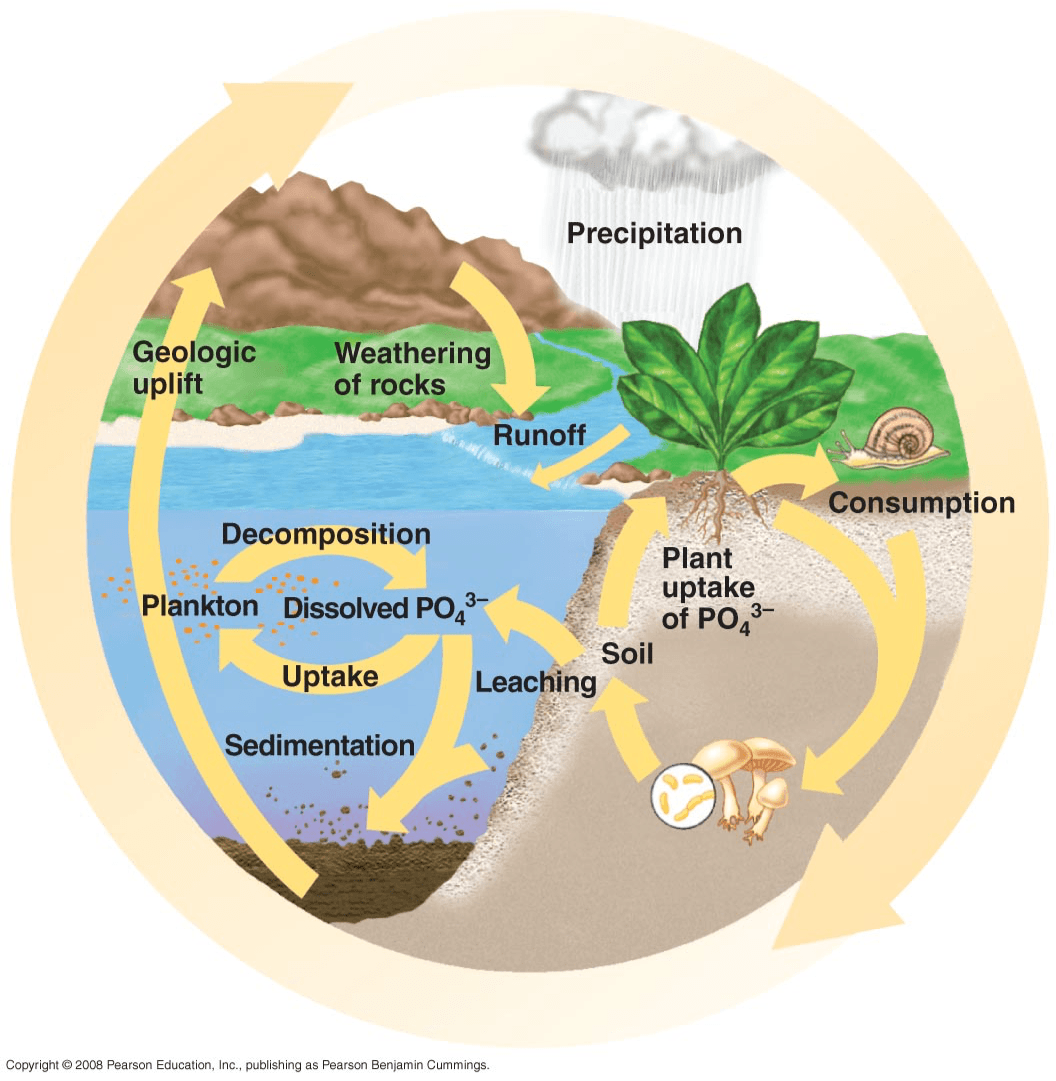
Phosphorus Cycle
This is the only cycle without an atmospheric portion.
Phosphate is released via the weathering of rocks.
Plants & some fungi take up phosphorus.
Phosphorus moves from producers to consumers via the food web.
Phosphorus is released back into the soil when organisms die & decomposers break them down.
Phosphorus gets into water via runoff and leaching from the groundwater.
Mining and agricultural runoff add to the phosphorus in the environment.
22
Multiple Choice
There is no portion of the phosphorus cycle in the...
atmosphere
rocks
water
living organisms
Biogeochemical Cycles

Show answer
Auto Play
Slide 1 / 22
SLIDE

Similar Resources on Wayground
15 questions
Circulatory and Respiratory Systems - Gas Exchange
Presentation
•
9th Grade
19 questions
Intro to Ecology
Presentation
•
9th Grade
19 questions
Karyotypes
Presentation
•
9th Grade
20 questions
G9 Chap 2.2 - Flow of Energy in an Ecosystem
Presentation
•
9th Grade
20 questions
13.1 Identifying the Substance of the Gene
Presentation
•
9th Grade
20 questions
Invasive/Keystone Review
Presentation
•
9th Grade
18 questions
Fossil Evidence
Presentation
•
9th Grade
16 questions
Scientific Variables Review
Presentation
•
9th Grade
Popular Resources on Wayground
20 questions
Math Review
Quiz
•
3rd Grade
15 questions
Fast food
Quiz
•
7th Grade
20 questions
Context Clues
Quiz
•
6th Grade
20 questions
Inferences
Quiz
•
4th Grade
19 questions
Classifying Quadrilaterals
Quiz
•
3rd Grade
20 questions
Figurative Language Review
Quiz
•
6th Grade
20 questions
Equivalent Fractions
Quiz
•
3rd Grade
10 questions
Identify Fractions, Mixed Numbers & Improper Fractions
Quiz
•
3rd - 4th Grade
Discover more resources for Biology
33 questions
Sustainability Unit Review
Quiz
•
9th Grade
36 questions
Biology Regents Review
Quiz
•
9th - 10th Grade
50 questions
NC EOC Biology Review part 1
Quiz
•
9th - 12th Grade
144 questions
Bio 2nd Semester Final Review
Quiz
•
9th Grade
60 questions
Biology Regents Review
Quiz
•
9th Grade
12 questions
Biology EOC Review #3
Quiz
•
9th - 10th Grade
25 questions
Cladograms and Phylogenetic Trees
Quiz
•
9th Grade
17 questions
Communicable and Chronic Diseases Slidedeck
Presentation
•
9th - 12th Grade