

Boyle's Law and Avogadro's Law

Presentation
•
Chemistry
•
9th - 12th Grade
•
Hard

Joseph Anderson
FREE Resource
5 Slides • 15 Questions
1

2
Multiple Choice
Boyle's law
Dalton's law
Charles' law
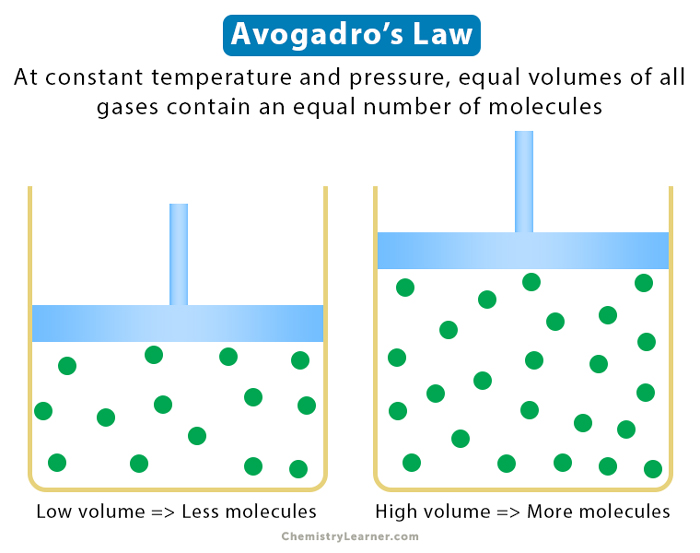
Avogadro's law
3
Multiple Choice
At constant temperature and pressure, the volume of a gas is directly proportional to the ________________.
pressure of the gas
temperature of the gas
number of moles of the gas
velocity of the gas
4
Multiple Choice
What must be held constant when applying Avogadro's law?
pressure and temperature
volume and temperature
number of moles and temperature
volume and number of moles
5


6
Sample Problem: Avogadro’s Law
A balloon has been filled to a volume of 1.90 L with 0.0920 mol of helium gas. If 0.0210 mol of additional helium is added to the balloon while the temperature and pressure are held constant, what is the new volume of the balloon?
Step 1: List the known quantities and plan the problem.
Known: Unknown:
V1 = 1.90 L V2 = ? L
n1 = 0.0920 mol
n2 = 0.0920 + 0.0210 = 0.1130 mol
Step 2: Solve. First, rearrange the equation algebraically to solve for V2.

Make sure you know how to rearrange the equation!!
7
Multiple Choice
If 3.25 mol of Ar occupies 100. L at a particular temp and pressure, what volume does 14.15 mol of Ar occupy under same condition?
Use scratch paper and a calculator!
435 L
225 L
100 L
522 L
8
Multiple Choice
A scientist records 8.0 moles of gas. The scientist does not check the pressure of this gas. At a later time the scientist measures the volume of gas to be 150 ml and the new number of moles of gas to be 48 what was the original volume of the gas?
Use scratch paper and a calculator!
25 ml
0.39 ml
2.56 ml
2.5 ml
9
Multiple Choice
A 10. ml balloon is not tied all the way and 5.0 of the original 20. moles of gas escape before the gas is tied.What is the new volume of the gas?
Use scratch paper and a calculator!
30 ml
10 ml
7.5 ml
2.5 ml
10
Multiple Choice
A scientist records the volume of gas in a bubble to be 43 mL The scientist determines that the bubble contains 8 moles of oxygen. The scientist checks in on the bubble later to find that the volume has expanded to 129 ml how much oxygen is in the bubble now?
Use scratch paper and a calculator!
2.4 moles
24 moles
240 moles
2400 moles
11


12

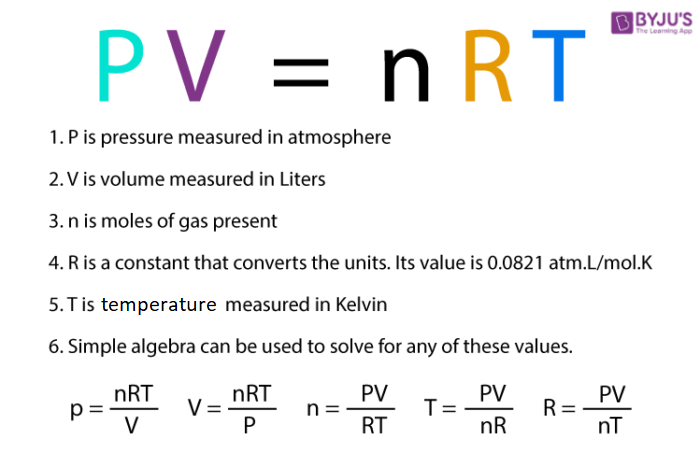
Check out these different ways to REARRANGE the equation depending on what variable you are solving for.
13
Multiple Choice
If the pressure exerted by a gas at 25 degrees C in a volume of 0.044 L is 3.81 atm, how many moles of gas are present?
Use scratch paper and a calculator!
.002766 mole
.0069 mol
2.766 mol
9.887 mol
14
Multiple Choice
In order to solve gas law calculations, temperature must be measured in:
Fahrenheit
Celsius
Kelvin
It doesn't matter
15
Multiple Choice
At what temperature will 0.654 moles of neon gas occupy 12.30 liters at 1.95 atmospheres?
Use scratch paper and a calculator!
427 K
447 K
437 K
457 K
16
Multiple Choice
Calculate the volume that a 0.323-mol sample of a gas will occupy at 265 K and a pressure of 0.900 atm.
Use scratch paper and a calculator!
7.18 L
7.81 L
4.63 L
4.36 L
17
Multiple Choice
Choose the correct set of variables to solve the following problem: What is the volume of a balloon if it contains 3.2 moles of helium at a temperature of 20⁰C and 1.2 atm?
P = x (unknown), V = 3.2 mol, n = 1.2 atm, T = 20⁰C K
P = 1.2 atm, V = 3.2 mol, n = 20⁰C, T = x (unknown)
P = 293 K, V = 3.2 mol, n = x (unknown), T = 1.2 atm
P = 1.2 atm, V = x (unknown), n = 3.2 mol, T = 293 K
18
Multiple Choice
What does the variable "n" represent in the ideal gas law?
pressure
volume
moles
the gas constant
temperature
19
Multiple Choice
In an ideal gas, if everything else is held constant, doubling the volume will ________ the pressure.
double
halve
not affect
eliminate
20
Multiple Choice
In an ideal gas, if everything else is held constant, tripling the pressure will ________ the Kelvin temperature.
triple
cut into a third
not affect
equal
Show answer
Auto Play
Slide 1 / 20
SLIDE
Similar Resources on Wayground

11 questions
P-T Diagram Group Practice
Presentation
•
9th - 12th Grade
13 questions
Molecular Basis of Specific Heat
Presentation
•
9th - 12th Grade
13 questions
Chemistry of Life
Presentation
•
9th - 12th Grade
13 questions
Molecular Empirical Lesson
Presentation
•
9th - 12th Grade
15 questions
Chapter 7 Section 3.2: Molar Mass & Percentage Composition
Presentation
•
10th - 12th Grade
18 questions
8.2-8.3 pH and pOH of Strong and Weak Acids and Bases
Presentation
•
9th - 12th Grade
17 questions
Percent Composition
Presentation
•
9th - 12th Grade
16 questions
Mole Conversions & Percent Composition Practice
Presentation
•
10th - 12th Grade
Popular Resources on Wayground
25 questions
The Ultimate College Knowledge Quiz

Quiz
•
8th Grade
20 questions
Math Review
Quiz
•
3rd Grade
15 questions
Fast food
Quiz
•
7th Grade
20 questions
Math Review
Quiz
•
6th Grade
20 questions
Context Clues
Quiz
•
6th Grade
20 questions
Inferences
Quiz
•
4th Grade
19 questions
Classifying Quadrilaterals
Quiz
•
3rd Grade
20 questions
Figurative Language Review
Quiz
•
6th Grade