
Cells and Cell Transport Review
Presentation
•
Biology
•
9th Grade
•
Hard

Joseph Anderson
FREE Resource
6 Slides • 21 Questions
1
Cells and Cell Transport Review
Please be sure to study!
2
Cell Theory
All living things are made of cells.
Cells are the basic unit of life.
Cells must come from preexisting cells.
3
Multiple Choice
There are three tenets of the Cell Theory. Which of the following is NOT a tenet?
Cells are the basic structure and function of life.
All living things are made of one or more cells.
The cell is the basic unit of matter.
All cells come from preexisting cells.
4
Multiple Choice
Which answer shows the levels of organization from least complex to most complex?
cells, organelles, tissues, organism, organ system
organelles, cells, tissues, organ systems, organism
Organism, organ systems, tissues, cells, organelles
5
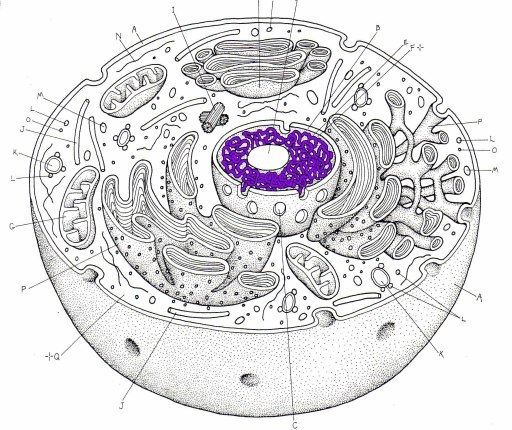
Cell Organelles You MUST Know
Nucleus: Control center of cell, contains DNA
Ribosome: synthesizes (makes) proteins
Chloroplast: Site of photosynthesis
Mitochondria: Site of cellular respiration-Breaks down nutrients to release energy in the form of ATP
Cell membrane: Controls what enters and exits the cell, involved in cell signaling, structure of cell
Vacuoles: storage
6
Multiple Choice
7
Multiple Choice
Which organelle is responsible for releasing energy in the form of ATP?
mitochondria
nucleus
ribosome
vacuole
8
Difference between Eukaryotic and Prokaryotic Cells
Prokaryote=no nucleus, example: Bacteria
Eukaryote=true nucleus, examples: Plants, Animals, Fungi, Protists
9
Multiple Choice
Plants and animal cells are examples of ___ cells
prokaryotic cells
eukaryotic cells
10
Multiple Choice
What kind of cell is this?
Eukaryotic
Prokaryotic
11
Multiple Choice
What kind of cell is this?
Eukaryotic
Prokaryotic
12
Passive Transport
Does not require energy!
Molecules travel from a high concentration to a low concentration (with the concentration gradient)
Diffusion
Osmosis (Diffusion of water across a semipermeable membrane.)
Facilitated diffusion (molecules that are too big to cross the membrane alone will diffuse across the membrane using channel proteins)
13
Multiple Choice
Passive Transport means
Energy is used
No energy is used
Energy is created
14
Multiple Choice
15
Multiple Choice
16
Multiple Choice
17
Multiple Choice
What is diffusion?
when molecules move from a low concentration to a high concentration
when molecules move from a high concentration to a low concentration.
no movement
molecules move everywhere
18
Multiple Choice
What is diffusion?
when molecules move from a low concentration to a high concentration
when molecules move from a high concentration to a low concentration.
no movement
molecules move everywhere
19
Active Transport
Requires energy
Moves molecules from a low to high concentration (against the concentration gradient)
Protein pumps
Endocytosis and exocytosis
20
Multiple Choice
21
Multiple Choice
22
Multiple Choice
A general term for the various types of active transport that move particles into a cell by enclosing them in a vesicle made out of plasma membrane.
Endocytosis
Exocytosis
Osmosis
Diffusion
23
Multiple Choice
Active transport across a cell membrane from low to high concentration, requires
energy (ATP)
no energy
water
oxygen
24
Multiple Choice
Active transport is the movement of large materials across a cell membrane from ______ to ______ concentration
high to low
low to high
high to high
low to low
25
Multiple Choice
26
Multiple Choice
Which type of transport requires an input of energy?
Passive Transport
Osmosis
Simple Diffusion
Active Transport
27
Multiple Choice
Which type of transport requires an input of energy?
Passive Transport
Osmosis
Simple Diffusion
Active Transport
Cells and Cell Transport Review
Please be sure to study!

Show answer
Auto Play
Slide 1 / 27
SLIDE

Similar Resources on Wayground
20 questions
G9 Chap 2.2 - Flow of Energy in an Ecosystem
Presentation
•
9th Grade
20 questions
13.1 Identifying the Substance of the Gene
Presentation
•
9th Grade
20 questions
6E: Mutations
Presentation
•
9th Grade
22 questions
Cell Cycle, DNA Replication, and Cancer
Presentation
•
9th Grade
22 questions
Biogeochemical Cycles Lesson
Presentation
•
9th Grade
19 questions
Intro to Ecology
Presentation
•
9th Grade
19 questions
Karyotypes
Presentation
•
9th Grade
22 questions
Mutations
Presentation
•
9th Grade
Popular Resources on Wayground
20 questions
"What is the question asking??" Grades 3-5
Quiz
•
1st - 5th Grade
20 questions
“What is the question asking??” Grades 6-8
Quiz
•
6th - 8th Grade
10 questions
Fire Safety Quiz
Quiz
•
12th Grade
20 questions
Equivalent Fractions
Quiz
•
3rd Grade
34 questions
STAAR Review 6th - 8th grade Reading Part 1
Quiz
•
6th - 8th Grade
20 questions
“What is the question asking??” English I-II
Quiz
•
9th - 12th Grade
20 questions
Main Idea and Details
Quiz
•
5th Grade
47 questions
8th Grade Reading STAAR Ultimate Review!
Quiz
•
8th Grade
Discover more resources for Biology
24 questions
BIOLOGY STAAR REVIEW
Quiz
•
9th Grade
30 questions
Biology STAAR Review #3
Quiz
•
9th Grade
16 questions
AP Biology: Unit 1 Review (CED)
Quiz
•
9th - 12th Grade
50 questions
Biology EOC Review
Quiz
•
9th Grade
25 questions
photosynthesis and cellular respiration
Quiz
•
9th Grade
20 questions
AP Biology: Unit 3 Review (CED)
Quiz
•
9th - 12th Grade
20 questions
Enzymes
Quiz
•
9th Grade
20 questions
Food Chains and Food Webs
Quiz
•
7th - 12th Grade