Electrode
Presentation
•
Chemistry
•
University
•
Hard

Joseph Anderson
FREE Resource
10 Slides • 16 Questions
1
Electrode and Cell Potentials
by Luis Bello
2
Previous Class
Galvanic Cells
3
4
Multiple Choice
In a Galvanic Cell, the anode is...
positive
negative
5
Multiple Choice
In a Galvanic Cell, the cathode is...
positive
negative
6
Multiple Choice
Oxidation occurs at the...
anode
cathode
7
Multiple Choice
Reduction occurs at the...
anode
cathode
8
Multiple Choice
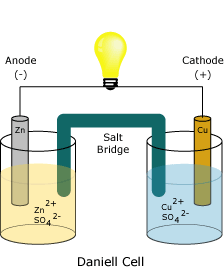
In the above Galvanic Cell, which half cell is undergoing reduction?
Cu | Cu2+
Zn | Zn2+
9
Multiple Choice
A certain galvanic cell has for its spontaneous cell reaction: Zn + HgO → ZnO + Hg
Which is the half-reaction occurring at the cathode?
HgO + 2 e- → Hg + O2-
Hg → Hg2+ + 2 e-
Zn → Zn2+ + 2 e-
ZnO + 2 e- → Zn
10
Multiple Choice
Which of the following deductions about this cell is correct?
11
Multiple Choice
The product(s) of the half-reaction occurring in half-cell 1 is (are)
12
Multiple Choice
For this cell, the overall equation will be
13
Learning Objetives
Describe and relate the definitions of electrode and cell potentials
Interpret electrode potentials in terms of relative oxidant and reductant strengths
Calculate cell potentials and predict redox spontaneity using standard electrode potentials
14
15
The electrode potential
In electrochemistry, the electrode potential is the electromotive force of a galvanic cell built from a standard reference electrode and another electrode to be characterized.
By convention, the reference electrode is the standard hydrogen electrode (SHE). It is defined to have a potential of zero volts.
16
17
The SHE electrode
The SHE electrode can be connected to any other electrode by a salt bridge to form a cell.
If the second electrode is also at standard conditions, then the measured cell potential is called the standard electrode potential for the electrode.
The standard electrode potential for the SHE is zero, by definition.
18
Standard electrode potentials
Standard electrode potentials reflect the relative oxidizing strength of the half-reaction reactant, with stronger oxidants exhibiting larger (more positive) E°X values. Tabulations of standard electrode potentials may be used to compute standard cell potentials, E°cell, for many redox reactions.
19
20
Multiple Choice
-0.41V
-0.27 V
+0.27 V
+0.41 V
21
Multiple Choice
The relevant standard electrode potentials for this cell are shown below.
Cr3+(aq) + 3e- ⇌ Cr(s) E= − 0.74 V
Ag+(aq) + e− ⇌ Ag(s) E = + 0.80 V
Calculate the emf of the cell shown in the diagram.
+1.54 V
-1.54 V
+ 0.06 V
- 0.06 V
22
Multiple Choice
Which species will oxidise Fe2+(aq) to Fe3+(aq)?
Br2 (aq)
Cl-(aq)
I2 (aq)
Mn2+(aq)
23
Multiple Choice
Calculate the emf for the reaction between MnO4– ions and Br– ions in acidic solution.
-0.42 V
+0.42 V
+2.60 V
-2.60 V
24
Multiple Choice
The standard electrode potentials of two half reactions are shown.
Which of the following processes is thermodynamically favourable? The reaction of
Co2+ with Cl2 to form Cl−
Co2+ with Cl− to form Cl2
Co3+ with Cl2 to form Cl−
Co3+ with Cl− to form Cl2
25
Multiple Choice
Calculate the cell potential of a galvanic cell that uses the two half equation below
Sn2+ + 2e- --> Sn4+ E0 = -0.14 V
Mg2+ + 2e- --> Mg E0 = -2.37 V
-2.23 V
-2.51 V
+ 2.23 V
26
Multiple Choice
Using the following standard reduction potentials
Fe3+(aq) + e --> Fe2+(aq) + e E0 = +0.77V
Ni2+ + 2e --> Ni E0 = -0.26V
Ni + 2 Fe3+ --> Ni2+ + 2 Fe2+
Calculate the standard cell potential for the above galvanic cell
-1.8V
+1.8V
+0.51 V
Electrode and Cell Potentials
by Luis Bello
Show answer
Auto Play
Slide 1 / 26
SLIDE

Similar Resources on Wayground
20 questions
Past Perfect & Past Continuous
Lesson
•
University
21 questions
Organic Chemistry - Functional Group
Lesson
•
University
20 questions
PPT Senyawa Hidrokarbon Fouri Ekadiani
Lesson
•
University
20 questions
Radical Expressions
Lesson
•
KG - University
20 questions
Would You Rather?
Lesson
•
KG
21 questions
Best Method: Solving Systems of Equations
Lesson
•
7th - 10th Grade
21 questions
Cold War Intro
Lesson
•
KG
21 questions
Activity
Lesson
•
University
Popular Resources on Wayground
10 questions
5.P.1.3 Distance/Time Graphs
Quiz
•
5th Grade
10 questions
Fire Drill
Quiz
•
2nd - 5th Grade
20 questions
Equivalent Fractions
Quiz
•
3rd Grade
15 questions
Hargrett House Quiz: Community & Service
Quiz
•
5th Grade
20 questions
Main Idea and Details
Quiz
•
5th Grade
20 questions
Context Clues
Quiz
•
6th Grade
20 questions
Inferences
Quiz
•
4th Grade
15 questions
Equivalent Fractions
Quiz
•
4th Grade