Elements and Molecules in Living Things
Presentation
•
Biology
•
10th - 12th Grade
•
Hard

Joseph Anderson
FREE Resource
16 Slides • 25 Questions
1
2
3
4
Multiple Choice
Which type of molecule is large, complex, and contains many C-H bonds?
inorganic molecules
organic molecules
ionic molecules
metallic compounds
5
Multiple Choice
What distinguishes and ion from other atoms or molecules?
ions are neutral
ions have a negative or positive charge
ions contain many C-H bonds
6
7
Multiple Choice
8
Multiple Choice
9
Multiple Choice
10
Multiple Choice
11
Multiple Choice
12
Multiple Choice
13
Multiple Choice
14
Multiple Choice
_____________.
15
Multiple Choice
16
17
18
19
Multiple Choice
Which part of the phospholipid molecule is hydrophobic?
phosphate head
glycerol
fatty acid tail
the entire molecule is hydrophobic
20
Multiple Choice
Which part of the phospholipid molecule is hydrophilic?
phosphate head
glycerol
fatty acid tail
the entire molecule is hydrophobic
21
Multiple Choice
Which of the following answers best explains why phospholipids form the structures in the image?
The polar heads of phospholipids are attracted to the polar water molecules
The nonpolar heads of phospholipids are attracted to the polar water molecules
The nonpolar tails of phospholipids are attracted to the polar water molecules
The polar tails of phospholipids are attracted to the polar water molecules
22
23
24
25
Multiple Choice
How can you differentiate between polar and nonpolar amino acids?
Nonpolar amino acids have R groups with Carbon and Hydrogen, while polar amino acids have R groups with Oxygen
Polar amino acids have R groups with Carbon and Hydrogen, while nonpolar amino acids have R groups with Oxygen
Nonpolar amino acids have charged side chains while polar amino acids do not
Polar amino acids have 2 Chainz, which makes them unpopular with most everyone
26
27
28
29
30
Multiple Choice
Macromolecules are made of repeating subunits called
monomers
monosaccharides
polymers
polysaccharides
31
Multiple Choice
A _________ reaction removes a molecule of water to bond molecules together to create a polymer.
hydrolysis
water
dehydration synthesis
magical
32
Multiple Choice
In order to break apart a polymer ________ must be added.
carbon
water
oxygen
hydrogen
33
Multiple Choice
What type of reaction is shown?
Dehydration synthesis
Hydrolysis
34
Multiple Choice
Which type of reaction is shown?
Dehydration Synthesis
Hydrolysis
35
36
37
Multiple Choice
38
Multiple Choice
39
Multiple Choice
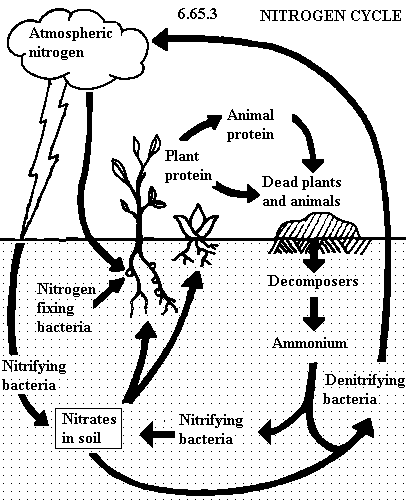
Can organisms absorb nitrogen gas directly out of the atmosphere?
Yes
No
40
Multiple Choice
How do animals obtain nitrogen stored in plants?
Denitrifying bacteria
Nitrogen fixing bacteria
Directly from the atmosphere
They eat the plants
41
Multiple Choice
Green plants and algae make their own food through photosynthesis. What is photosynthesis?
a cell process that uses energy from sunlight to convert water and oxygen into food
a cell process that uses energy from sunlight to convert water and glucose into food
a cell process that uses energy from sunlight to convert water and chlorophyll into food
a cell process that uses energy from sunlight to convert water and carbon dioxide into food
Show answer
Auto Play
Slide 1 / 41
SLIDE

Similar Resources on Wayground
37 questions
Evolution Lesson 3
Presentation
•
9th - 12th Grade
37 questions
Preterite Vs. Imperfect Introduction
Presentation
•
9th - 12th Grade
34 questions
Molecular Genetics (Central Dogma - Protein Synthesis) Review
Presentation
•
9th - 12th Grade
35 questions
Ionic Radius Trends and Multiple Ionization Energies
Presentation
•
10th - 12th Grade
34 questions
Acid and Base 2
Presentation
•
10th - 12th Grade
35 questions
Plant Anatomy & Physiology: Recap
Presentation
•
9th - 12th Grade
34 questions
Stoichiometry Review
Presentation
•
10th - 12th Grade
Popular Resources on Wayground
16 questions
Grade 3 Simulation Assessment 2
Quiz
•
3rd Grade
19 questions
HCS Grade 5 Simulation Assessment_1 2526sy
Quiz
•
5th Grade
10 questions
Cinco de Mayo Trivia Questions
Interactive video
•
3rd - 5th Grade
17 questions
HCS Grade 4 Simulation Assessment_2 2526sy
Quiz
•
4th Grade
24 questions
HCS Grade 5 Simulation Assessment_2 2526sy
Quiz
•
5th Grade
13 questions
Cinco de mayo
Interactive video
•
6th - 8th Grade
20 questions
Math Review
Quiz
•
3rd Grade
30 questions
GVMS House Trivia 2026
Quiz
•
6th - 8th Grade
Discover more resources for Biology
210 questions
Unit 1 - 4 AP Bio Review
Quiz
•
9th - 12th Grade
16 questions
AP Biology: Unit 1 Review (CED)
Quiz
•
9th - 12th Grade
20 questions
AP Biology: Unit 3 Review (CED)
Quiz
•
9th - 12th Grade
21 questions
AP Biology: Unit 6 Review (CED)
Quiz
•
9th - 12th Grade
14 questions
AP Biology: Unit 4 Review (CED)
Quiz
•
9th - 12th Grade
15 questions
Biology EOC Review P2
Quiz
•
10th Grade
20 questions
Food Chains and Food Webs
Quiz
•
7th - 12th Grade
20 questions
Biology EOC Review 1
Quiz
•
10th Grade