Forces Objectives
Presentation
•
Science
•
8th Grade
•
Hard

Joseph Anderson
FREE Resource
57 Slides • 30 Questions
1
Forces
2
Forces: Objectives
- I can describe a force.
- I know the unit of measurement for force.
- I know the difference between mass and weight.
3
FORCES
4
5
6
7
8
9
Balanced Forces
A good example of balanced and unbalanced forces is a
tug-of-war between two teams of students. If the opposing
teams are of equal strength, neither team can move the
other, because their net force is zero and the forces are
balanced. This is shown in the diagram to the right.
The same result occurs when a force pushes on an
unmovable object, or when friction prevents the motion of an
object because not enough force was applied to overcome
that friction. In both of these cases, the two forces are equal
but in opposite directions—they cancel each other out.
10
Balanced Forces
Balanced forces exist when all of the forces acting
on an object cancel each other out, resulting in a
net force of zero. If the object pulled down by
gravity is resting on the ground, which is strong
enough to push up with equal force, the two
forces cancel each other out, and no motion
results In the diagram to the right, the down arrow
(gravity) and the up arrow (ground support) are of
equal length but opposite direction. If the net force
is zero, the forces are balanced, and no
acceleration (change of motion) occurs.
11
12
Unbalanced Forces
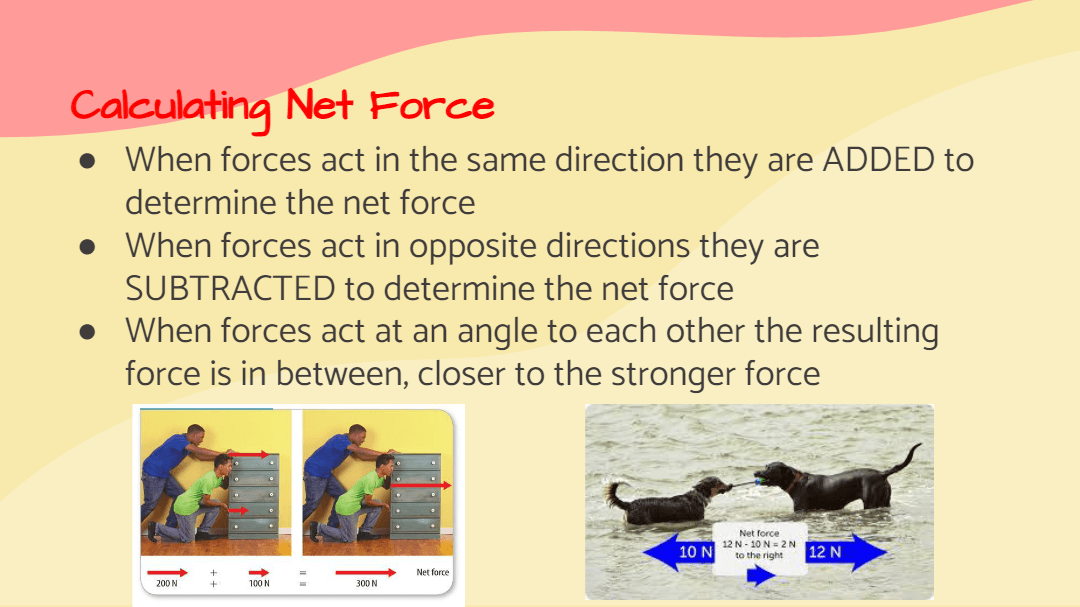
Unbalanced forces exist on an object when the net
force acting on that object is greater than zero. In the
above example, gravity pulls down more strongly than
the air resistance pushes back. The two forces can be
represented by arrows, as shown to the right. The size
of the arrows represent the relative strength of the two
forces. The larger down arrow represents gravity, and
the smaller up arrow represents air resistance. By
subtracting the down arrow length from the up arrow
length, the net force arrow shows the smaller
downward acting force
13
Unbalanced Forces
The same result occurs when a force pushes on an
unmovable object, or when friction prevents the motion
of an object because not enough force was applied to
overcome that friction. In both of these cases, the two
forces are equal but in opposite directions—they cancel
each other out.
If Team B becomes tired, and pulls less hard than Team
A, Team B eventually lose because they were moved
(accelerated) to the left, the direction of the greater
force.
14
15
Multiple Choice
30 N left
25 N right
5 N left
55 N right
16
17
Multiple Choice
_________ opposes motion. (___________tries to stop motion from happening)
Acceleration
Gravity
Friction
Velocity
18
Multiple Choice
What force holds the planets in motion around the sun?
Magnetic
Electrical
Gravitational
Air Resistance
19
Multiple Choice
The illustration below shows what happened when a balloon touched a girl’s hair.
Which type of force do you think caused the girl’s hair to cling to the balloon?
magnetic force
frictional force
electrical force
gravitational force
20
Multiple Choice
Magnets can be a useful tool. Look closely at the picture below which shows a magnet and various metal objects.
What do you think will happen as the magnet moves closer to the metal objects?
The magnet will attract the objects.
The magnet will become heavier.
The magnet will push the objects away
Nothing will happen to the objects
21
22
23
24
Multiple Choice
Which force acts as an upward push in a fluid?
Thrust
Buoyancy
Friction
Elastic Force
25
Multiple Choice
______ between your feet and a sidewalk prevents you from slipping as you walk.
Gravity
Friction
Weight
Inertia
26
Multiple Choice
Which force is caused by STRETCHING?
Thrust
Elastic Force
Bouyancy
Friction
27
28
29
30
31
Multiple Choice
A measure of how much MATTER is in an object
Mass
Velocity
Weight
Net Force
32
Multiple Choice
Forces that do NOT need to touch. Act at a DISTANCE
Fuerzas que NO necesitan tocar. Actuar a DISTANCIA
Contact forces
Non Contact forces
33
Multiple Choice
Some forces can act over a distance, and others can only act by contact. Which type of force can act only when two objects touch each other?
gravitational
frictional
electrical
34
35
36
37
Floating and Sinking
Some things float and some things sink. Upthrust pushes objects against the other forces acting on the object if it is in a liquid or gas. The result is called floating.
38
39
40
41
42
43
44
Multiple Choice
Balanced
Unbalanced
45
Multiple Choice
Balanced
Unbalanced
46
Open Ended
Is this Balanced or Unbalanced?
What is the Net Force?
What is the Direction of the Force?
47
Open Ended
Is this Balanced or Unbalanced?
What is the Net Force?
What is the Direction of the Force?
48
Open Ended
Is this Balanced or Unbalanced?
What is the Net Force?
What is the Direction of the Force?
49
50
51
Multiple Choice
Which of the following is an example of an unbalanced force?
52
Multiple Choice
A contact force is from
objects physically touching
far apart objects
not touching object
always a pull
53
Multiple Choice
The three examples pictured are of
Non-contact Forces
Contact Forces
54
Multiple Choice
Normal force is a...
Contact Force
Non-Contact Force
55
Multiple Choice
What is a NON-CONTACT force?
A push or pull force where the objects are not touching
A push force where the objects are touching.
An example would be pulling open a door.
The only type of force that exists in the world.
56
Multiple Choice
What are the three NON-CONTACT forces we are studying this unit?
Gravity, friction, air resistance
Forces, motion, human body systems
Friction, electricity, muscular system
Gravity, electricity, and magnetism
57
Multiple Choice
Forces are only present when things are moving.
True
False
58
A Force is a push...
59
...or a pull
60
...or any action that has the ability to change motion.
61
Open Ended
Can you think of a specific example of a type of force?
62
Force is an action! You need force to start things moving, and to make any change to an objects motion.
63
Forces can increase or decrease the speed of an object.
Forces can also change the direction in which an object is moving.
64
A force can start movement.
In this example, a force is being applied to a golf ball sitting still, to start movement.
65
A force can also stop a moving object.
In this example, a force is being applied to the moving ball to stop it.
66
A force also changes the direction of an object.
In this example, wind is affecting the direction the soccer ball is traveling in, causing it to spin and turn and change direction.
67
Newton - a unit that measures force.
The newton is defined by how much force can change the motion of an object.
68
Multiple Choice
Friction is a force.
True
False
69
There are 4 Universal Forces
1. Strong Nuclear Force
2. Electromagnetic Force
3. Weak Nuclear Force
4. Gravity
(listed from strongest to weakest)
70
The nucleus of an atom is made of protons, which all have a positive charge. But similar charges repel each other. Positive pushes away positive and negative pushes away negative.
71
So what stops the atoms from flying apart and every atom and molecule in your body exploding into smithereens'!?!?!
72
1. Strong Nuclear Force
The strong nuclear force does. It’s basically the glue that holds nucleus together, but it only works over very, very small distances.
73
2. Electromagnetic Force
This is what light is made of. No, really. I promise. And it is one million million million million million million times stronger than gravity. Seriously. Don’t believe me? Tell that to your sunburn this summer. The energy from electromagnetic forces that gives you a sunburn (UV Rays) travels millions of miles just to burn you. That's a strong force.
74
2. Electromagnetic Force
You don’t feel the sun’s gravity pulling on you as it moves through the sky, but you definitely feel light blistering your skin.
This force comes in waves, and emits light (visible and invisible).
75
2. Electromagnetic Force
The electromagnetic force is also responsible for what holds electrons in an orbit around an atom as the negatively charged electron orbits around the positively charged nucleus.
76
3. Weak nuclear force
The weak force is a force that leads to some kinds of radioactivity, as seen by the neutrons and protons leaving the atom.
Radioactivity is when an atom is unstable and loses some of its energetic particles.
77
4. Gravity
The one we might think is the strongest, is actually the weakest. But the more stuff you have (the more mass) the stronger gravity becomes, and the Earth is made of a LOT of stuff, so the gravitational pull of the Earth feels very strong indeed.
78
4. Gravity
The universal force of attraction acting between all matter.
79
Earth's gravity creates a force called weight that pulls on everything around you.
Weight is a force that comes from gravity pulling down on any object with mass. The more the mass, the greater the gravity.
80
Open Ended
What do you think the difference between mass and weight is?
81
The difference between mass and weight is that weight is a force that involves gravity.
MASS IS NOT A FORCE!
weight (W) = mass (m) X gravity (g)
82
This is why your weight on Mars is less than on Earth.
Even though your mass is the same on Earth and Mars, the gravitational pull on you is different.
Mars has less of a pull on you because it has less mass than Earth.
83
Multiple Choice
This type of force is responsible for holding atoms together at their nucleus.
Strong nuclear
Weak nuclear force
Gravity
Electromagnetic
84
Multiple Choice
This type of force is responsible for planets orbiting.
Strong nuclear
Weak nuclear force
Gravity
Electromagnetic
85
Multiple Choice
This type of force is responsible for the light you see.
Strong nuclear
Weak nuclear force
Gravity
Electromagnetic
86
Multiple Select
This type of force is responsible for The Hulk's superpowers.
Strong nuclear
Weak nuclear force
Gravity
Electromagnetic
87
To sum up the 4 Universal Forces...
Strong Force
Gravitational Force
Weak Force
Electromagnetic Force
holds protons and neutrons together in the nucleus.
force between all objects that contain with mass.
responsible for radioactivity.
holds electrons in orbit around an atom, travels in waves through space.
Forces
Show answer
Auto Play
Slide 1 / 87
SLIDE

Similar Resources on Wayground
78 questions
part 2 atom bonding --naming compound rules fo ionic & covalent
Presentation
•
8th Grade
80 questions
8th Grade Science EOG Review
Presentation
•
9th Grade
87 questions
Ecology STAAR Review
Presentation
•
8th Grade
79 questions
G7A M2L5 C&IP
Presentation
•
7th Grade
83 questions
F3(S) The Wonders of Nature L25
Presentation
•
8th Grade
85 questions
ปรับพื้นฐาน ม. 4
Presentation
•
8th Grade
86 questions
Thursday August 15Lesson
Presentation
•
9th Grade
85 questions
ZAT ADITIF
Presentation
•
8th Grade
Popular Resources on Wayground
20 questions
STAAR Review Quiz #3
Quiz
•
8th Grade
20 questions
Equivalent Fractions
Quiz
•
3rd Grade
6 questions
Marshmallow Farm Quiz
Quiz
•
2nd - 5th Grade
20 questions
Main Idea and Details
Quiz
•
5th Grade
20 questions
Context Clues
Quiz
•
6th Grade
20 questions
Inferences
Quiz
•
4th Grade
19 questions
Classifying Quadrilaterals
Quiz
•
3rd Grade
12 questions
What makes Nebraska's government unique?
Quiz
•
4th - 5th Grade
Discover more resources for Science
8 questions
Amoeba Sister Asexual vs Sexual Reproduction
Interactive video
•
8th Grade
19 questions
Introduction to Properties of Waves
Presentation
•
6th - 8th Grade
16 questions
Interactions within Ecosystems
Presentation
•
6th - 8th Grade
45 questions
Food Webs
Quiz
•
6th - 8th Grade
50 questions
Stars, Galaxies, HR Diagram
Quiz
•
8th Grade
40 questions
Unit F1 Review
Quiz
•
8th Grade
20 questions
Energy Transformations
Quiz
•
6th - 8th Grade
46 questions
8th Science STAAR Review
Quiz
•
8th Grade