

History of Elements

Presentation
•
Chemistry
•
10th - 12th Grade
•
Hard

Joseph Anderson
FREE Resource
8 Slides • 20 Questions
1

2
3
Multiple Choice
Dmitri Mendeleev arranged the 63 known elements at the time by __________________.
atomic number
atomic mass
neutron number
none of the above
4
Multiple Choice
Why did Dmitri Mendeleev leave spaces in his periodic table?
He left spaces for undiscovered elements.
He left spaces for discovered elements.
He left spaces to be more organized.
none of the above
5

6
Multiple Choice
Henry Moseley's X-rays showed that each element had a unique positive charge in the nucleus. This led to the discovery of the ________________.
atomic number
atomic mass
neutrons only
none of the above
7
Multiple Choice
The modern periodic table is arranged by ___________________.
atomic number
atomic mass
neutrons only
none of the above
8

9
Match
Match the following
1969 Periodic Table was organized by:
Modern Periodic Table is organized by:
Group
Period
Atomic Mass
Atomic Number
Group
Period
Atomic Mass
Atomic Number
10
11
Multiple Choice
Alkali Metals are..
in group 1 and are the most reactive metals.
in group 2 and are the second most reactive metals.
in group 17 and are the most reactive nonmetals.
in group 18 and are inert (unreactive).
12
Multiple Choice
Alkaline Earth Metals are..
in group 1 and are the most reactive metals.
in group 2 and are the second most reactive metals.
in group 17 and are the most reactive nonmetals.
in group 18 and are inert (unreactive).
13

14
Match
Match the following
in group 1 and are the most reactive metals.
In group 2 and are the 2nd most reactive metals.
In group 17 and are the most reactive nonmetals..
Complete, Stable!
Metallic elements that have valence electrons in two shells instead of only one.
Alkali Metals
Alkaline Earth Metals
Halogens
Noble Gases
Transition Metals
Alkali Metals
Alkaline Earth Metals
Halogens
Noble Gases
Transition Metals
15
16
Reorder
Reorder the following according to how the Periodic Table is organized:
Metals
(except Hydrogen)
Metalloids
Nonmetals
17
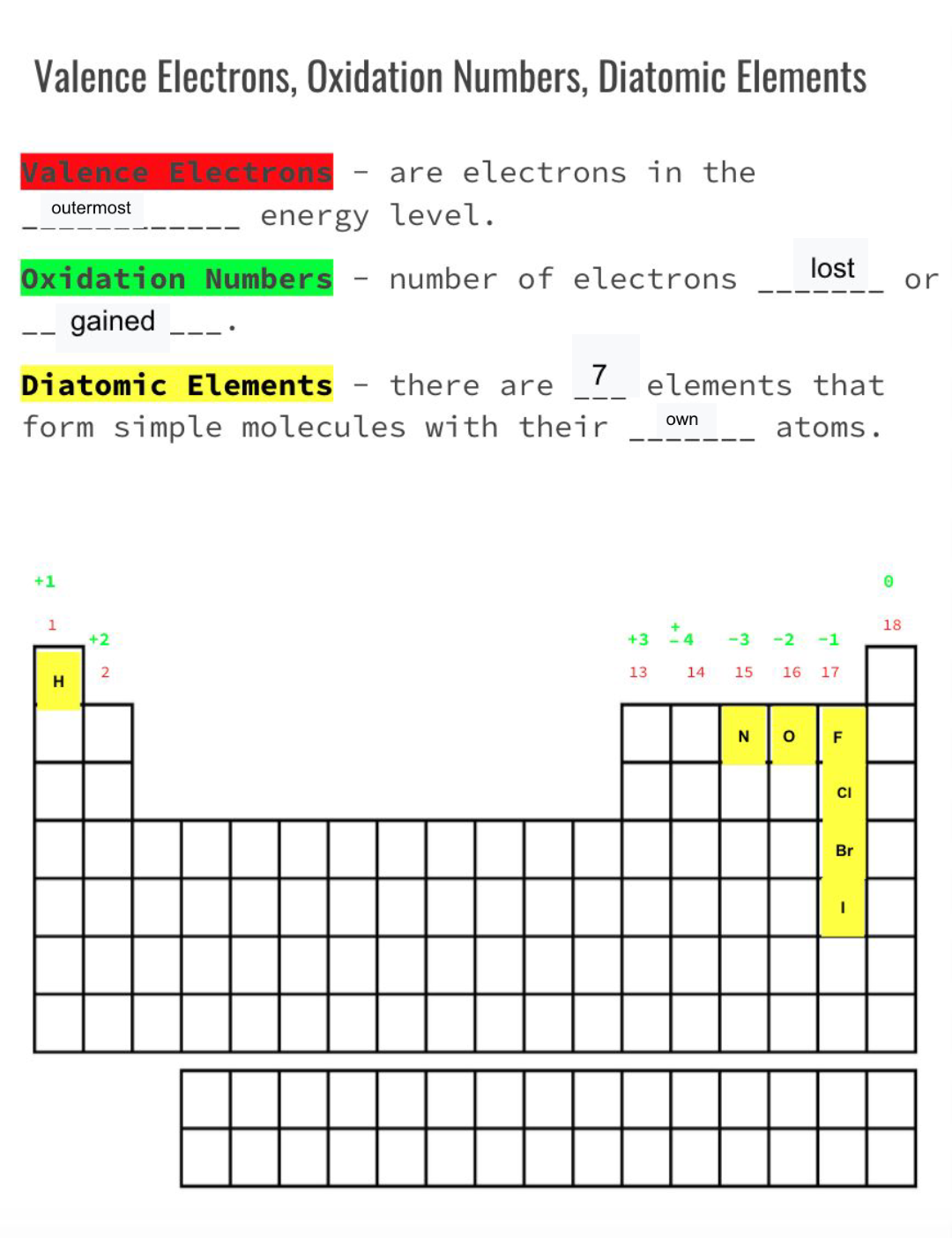
18
Draw
Label the Valence Electrons, Oxidation Numbers, and Diatomic Elements on this Periodic Table.
19
Multiple Choice
He arranged all of the known elements by their atomic number
He realised that there was a pattern of reactivity which repeated every 8 elements
He predicted the existence (and properties) of new elements
He identified the "law of triads" which became the groups
20
Multiple Choice
The modern periodic table is organized by the number of __________ atomic number.
decreasing
increasing
constant
21
Multiple Choice
Mosely
Einstein
Mendeleev
Bohr
22
Multiple Choice
atomic number
atomic mass
alphabetical order
chemical properties
23
Multiple Choice
Scientists like things organized
make it easier to understand the elements
have one list of the known elements.
none of the above
24
Multiple Choice
Why were there blank spaces left in Mendeleev's periodic table?
He didn't know what to put there.
Undiscovered elements not yet known.
Multiple elements could have fit
He forgot to add the elements in.
25
Multiple Choice
Moseley discovered that the ________ was the most fundamental property needed for organization.
atomic mass
mass number
number of protons
26
Multiple Choice
A ___________ is an arrangement of elements in columns.
columns
rows
periodic table
electron shell
27
Multiple Choice
In the modern periodic table elements are arranged by:
atomic mass
atomic number
valence electrons
number of isotopes
28
Multiple Choice

I am a British scientist who came up with today's periodic table of elements that is based on ATOMIC NUMBER. Who am i?
Henry G.J Mosely
J.J Thomson
Erwin Schrodinger
John Dalton
Show answer
Auto Play
Slide 1 / 28
SLIDE
Similar Resources on Wayground

21 questions
English II STAAR Prep - Revising
Presentation
•
10th - 12th Grade
20 questions
Atomic Structure Review
Presentation
•
9th - 12th Grade
20 questions
Water, Solubility, Solutions, Molarity
Presentation
•
9th - 12th Grade
21 questions
Significant Figure and Scientific Notation Review
Presentation
•
10th - 11th Grade
24 questions
History of the Periodic Table
Presentation
•
9th - 12th Grade
20 questions
Oxidation State Practice
Presentation
•
10th - 12th Grade
20 questions
DLD Performance Final
Presentation
•
9th - 12th Grade
21 questions
Color Theory
Presentation
•
10th - 12th Grade
Popular Resources on Wayground
10 questions
Safety Day 2026 – Student Review

Quiz
•
9th Grade
21 questions
Continents and Oceans
Quiz
•
6th Grade
20 questions
Parts of Speech
Quiz
•
5th Grade
16 questions
Subject & Predicate
Quiz
•
5th Grade
25 questions
Multiplication Facts
Quiz
•
5th Grade
12 questions
Map Skills
Quiz
•
3rd Grade
22 questions
Continents and Oceans
Quiz
•
5th Grade
15 questions
Rounding Decimals
Quiz
•
5th Grade
Discover more resources for Chemistry
20 questions
electron configurations and orbital notation
Quiz
•
9th - 12th Grade
20 questions
Periodic Table Trends
Quiz
•
11th Grade
25 questions
Writing and Naming Binary Ionic compounds
Quiz
•
10th Grade
20 questions
COUNTING ATOMS
Quiz
•
10th Grade
50 questions
Unit 3: Atomic Assault Summative Review
Quiz
•
11th Grade
20 questions
Physical or Chemical Change/Phases
Quiz
•
8th Grade - University
15 questions
Periodicity Module Exam Practice Quiz
Quiz
•
9th - 12th Grade
20 questions
Naming Ionic Compounds
Quiz
•
10th Grade