
Interdependence Amongst Organisms

Presentation
•
Science
•
4th Grade
•
Hard

Joseph Anderson
FREE Resource
10 Slides • 0 Questions
1

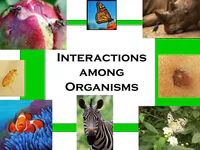
Interactions Among
Organisms
In the natural world, organisms interact with each other and their environment
in a variety of ways. These interactions are essential for the functioning of
ecosystems and the survival of individual species. From predator-prey
relationships to symbiotic partnerships, the intricate web of connections
between living things is a fascinating and complex topic to explore.
by MS. HAZEL S. DIONIO
2

Population and Communities
Populations
A population is a group of organisms of
the same species that live in a particular
area. The size and density of a
population can be influenced by factors
such as resources, predators, and
environmental conditions.
Communities
A community is the collection of all the
populations of different species that live
and interact in a particular area.
Communities can vary greatly in their
diversity and the relationships between
the organisms that make them up.
Interactions
Organisms within a community interact
in various ways, such as competition for
resources, predation, and symbiotic
relationships. These interactions shape
the structure and function of the
community as a whole.
3

Producers and Consumers:
Examples and Pictures
1
Producers
Producers are organisms that
can make their own food,
usually through the process of
photosynthesis. Examples
include plants, algae, and
certain types of bacteria.
2
Consumers
Consumers are organisms
that cannot make their own
food and must obtain it from
other sources. Examples
include animals, fungi, and
some bacteria that feed on
organic matter.
3
Importance
Producers and consumers are both essential components of
ecosystems, as they play crucial roles in the flow of energy and the
cycling of nutrients.
4

Classification of Organisms by
Food Source
Autotrophs
Autotrophs are organisms that
can produce their own food,
usually through photosynthesis
or chemosynthesis. Examples
include plants, algae, and some
bacteria.
Heterotrophs
Heterotrophs are organisms that
cannot produce their own food
and must obtain it from other
sources, such as other
organisms or organic matter.
Examples include animals, fungi,
and some bacteria.
Decomposers
Decomposers are a type of heterotroph that break down dead or
decaying organic matter, releasing nutrients back into the ecosystem.
Examples include fungi and certain bacteria.
5

Herbivores, Carnivores, and
Omnivores
1
Herbivores
Herbivores are organisms that primarily consume plants or
other producers. Examples include deer, rabbits, and many
species of insects.
2
Carnivores
Carnivores are organisms that primarily consume other
animals. Examples include lions, sharks, and spiders.
3
Omnivores
Omnivores are organisms that consume both plants and
animals. Examples include bears, raccoons, and humans.
6

Decomposers and
Scavengers
Fungi
Fungi are important decomposers that break down dead organic matter,
releasing nutrients back into the soil.
Bacteria
Bacteria are also a vital group of decomposers, playing a crucial role in the
nutrient cycling process.
Scavengers
Scavengers, such as vultures and hyenas, feed on the carcasses of dead
animals, helping to recycle nutrients.
7

Food Chains and Food Webs
1
Primary Producers
The producers, such as plants and algae, form the base of the
food chain by converting sunlight and inorganic nutrients into
organic matter.
2
Primary Consumers
Primary consumers, like herbivores, feed directly on the
producers, converting the energy and nutrients into their own
biomass.
3
Secondary Consumers
Secondary consumers, or carnivores, feed on the primary
consumers, transferring energy and nutrients up the food chain.
4
Decomposers
Decomposers, such as fungi and bacteria, break down the
remains of dead organisms, recycling the nutrients back into
the ecosystem.
8

The Role of Scavengers
Nutrient Recycling
Scavengers, such as vultures,
hyenas, and certain insects, play
a crucial role in the nutrient
cycling process by breaking
down and consuming the
remains of dead animals.
Disease Control
Scavengers help to control the
spread of diseases by quickly
removing and consuming the
carcasses of dead animals,
preventing the buildup of
decaying matter that could
harbor pathogens.
Ecosystem Balance
By efficiently breaking down and consuming dead matter, scavengers
help to maintain the balance and stability of the ecosystem, preventing
the accumulation of waste and promoting the recycling of essential
nutrients.
9

Nutrient Cycling in
Ecosystems
Producers
Absorb and incorporate inorganic
nutrients, such as nitrogen and
phosphorus, into their tissues
through photosynthesis or
chemosynthesis.
Consumers
Obtain nutrients by consuming
producers or other consumers,
and then excrete or decompose,
releasing nutrients back into the
environment.
Decomposers
Break down the remains of dead
organisms, releasing the stored
nutrients back into the soil or
water, where they can be
reabsorbed by producers.
This continuous cycling of nutrients is essential for the long-term
sustainability and productivity of ecosystems, as it ensures that essential
resources are continuously replenished and made available to support the
growth and development of all living organisms.
10

Conclusion and Key Takeaways
1
Interactions Sustain
Ecosystems
The intricate web of interactions
between organisms, including
producers, consumers, and
decomposers, is essential for the
proper functioning and balance of
ecosystems.
2
Nutrient Cycling is Key
The cycling of essential nutrients,
facilitated by producers,
consumers, and decomposers,
ensures the long-term sustainability
of ecosystems by continuously
replenishing and making available
the resources needed for life.
3
Diversity Matters
A diverse range of organisms, each
with their unique roles and
adaptations, contributes to the
overall stability and resilience of
ecosystems, allowing them to
better withstand and recover from
disturbances.
By understanding the complex interactions and interdependencies within ecosystems, we can better appreciate the delicate balance of
nature and the importance of preserving the diversity and health of our environment.
Interactions Among
Organisms
In the natural world, organisms interact with each other and their environment
in a variety of ways. These interactions are essential for the functioning of
ecosystems and the survival of individual species. From predator-prey
relationships to symbiotic partnerships, the intricate web of connections
between living things is a fascinating and complex topic to explore.
by MS. HAZEL S. DIONIO
Show answer
Auto Play
Slide 1 / 10
SLIDE
Similar Resources on Wayground

8 questions
Multiplicative comparison word problems
Presentation
•
4th Grade
7 questions
Speed, Distance, Time Calculations 1
Presentation
•
4th - 5th Grade
9 questions
Condensation
Presentation
•
4th - 5th Grade
6 questions
Science - Phenomenon
Presentation
•
4th - 5th Grade
7 questions
WORD PROBLEMS
Presentation
•
4th Grade
11 questions
Moon Phases
Presentation
•
4th Grade
7 questions
double digit by double digit multiplication
Presentation
•
4th Grade
8 questions
Water Distribution
Presentation
•
5th Grade
Popular Resources on Wayground
10 questions
Safety Day 2026 – Student Review

Quiz
•
9th Grade
21 questions
Continents and Oceans
Quiz
•
6th Grade
20 questions
Parts of Speech
Quiz
•
5th Grade
16 questions
Subject & Predicate
Quiz
•
5th Grade
25 questions
Multiplication Facts
Quiz
•
5th Grade
12 questions
Map Skills
Quiz
•
3rd Grade
22 questions
Continents and Oceans
Quiz
•
5th Grade
15 questions
Rounding Decimals
Quiz
•
5th Grade
Discover more resources for Science
10 questions
Mixtures and Solutions
Quiz
•
4th Grade
10 questions
Identifying Physical and Chemical Changes

Interactive video
•
1st - 5th Grade
13 questions
Reflect, refract, and absorb
Quiz
•
3rd - 5th Grade
15 questions
Weathering and Erosion
Interactive video
•
4th Grade
14 questions
Scientific Method
Quiz
•
3rd - 5th Grade
11 questions
Force and Motion
Quiz
•
4th Grade
30 questions
Unit 2 Energy Resources
Quiz
•
4th Grade
15 questions
Mixtures and Solutions
Quiz
•
4th Grade