Interpreting Graphs, Charts, and Tables
Presentation
•
Science
•
9th - 12th Grade
•
Hard
+2
Standards-aligned
Joseph Anderson
FREE Resource
12 Slides • 25 Questions
1
2
Graphs in Science
• Graphs are often used in science to
depict information.
• Graphs are commonly found in the
“data” section of a lab report.
• There are several different types of
graphs that you will be asked to
analyze this year…
– Bar graphs
– Line graphs
– Pie Charts
– Tables/charts
3
Multiple Select
Which of the following are types of graphs we can use in science
Pie Chart
Bar Graph
Line Graphs
Tables/charts
Box plots
4
• Shows
comparisons
Bar Graph
5
Multiple Choice
6
1.
Take a look at the graph
to the right.
2.
What is this graph
showing a comparison
of?
3.
How did you know this?
4.
How many more red
skittles were in this pack
as compared to purple
skittles?
5.
Which two colors
showed the same
frequency?
Bar Graph
(from a regular size pack of Skittles)
7
Multiple Choice
Which type of graph is best suited for comparing data in different categories?
line graph
bar graph
scatter plot
pie chart
8
Multiple Choice
9
Multiple Choice
10
Multiple Choice
11
Multiple Choice
12
• Shows change over time
Line Graph
13
Multiple Choice
14
1.
What “change over time” is this graph representing?
2.
What can be said about the temperature of coffee as time
passes?
3.
What could have caused the temperature to drop more rapidly at
minute 20?
Line Graph
15
Multiple Choice
16
Multiple Choice
17
• Shows
comparisons of
parts to a whole
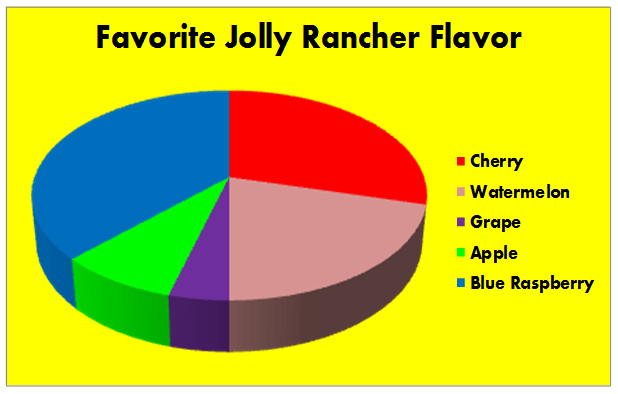
Pie Chart or Circle Graph
18
Multiple Choice
19
Multiple Choice
information about the parts of a whole
20
1. What does this
pie chart
represent?
2. What is the
most popular
choice of
topping?
3. What is the
least popular
choice?
Pie Chart or Circle Graph
21
Multiple Choice
22
Multiple Choice
23
Multiple Choice
24
• Reports
data
Tables
25
Multiple Choice
26
Tables
1.
What is this table
representative of?
2.
According to the
table, which metal is
most dense?
3.
If water has a density
of 1 g/cm3, which of
these metals would
sink when placed in
water?
27
• S- Scale
• U- Units
• L- Labels (X & Y)
• T- Title
• A- Accurate
• N- Neat
Creating Graphs
Remember
“SULTAN”
All graphs must..
28
Interpreting Graphs
How to know when a graph is
misleading:
Video Link: https://www.youtube.com/watch?v=E91bGT9BjYk
29
Multiple Choice
What type of graph is best used to compare different categories of data?
Bar graph
Line graph
Pie chart
Scatter plot
30
Multiple Choice
In a bar graph, what does the length of each bar represent?
The font size of the label
The width of the bar
The value of the data
The color of the bar
31
Multiple Choice
When should a line graph be used instead of a bar graph?
When comparing individual values
When the data points are discrete
When showing trends over time or continuous data points.
When the data is categorical
32
Multiple Choice
How can you determine the trend of data from a line graph?
By observing the overall direction of the line on the graph.
By changing the color of the line
By counting the number of data points
By measuring the thickness of the line
33
Multiple Choice
What is the purpose of labeling the axes in a graph?
To waste time
To make the graph look pretty
To confuse the audience
The purpose of labeling the axes in a graph is to provide context and understanding of the data being presented.
34
Multiple Choice
How can you ensure that your data interpretation from a graph is accurate?
Carefully read the axes labels, understand the units of measurement, check for scaling or truncation, analyze data trends, and verify the source and reliability of the graph.
Assume all data trends are accurate
Ignore the axes labels and units of measurement
Don't verify the source and reliability of the graph
35
Multiple Choice
What are the advantages of using graphs to represent data?
Graphs make data harder to interpret
Graphs provide visual representation, simplify complex data, identify trends, patterns, and communicate insights effectively.
Graphs cannot identify trends or patterns
Graphs are not visually appealing
36
Multiple Choice
What is the significance of choosing appropriate scales for the axes in a graph?
It ensures accurate representation of data and allows for clear interpretation of trends and relationships.
It limits the amount of data that can be displayed.
It has no impact on the accuracy of the graph.
It distorts the data and makes interpretation difficult.
37
Multiple Choice
How can you effectively present your data using both bar and line graphs in the same graph?
Present the data in a text-only format
Use a dual-axis chart with one data series assigned to a bar chart and another to a line chart.
Manually draw the bar and line graphs on paper
Use a pie chart instead of bar and line graphs
Show answer
Auto Play
Slide 1 / 37
SLIDE

Similar Resources on Wayground
35 questions
12.1 Air Pollution
Presentation
•
9th - 12th Grade
32 questions
Colligative properties practice
Presentation
•
10th - 12th Grade
28 questions
Solubility Curves
Presentation
•
10th - 12th Grade
32 questions
Significant Figure Rules
Presentation
•
9th - 12th Grade
34 questions
[6.1] Habitats, Niches, and Species Interactions
Presentation
•
10th - 12th Grade
32 questions
Lab Equipment
Presentation
•
9th - 12th Grade
32 questions
Introduction to Reflexive Verbs
Presentation
•
9th - 12th Grade
31 questions
7.1 Biodiversity Lesson 1
Presentation
•
9th - 12th Grade
Popular Resources on Wayground
20 questions
STAAR Review Quiz #3
Quiz
•
8th Grade
20 questions
Equivalent Fractions
Quiz
•
3rd Grade
6 questions
Marshmallow Farm Quiz
Quiz
•
2nd - 5th Grade
20 questions
Main Idea and Details
Quiz
•
5th Grade
20 questions
Context Clues
Quiz
•
6th Grade
20 questions
Inferences
Quiz
•
4th Grade
19 questions
Classifying Quadrilaterals
Quiz
•
3rd Grade
12 questions
What makes Nebraska's government unique?
Quiz
•
4th - 5th Grade
Discover more resources for Science
46 questions
Unit 4 Geosphere Test Review
Quiz
•
9th - 12th Grade
25 questions
Naming Ionic and Covalent Compounds
Quiz
•
9th Grade
20 questions
Human Impact on the Environment Review #2
Quiz
•
9th Grade
16 questions
Ecosystem Stability
Quiz
•
9th Grade
20 questions
Mendelian Genetics Review
Quiz
•
9th Grade
12 questions
Unit 6 Quiz #3 (Life Cycles of Stars)
Quiz
•
9th Grade
34 questions
Human Impact on Ecosystems Quiz
Quiz
•
9th Grade
10 questions
Exploring Alfred Wegener's Continental Drift Theory
Interactive video
•
6th - 10th Grade