

Introduction to Thermal Energy

Presentation
•
Physics
•
8th - 9th Grade
•
Hard

Joseph Anderson
FREE Resource
21 Slides • 19 Questions
1
Thermal Energy
by William Lovering
2
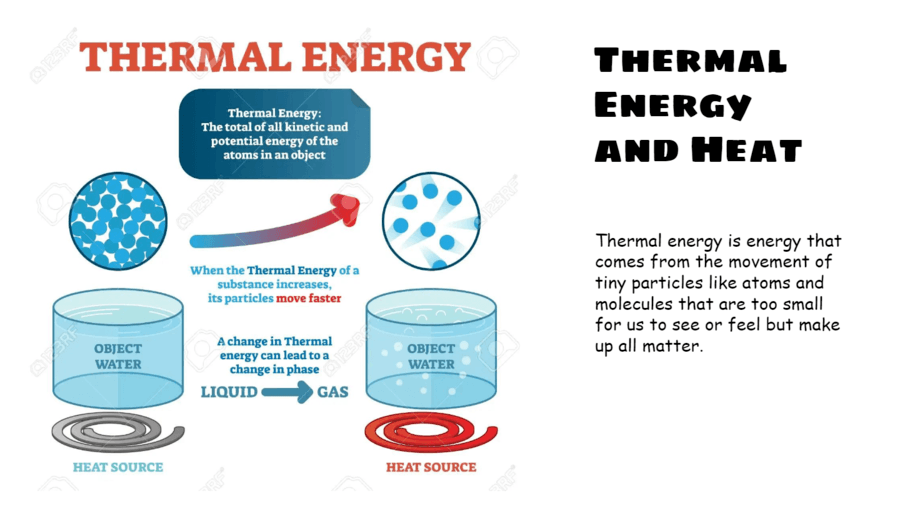
3

4
Multiple Choice
All matter is made of tiny particles that are constantly moving
True
False
5

6

7

8
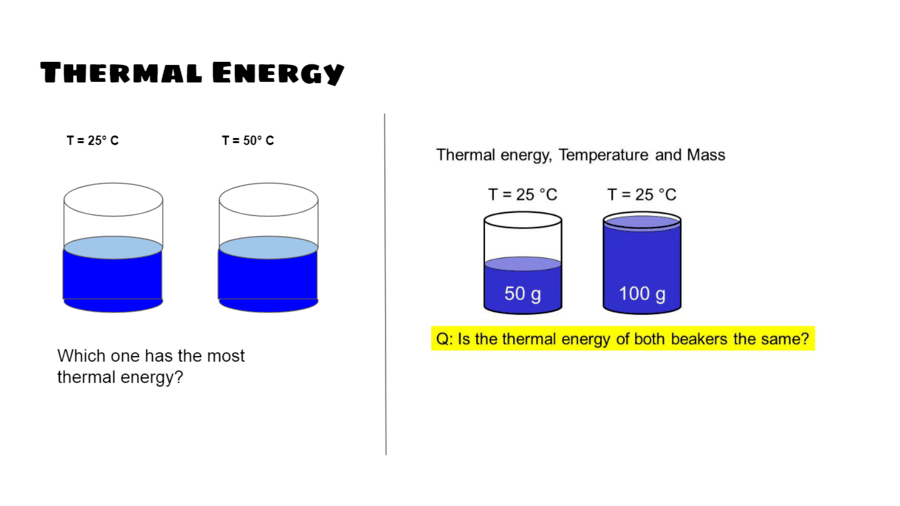
9

10
Multiple Choice
What is the thermal energy of a system?
the total kinetic energy of moving particle
the average kinetic energy of moving particles
the amount of heat in a substance
11
Multiple Select
If the particles of an object begin moving faster...(May be more than one answer)
the temperature will go up
the thermal energy will go up
the mass will go up
the object will move across the floor
12
Fill in the Blanks
Type answer...
13
Multiple Select
Which of the following will increase the thermal energy of an object. (May be more than one answer)
increasing the temperature
increasing the mass
reducing the mass
reducing the temperature
14
Multiple Choice
Increasing the mass of an object will increase its temperature
True
False
15

16

17

18

19

20
Match
Specific Heat Capacity
Temperature
Thermal Energy
Convection
Conduction
the amount of energy it takes to raise the temperature of a substance
the average amount of kinetic energy in particles
the total amount of kinetic energy in particles
the movement of fluids (gases and liquids) due to temperature differences
the transfer of thermal energy through collisions of particles when objects touch
the amount of energy it takes to raise the temperature of a substance
the average amount of kinetic energy in particles
the total amount of kinetic energy in particles
the movement of fluids (gases and liquids) due to temperature differences
the transfer of thermal energy through collisions of particles when objects touch
21

22

23
Fill in the Blanks
Type answer...
24

25
Fill in the Blanks
Type answer...
26
Fill in the Blanks
Type answer...
27
How much heat is needed to raise a 0.30 kg piece of aluminum from 30℃ to 150℃?
Formula: Q = mcΔT
Solving Specific Heat Problems
Some text here about the topic of discussion
28

Look for a chart like this which lists the specific heat of different substances.
Solving Specific Heat
29
How much heat is needed to raise a 0.30 kg piece of aluminum from 30℃ to 150℃?
specific heat (c) of aluminum = 900 j/kgC
Formula: Q = mcΔT
m = mass = 0.30 kg,
Solving Specific Heat Problems
Some text here about the topic of discussion
30
How much heat is needed to raise a 0.30 kg piece of aluminum from 30℃ to 150℃?
Formula: Q = mcΔT
What is ΔT? Change in temperature.
150℃ - 30℃ = 120℃
Solving Specific Heat Problems
Some text here about the topic of discussion
31
How much energy is needed to raise a 0.30 kg piece of aluminum from 30℃ to 150℃?
Formula: Q = mcΔT
m = 0.30, c = 900, ΔT = 120
Q = 32400 j (amount of energy needed)
Solving Specific Heat Problems
Some text here about the topic of discussion
32
Multiple Choice
33
Multiple Choice
34
Multiple Choice

35
Multiple Choice

36
Multiple Choice
37
Multiple Choice
38
Multiple Choice
39
Multiple Choice
40
Multiple Choice
Thermal Energy
by William Lovering
Show answer
Auto Play
Slide 1 / 40
SLIDE
Similar Resources on Wayground

35 questions
Simple Machines Lesson
Presentation
•
8th - 9th Grade
35 questions
Newton's Laws of Motion
Presentation
•
8th Grade
33 questions
Grade 9 General Unit 2 Lesson 6
Presentation
•
8th - 9th Grade
34 questions
Linear, Quadratic, or Exponential?
Presentation
•
9th Grade
31 questions
Speed, Velocity, and Acceleration Notes
Presentation
•
8th Grade
36 questions
Q4 Week 2 Computer Hardware Components
Presentation
•
7th - 9th Grade
36 questions
Subject Verb Agreement
Presentation
•
KG - 9th Grade
Popular Resources on Wayground
11 questions
Hallway & Bathroom Expectations

Quiz
•
6th - 8th Grade
10 questions
HCS SCI 03 Summer School Assessment 2
Quiz
•
3rd Grade
11 questions
Home Scope
Quiz
•
7th - 8th Grade
12 questions
2026 TAP Technology in the Classroom
Presentation
•
Professional Development
15 questions
HCS SCI 05 Summer School Assessment 2 Review
Quiz
•
5th Grade
15 questions
HCS SCI 04 Summer School Review 2
Quiz
•
4th Grade
59 questions
Geometry Unit 3 Review
Quiz
•
9th - 12th Grade
14 questions
FAST ELA READING SMAPLE TEST MATERIALS

Passage
•
3rd Grade