

Leap Social Studies

Presentation
•
Social Studies
•
7th Grade
•
Hard

Joseph Anderson
FREE Resource
25 Slides • 11 Questions
1
AH LEAP 2025 PRACTICE TEST SESSION 2/ IXL/VIDEOS/SLIDES
2
ELECTION OF ABRAHAM LINCOLN SOURCE SET
Source Session 2 Leap 2025 Practice Test 27-32
3
Read and study the sources about the election of Abraham Lincoln. Then use the three sources and your knowledge of social studies to answer the questions.
4

5

6

7
Multiple Choice
Using Source 1, which statement best explains how Abraham Lincoln and
Stephen Douglas differed on the issue of slavery in the years leading up to the
Civil War?
Lincoln believed that slavery was morally wrong in all cases, and Douglas
believed that most states should allow slavery for economic reasons.
Lincoln believed that the country should have a single policy on slavery, and
Douglas believed that each state should decide its own policy.
Lincoln supported the gradual abolition of slavery, and Douglas supported the
immediate and total end of slavery.
Lincoln wanted to put the issue of slavery to a national vote, and Douglas
thought that the president should decide.
8
Multiple Select
Based on Source 1 and Source 3, which statements best describe viewpoints
expressed by Abraham Lincoln in the years leading up to the Civil War?
Select the two correct answers.
The Union must uphold the rule of law.
The secession of southern states was unavoidable.
States should have the right to overturn federal laws.
The secession of northern states would cause slavery to end.
Individual states lacked the right to secede from the Union.
9
Multiple Choice
Using Source 2, which statement best describes the outcome of the 1860 presidential election?
The Senate selected the president because no candidate received a majority
of the popular vote.
Lincoln received a majority of the electoral votes, but failed to secure a
majority of the popular vote.
The House of Representatives chose the president because no candidate
received a majority of electoral votes.
Breckinridge won a clear majority of the popular vote, but failed to receive
enough electoral votes.
10
Multiple Choice
Which statement best explains a reason for the outcome of the 1860 presidential
election shown in Source 2?
Southern Democratic voters were divided on the issue of slavery.
High voter turnout in the territories resulted in a Republican victory.
Voter decisions reflected the significant divisions between regions.
Northern states removed southern candidates from voters’ ballots.
11
Multiple Choice
Using Source 3, which statement best explains the relationship between the
Civil War and the ideas expressed by President Lincoln in his first inaugural
address?
Conflict over territorial expansion caused the war.
The regions held different views on the rights of citizens.
The federal government sought to impose military rule.
Sectional tension led to divisions among people in the nation.
12
Open Ended

There are seven underlined phrases in the excerpt from President Abraham
Lincoln’s first inaugural address. From these seven phrases, write the four
phrases that best reflect the reasons for the Civil War.
13
U.S. foreign policy before 1850 Source Set
Source: Leap 2025 Practice Test Session 2 33-37
14
As you read the four sources, evaluate the effectiveness of U.S. foreign policy decisions on foreign and domestic affairs of the United States during the late eighteenth and
early nineteenth centuries. After you read the sources, answer the questions.
15

16

17

18

19
Multiple Choice
Using Source 2, which statement best summarizes an argument that
George Washington made during his Farewell Address?
The United States should avoid long-term allies or enemies.
The United States should maintain a large army and navy.
The United States should refuse to participate in foreign trade.
The United States should make slavery illegal.
20
Multiple Choice
Based on Source 3, which statement best explains how the Monroe Doctrine
reflected the ideals expressed by George Washington in Source 2?
It discouraged the colonies controlled by European nations from declaring
independence.
It confirmed that the United States wished to stay out of European affairs.
It announced that the intention of the United States was to be hostile to
European nations.
It declared that the government would encourage European involvement in
the Western Hemisphere.
21
Multiple Choice
Using Source 3, which statement best explains how the Monroe Doctrine
encouraged the territorial changes shown in Source 4?
It promoted hostile relations between Great Britain and the United States.
It allowed the United States to gain Texas from Mexico.
It discouraged European powers from further colonizing the Western
Hemisphere.
It called for the forceful seizure of Florida from Spanish control.
22
Multiple Choice
Which statement explains how the relationship between the United States and
Great Britain was most likely affected by the Oregon Treaty, as shown in Source 1 and Source 4?
Relations improved because both nations were better able to participate in
the trade of North America’s resources.
Relations grew worse because the two nations began to focus on new border
disputes in the Northeast.
The United States supported Great Britain in its ongoing trade war with
France.
Great Britain provided the United States with troops for its war with Mexico.
23
Based on the sources and your knowledge of social studies, evaluate the
effectiveness of U.S. foreign policy decisions on the foreign and domestic affairs of the United States during the late eighteenth and early nineteenth centuries.
24
REMEMBER TO
As you write, follow the directions below.
Address all parts of the prompt.
Include information and examples from your own knowledge of social studies.
Use evidence from the sources to support your response.
25
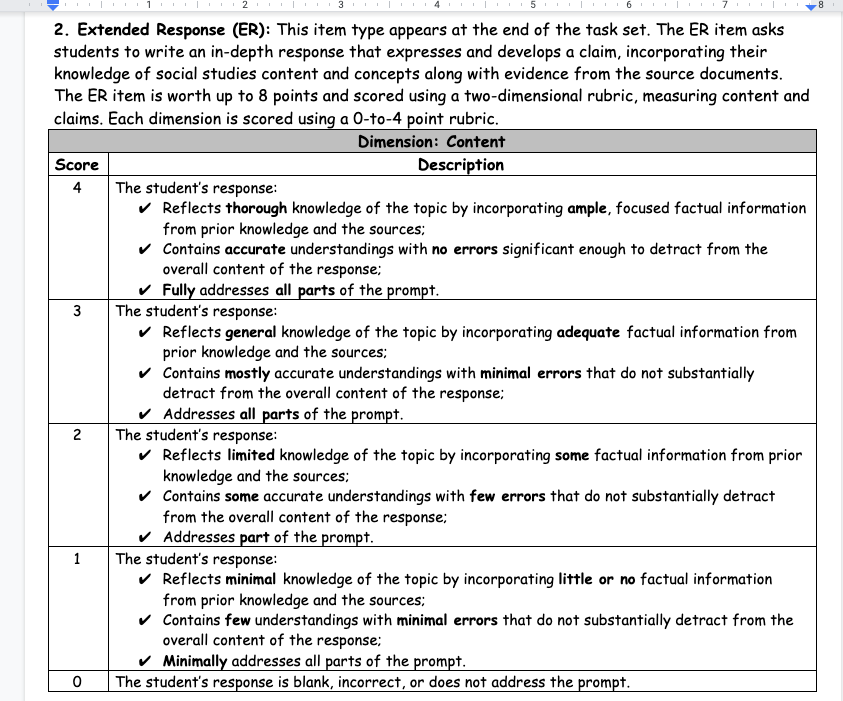
HOW TO ANSWER AN EXTENDED RESPONSE
26
RUBRIC
27
28

29
evaluate the
effectiveness of U.S. foreign policy decisions on the foreign and domestic affairs of the United States during the late eighteenth and early nineteenth centuries
30
What occurred in the late 18th and early 19th centuries?-- Territorial Expansion
U.S. foreign policy decisions during the late eighteenth and early nineteenth centuries were effective in achieving the territorial expansion of the United States by acquiring land from other countries. Purchases of vast territory, such as the Louisiana Purchase from France, the purchase of Florida from Spain, and the Gadsden Purchase from Mexico, showed the willingness of the U.S. government to expand its territory
The willingness of America to make such purchases granted America to more than triple in size in less than 100 years.
31
U.S. participation in the Mexican-American War and the signing of a treaty with Great Britain that established permanent borders for the Oregon Country also enabled the territorial expansion of the United States.
32
What occurred in the late 18th and early 19th centuries?-- America became a powerful nation
U.S. foreign policy decisions during the late eighteenth and early nineteenth centuries were effective in helping the country become a powerful nation in the Western Hemisphere. The Monroe Doctrine influenced foreign and domestic affairs by helping to provide the United States with the ability to explore western lands and establish commercial interests throughout North America.
33
What occurred in the late 18th and early 19th centuries?-- not neutral like suggested by George Washington
U.S. foreign policy decisions during the late eighteenth and early nineteenth centuries were not fully effective in keeping the nation out of wars with foreign countries.
Despite George Washington’s declarations that the United States wished to maintain friendly relations with other countries, disagreement with Great Britain over a number of issues, such as trade and the impressment of U.S. sailors, caused the two countries to go to war in 1812. The United States also went to war with Mexico in 1846, partially in order to gain new territory
34
What occurred in the late 18th and early 19th centuries?-- Slave/Free States
U.S. foreign policy decisions during the late eighteenth and early nineteenth centuries influenced but did not effectively resolve foreign and domestic issues related to the issue of slavery. Acquiring new territories caused the United States to face the question of whether these territories would allow slavery and whether they would become slave states or free states. The tension caused by this issue eventually led to the Civil War, as several compromises regarding this issue failed to deal with the essential question of slavery.
35
Remember to use sources
36
Open Ended
Based on the sources and your knowledge of social studies, evaluate the
effectiveness of U.S. foreign policy decisions on the foreign and domestic affairs of the United States during the late eighteenth and early nineteenth centuries.
(i have given you the information that is needed, if you need to use the sources it is available to you either on this quizizz or in the LEAP practice test session 2) please answer this as if you are answering on leap this will be graded for 25 points.
AH LEAP 2025 PRACTICE TEST SESSION 2/ IXL/VIDEOS/SLIDES
Show answer
Auto Play
Slide 1 / 36
SLIDE
Similar Resources on Wayground

26 questions
Systems of Govt
Presentation
•
7th Grade
31 questions
Part 1: Southern Colonies Lesson
Presentation
•
4th Grade
32 questions
Geography of Canada
Presentation
•
6th Grade
29 questions
SWA Geography
Presentation
•
7th Grade
29 questions
4.2 Revolutionary War
Presentation
•
7th Grade
32 questions
Preamble
Presentation
•
7th Grade
29 questions
The Civil Rights Movement
Presentation
•
7th Grade
27 questions
Great Depression
Presentation
•
7th Grade
Popular Resources on Wayground
10 questions
How much do you know about our Portrait of an Eagle?

Quiz
•
10th Grade
10 questions
Fast Food Slogans
Quiz
•
6th - 8th Grade
21 questions
Continents and Oceans
Quiz
•
6th Grade
20 questions
Parts of Speech
Quiz
•
5th Grade
16 questions
Subject & Predicate
Quiz
•
5th Grade
25 questions
Multiplication Facts
Quiz
•
5th Grade
12 questions
Map Skills
Quiz
•
3rd Grade
22 questions
Continents and Oceans
Quiz
•
5th Grade
Discover more resources for Social Studies
10 questions
Exploring the Age of Exploration: Key Events and Figures

Interactive video
•
6th - 10th Grade
13 questions
13 Colonies Map Quiz
Quiz
•
6th - 8th Grade
19 questions
Unit 3 Spanish Colonial Era
Quiz
•
7th Grade
10 questions
Pillars of Free Enterprise
Quiz
•
6th - 8th Grade
26 questions
QA 1 Review
Quiz
•
6th - 8th Grade
10 questions
Exploring the 13 Colonies Regions
Interactive video
•
6th - 10th Grade
21 questions
ss.7.cg.1.1- Ancient Influences
Quiz
•
7th Grade
21 questions
Unit 2 Age of Contact 7th gr
Quiz
•
7th Grade