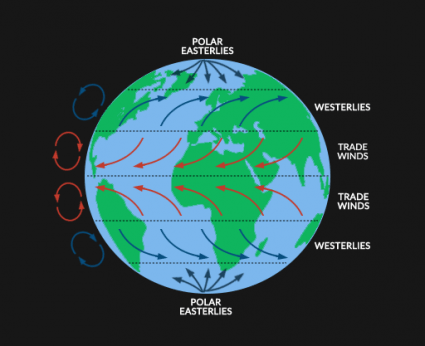
Natural Climate Variability
Presentation
•
Science
•
6th Grade
•
Hard

Joseph Anderson
FREE Resource
17 Slides • 51 Questions
1
2
Multiple Choice
What is climate?
weather
rain, sleet, snow, or hail
average weather in a region over a long period of time
the amount of ice cream available in a city
3
4
Multiple Choice
What is the source of energy that heats our planet's atmosphere and oceans?
the weather
the wind
the Sun
the Earth's core
5
Multiple Choice
Why does the Earth experience unequal heating?
The oceans are not equally distributed around the Earth.
The Earth's revolution brings it closer to the Sun at certain points during the year.
The Earth's axis is tilted.
The atmosphere is not equally distributed around the Earth.
6
Multiple Choice
Ocean currents are the result of uneven heating of the water, which leads to
conduction
convection
reflection
condensation
7
Multiple Choice
What is the primary or most important factor that influences climate?
latitude
longitude
elevation
climate zone
8
Multiple Choice
Because it is closest to the sun.
Because it receives the most direct sunlight
Because no clouds form here.
Because it is far from the sun
9
Multiple Choice
Most of the electromagnetic radiation on Earth comes from
the sun.
radio towers.
X ray machines.
microwave ovens.
10
Unequal Heating Lab In Action
11
Multiple Choice
In this lab, why is the Earth heated unequally?
It is Tilted
It is Straight
It is a Square
None of these responses are correct
12
Multiple Choice
From our lab, when we were modeling the Earth's tilt. What did we use to model the Earth.
Paper
Crayon
Beans
Pencils
13
14
Multiple Choice
Convection currents occur when ______________________ energy transfers between a fluid.
potential
kinetic
thermal/heat
electric
15
Multiple Choice
conduction currents
radiation
condition currents
convection currents
16
Multiple Choice
the sun heats the air and ocean evenly everywhere
the heat inside the earth heats the ocean and the ocean heats the air
the sun cannot heat both the air and water, so one must heat the other
the sun heats air and water more at the equator because it receives more direct sunlight
17
Multiple Choice
The sun
The moon
Solar winds
The ocean
18
Convection Currents LAB
19
Multiple Choice
In the lab, what do you need to make convection currents?
A Lamp for Cold Water
A Lamp for Warm Water
20
Multiple Choice
Heat flow (convection current) in the ocean and the atmosphere is...
cool flows down - warm flows up
cool flows up - warm flows down
cool flows up - warm flows up
cool flows down - warm flows down
21
22
Multiple Choice
Cold
Warm
Freezing
Fresh
23
Multiple Choice
Cool the coast
Warm the coast
Cause snow to fall
Cause higher tides
24
Multiple Choice
Gulf Stream
California Current
North Equatorial Current
Brazil Current
25
Multiple Choice
Air always moves from
high pressure to low pressure.
low pressure to high pressure.
26
27
Multiple Choice
Earth rotating around the sun
Earth rotating on its axis
The tides
Gravity
28
Multiple Choice
The Coriolis effect causes ___________.
global winds and water to move in a curved path instead of a straight line
continental deflection
the Earth to rotate on its axis
the orbit Earth takes around the sun
29
Multiple Choice
What makes winds and currents move in curved paths?
Coriolis effect
wave height
longshore drift
ocean trenches
30
31
Multiple Choice
Is the equator a line of latitude or longitude?
latitude
longitude
both
neither
32
Multiple Choice
Which location has a higher line of latitude?
A
B
33
Multiple Choice
Which location has a lower line of latitude?
A
B
34
Multiple Choice
What causes convection cells in the Earth's atmosphere?
Different amounts of direct sunlight at each latitude
The spinning of Earth
Being closer to or farther away from the sun
Different amounts of living things below the atmosphere
35
Multiple Choice
Canada and Ireland are at the similar latitudes. Why is Canada so much colder that Ireland?
The Gulf Stream causes Ireland to have a warm and moist climate.
Ireland is at a much lower elevation.
Ireland is on a cold current coming down from the polar regions.
36
37
Multiple Choice
______________ absorb the most energy from the Sun.
Land
Houses
Oceans
Atmosphere
38
Multiple Choice
Compared to places by large bodies of water, inland areas experience ______.
Less Rain
More Rain
No Rain
Frequent Hurricanes
39
40
41
Altitude & Elevation are the same thing!
The higher you climb a mountain, the cooler it gets and the less dense the air gets!
42
Multiple Choice
LOWER elevation = COLDER temperatures
HIGHER elevation = COLDER temperatures
HIGHER elevations = WARMER temperatures
There is no relationship
43
Multiple Choice
Air at the top of a mountain is _______ dense.
More
Less
44
45
Multiple Choice
Which statement is true about air's capacity to hold water?
As air rises higher up the mountain, its capacity to hold water vapor decreases
As air rises higher up the mountain, its capacity to hold water vapor increases
46
Multiple Choice
What landform causes the rain shadow effect?
mountains
lakes
plains
valley
47
Multiple Choice
As you go to the top of a mountain, what happens to the air temperature?
nothing
it decreases
it increases
it fluctuates between warm and cold
48
Multiple Choice
Warm air can carry more water vapor (moister) than cool air.
true
false
49
Multiple Choice
1. This side of the mountain is dry and desert like because of the rain shadow effect.
Leeward
Sideward
Windward
Land
50
Multiple Choice
On the leeward side of a mountain, you might find _____.
Heavy rainfall
Desert
More vegetation
More snow
51
Multiple Choice
What landform causes the rain shadow effect?
Mountains
Lakes
Plains
Valleys
52
Multiple Choice
This side of the mountain is where the wind originates and evaporation occurs
windward
leeward
rain shadow
prevailing winds
53
54
Multiple Choice
Climates are classified according to two major factors:
elevation and precipitation
latitude and temperature
elevation and latitude
precipitation and temperature
55
Multiple Choice
Elevation (Altitude) affects the climate of an area.
True
False
56
Multiple Choice
If you were to climb high up Mt. Everest, would it get warmer or colder?
warmer
colder
57
Multiple Choice
Yes or no: Do landforms, such as mountains, affect the climate?
yes
no
58
Multiple Choice
What is moist air blocked by mountains causing other side to be dry?
rain shadow
lake effect
maritime climate
continental climate
59
Multiple Choice
True or False: The equator receives the most direct sunlight.
True
False
60
Multiple Choice
what is the coriolis effect?
change in location of warm and cold surface water every 2-7 years
tendency of objects moving large distances on Earth’s surface to bend to the right in the northern hemisphere & to the left in the southern hemisphere
winds in northern Indian ocean that blow from the southwest in the summer & from the northeast in winter
two layers of horizontal winds moving in opposite directions
61
Multiple Choice
Southern Hemisphere
Continents
Equator
Poles
62
Multiple Choice
What is the difference between weather and climate?
there is no difference
weather is day-to-day and climate is a pattern over a long period of time.
weather is precipitation and climate is temperature
weather is temperature and precipitation, climate is just precipitation
63
64
Multiple Choice
Why does New Mexico have a Dry Climate?
It is Near Water.
It is located at the poles.
It is Not Near Water.
It is located on the equator.
65
66
Multiple Choice
Why does San Diego, CA have a moist, wet and rainy climate?
It is Near Water.
It is located at the poles.
It is Not Near Water.
It is located on the equator.
67
68
Multiple Select
Climate is affected by ___________ (choose ALL that apply).
latitude
altitude
distance from large bodies of water
ocean currents
global prevailing winds
Show answer
Auto Play
Slide 1 / 68
SLIDE

Similar Resources on Wayground
60 questions
Unit 3 Energy Test Review
Presentation
•
7th Grade
64 questions
Unit 1 Review
Presentation
•
6th Grade
63 questions
Microscope
Presentation
•
6th - 7th Grade
66 questions
Parts of an atom and matter
Presentation
•
6th Grade
67 questions
Lesson 1.3 - Metabolism
Presentation
•
6th Grade
62 questions
Dictionary Skills (6th Grade)
Presentation
•
6th Grade
64 questions
No Guitar Blues
Presentation
•
5th Grade
67 questions
Wave Lesson in Physical Science
Presentation
•
6th Grade
Popular Resources on Wayground
20 questions
STAAR Review Quiz #3
Quiz
•
8th Grade
20 questions
Equivalent Fractions
Quiz
•
3rd Grade
6 questions
Marshmallow Farm Quiz
Quiz
•
2nd - 5th Grade
20 questions
Main Idea and Details
Quiz
•
5th Grade
20 questions
Context Clues
Quiz
•
6th Grade
20 questions
Inferences
Quiz
•
4th Grade
19 questions
Classifying Quadrilaterals
Quiz
•
3rd Grade
12 questions
What makes Nebraska's government unique?
Quiz
•
4th - 5th Grade
Discover more resources for Science
19 questions
Introduction to Properties of Waves
Presentation
•
6th - 8th Grade
16 questions
Interactions within Ecosystems
Presentation
•
6th - 8th Grade
45 questions
Food Webs
Quiz
•
6th - 8th Grade
15 questions
Punnett Squares
Quiz
•
6th Grade
20 questions
Energy Transformations
Quiz
•
6th - 8th Grade
23 questions
Cartoon Trivia
Quiz
•
6th Grade
20 questions
Levels of Organization
Quiz
•
6th Grade
20 questions
Cells! Cell Theory and Characteristics of Eukaryotes/Prokaryotes
Quiz
•
6th Grade