
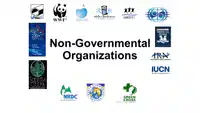
Ngo's

Presentation
•
Social Studies
•
University
•
Hard

Joseph Anderson
FREE Resource
9 Slides • 4 Questions
1
NGOs: Making a Difference
Exploring the impact of NGOs in creating positive change and addressing social issues around the world.
2
NGOs: Making a Difference
NGO: Non-profit, citizen-based group
Independence: Promote public interest, monitor government performance
Impact: Major social movements, democratic institution-building
History: Concept dates back to 1839, when millions of NGOs worldwide
Purpose: Improve lives, solve social problems
3
Multiple Choice
What is the purpose of NGOs?
To promote public interest
To monitor government performance
To improve lives and solve social problems
To build democratic institutions
4
NGOs: Improving Lives
NGOs are non-governmental organizations that work to improve lives and solve social problems. They play a crucial role in addressing issues such as poverty, education, healthcare, and human rights. NGOs often collaborate with governments and communities to create positive change and make a lasting impact. Through their efforts, they strive to create a better world for all.
5
NGO Legitimacy and Accountability
Legitimacy: NGOs must be seen as addressing a societal need and have a board of directors to ensure public trust.
Well-Governed: NGOs should have diverse leadership to prevent personal interests from overriding the public interest.
Accountability: NGOs must answer to stakeholders, including funders, members, partners, and the community they serve.
6
Multiple Choice
What are the three key factors that contribute to the legitimacy and governance of NGOs?
Transparency, accountability, and diversity
Funding, partnerships, and community service
Public trust, diverse leadership, and stakeholder engagement
Societal need, board of directors, and public interest
7
Key Factors for NGO Governance
Public trust, diverse leadership, and stakeholder engagement are the three key factors that contribute to the legitimacy and governance of NGOs. These factors ensure transparency, accountability, and effective decision-making. NGOs with these qualities are more likely to gain support and make a positive impact in their communities.
8
NGO Types and Orientations
NGO Types: Community-based Organizations (CBOs), Citywide Organizations
NGO Orientations: Service, Participatory, Empowering
9
Multiple Choice
What are the types of NGOs mentioned in the passage?
Community-based Organizations (CBOs), Citywide Organizations
International Organizations (IOs), National Organizations (NOs)
Government Organizations (GOs), Non-profit Organizations (NPOs)
Educational Organizations (EOs), Religious Organizations (ROs)
10
Types of NGOs
Community-based Organizations (CBOs)
Citywide Organizations
11
NGOs: Making a Difference
NGOs: Nonprofit organizations that operate for collective, public, or social benefit.
Purpose: Helping the poor, funding local NGOs, and implementing projects.
Types: National NGOs (Red Cross, YMCAs/YWCAs) and International NGOs (Redda BArna, Save the Children, OXFAM).
Non-distribution constraint: Revenues must be committed to the organization's purpose.
Accountability: Nonprofits are accountable to donors, volunteers, and the public community.
12
Multiple Choice
What is the purpose of NGOs?
To generate profit for the organization
To provide collective, public, or social benefit
To implement projects for personal gain
To distribute revenues to donors
13
Purpose of NGOs
NGOs are organizations that exist to provide collective, public, or social benefits. They work towards addressing various issues such as poverty, education, healthcare, and human rights. NGOs rely on donations and volunteers to carry out their missions. They play a crucial role in creating positive change in society.
NGOs: Making a Difference
Exploring the impact of NGOs in creating positive change and addressing social issues around the world.
Show answer
Auto Play
Slide 1 / 13
SLIDE
Similar Resources on Wayground

11 questions
PARTICIPLE CLAUSES
Presentation
•
University
9 questions
WHAT'S IT LIKE ...
Presentation
•
University
10 questions
Sai's Thai
Presentation
•
KG
9 questions
PRZYWÓDZTWO W BIZNESIE. MOTYWACJA W BIZNESIE.
Presentation
•
University
9 questions
Metody Zbierania informacji
Presentation
•
University
11 questions
Present continuous vs Present simple
Presentation
•
University
10 questions
Plessy v. Ferguson
Presentation
•
12th Grade
9 questions
Intrinsic and Extrinsic Motivation Psychology
Presentation
•
University
Popular Resources on Wayground
6 questions
PRIDE Always and Everywhere
Presentation
•
12th Grade
20 questions
Lab Safety Quiz

Quiz
•
6th Grade
26 questions
KOR Review Kahoot Questions
Quiz
•
8th Grade
21 questions
Continents and Oceans
Quiz
•
6th Grade
12 questions
Unit Zero lesson 2 cafeteria
Presentation
•
9th - 12th Grade
20 questions
Parts of Speech
Quiz
•
5th Grade
10 questions
Riddles Riddles fun Riddles
Quiz
•
6th - 12th Grade
16 questions
Subject & Predicate
Quiz
•
5th Grade