
Nuclear Reactions and Nuclear Energy

Presentation
•
Chemistry
•
9th - 12th Grade
•
Hard

Joseph Anderson
FREE Resource
9 Slides • 29 Questions
1
By Nahrain Barno
2

3
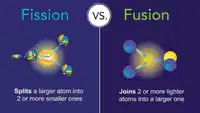
Wouldn’t it be great if people could use the same method as the sun to produce energy? The kind of reactions that power the sun involve the central cores of atoms. The central core of an atom that contains the protons and neutrons is called the NUCLEUS. Reactions that involve nuclei, called nuclear reactions, result in tremendous amounts of energy. Two types of nuclear reactions are:
Nuclear Fission: The splitting of an atom’s nucleus into two smaller nuclei.
Nuclear Fusion: The combining of two atomic nuclei to produce a single larger nucleus.

4
Multiple Choice
The central core of an atom that contains the protons and neutrons is called the
molecule
electron
nucleus
5
Fill in the Blanks
Two types of nuclear reactions are:
Type answer...
6

Nuclear reactions convert matter into energy. As part of his theory of relativity, Albert Einstein developed a formula that described the relationship between energy and matter. You have probably seen this famous equation: E = mc2. In the equation, the E represents energy and the m represents mass. The c, which represents the speed of light, is a very large number. This equation states that when matter is changed into energy, an enormous amount of energy is released.
Nuclear Fission
7
Fill in the Blanks
Nuclear reactions convert _______ into _________.
Type answer...
8
Fill in the Blanks
In the equation E=mc2, the E represents _____ and the m represents ____, and the c, represents _______
Type answer...
9
Fission Reactions
Nuclear fission is the splitting of an atom's nucleus into two smaller nuclei. The nucleus splits apart into two smaller nuclei and two or more neutrons, so the fission reaction has produced more neutrons. If any of these neutrons strikes another nucleus, the fission reaction is repeated. More neutrons and more energy are released. If there are enough nuclei nearby, the process repeats in a chain reaction, just like a row of dominoes falling. In a nuclear chain reaction, the amount of energy released increases rapidly with each step in the chain.

10
What happens to all the energy released by these fission reactions? If a nuclear chain reaction is not controlled, the released energy causes a huge explosion. The explosion of an atomic bomb is an uncontrolled nuclear fission reaction. A few kilograms of matter explode with more force than several thousand tons of dynamite. However, if the chain reaction is controlled in a power plant, the energy is released as heat, which can then be used to generate electricity.
Some text here about the topic of discussion
11
Fill in the Blanks
When a nuclear chain reaction is controlled in a power plant, the energy is released as _____, which can then be used to generate ______.
Type answer...
12
Nuclear Fission Reactions in Nature
This process causes convection currents
moves Earth's tectonic plates
Generates:
Earthquakes
Volcanic eruptions
Produces vast quantities of energy.
Involves the splitting of harmful radioactive elements.
Loss of control leads to harmful radiation exposure.
13

In a nuclear power plant, the heat released from fission is used to change water into steam. The steam then turns the blades of a turbine to generate electricity.
Some text here about the topic of discussion.
Nuclear Power Plants
14

Nuclear fusion is the combining of two atomic nuclei to produce a single larger nucleus. In nuclear fusion, two hydrogen nuclei combine to create a helium nucleus, which has slightly less mass than the two hydrogen nuclei. The lost mass is converted to large amounts of energy. Nuclear fusion is the process by which the sun produces energy. On Earth, fusion is a promising future energy source. Fusion fuels are readily available-water contains a form of hydrogen that could be used. Since its fuel can be found in water, fusion is considered a renewable energy source. Fusion would not produce air pollution. And unlike fission, fusion would not produce long-lived radioactive wastes. However, fusion can take place only at extremely high pressures and temperatures.
Nuclear Fusion
15
Multiple Choice
Nuclear fission is the combining of two atomic nuclei to produce a single larger nucleus.
TRUE
FALSE
16
Fill in the Blanks
In nuclear fusion, two hydrogen nuclei are forced together, forming a helium nucleus, a neutron, and energy. What is released during a fusion reaction?
Type answer...
17
Dropdown
18
Multiple Choice
fusion
fission
decay
gamma radiation
19
Multiple Choice
20
Multiple Choice
It is easy to implement.
It produces less energy than nuclear fission.
It produces more energy than nuclear fission.
It has the ability to occur easily in everyday life.
21
Multiple Choice
fission
fusion
22
Multiple Choice
In which process does a heavy nucleus split into two lighter nuclei?
freezing
condensation
fission
fusion
23
Multiple Choice
Which phrase describes a risk associated with producing energy in a nuclear power plant?
depletion of atmospheric hydrogen
depletion of atmospheric carbon dioxide
production of wastes needing long-term storage
production of wastes that cool surrounding water supplies
24
Multiple Choice
What occurs in both fusion and fission reactions?
Small amounts of energy are converted into large amounts of matter.
Small amounts of matter are converted into large amounts of energy.
Heavy nuclei are split into lighter nuclei.
Light nuclei are combined into heavier nuclei.
25
Dropdown
26
Dropdown
27
Dropdown
28
Dropdown
29
Dropdown
30
Dropdown
31
Dropdown
32
Dropdown
33
Dropdown
34
Dropdown
35
Dropdown
36
Dropdown
37
Dropdown
38
Dropdown
By Nahrain Barno
Show answer
Auto Play
Slide 1 / 38
SLIDE
Similar Resources on Wayground

33 questions
Introduction to Radioactivity
Presentation
•
10th - 12th Grade
29 questions
Nuclear Chemistry Application
Presentation
•
9th - 12th Grade
32 questions
Quimica nuclear
Presentation
•
8th Grade - University
32 questions
What is Physics?
Presentation
•
9th - 12th Grade
33 questions
1970s America
Presentation
•
9th - 12th Grade
33 questions
1970s US History
Presentation
•
9th - 12th Grade
28 questions
Thermodynamics Review Part 1
Presentation
•
10th - 12th Grade
34 questions
4.3: Periodic Trends
Presentation
•
9th - 12th Grade
Popular Resources on Wayground
10 questions
Safety Day 2026 – Student Review

Quiz
•
9th Grade
21 questions
Continents and Oceans
Quiz
•
6th Grade
20 questions
Parts of Speech
Quiz
•
5th Grade
16 questions
Subject & Predicate
Quiz
•
5th Grade
25 questions
Multiplication Facts
Quiz
•
5th Grade
12 questions
Map Skills
Quiz
•
3rd Grade
22 questions
Continents and Oceans
Quiz
•
5th Grade
15 questions
Rounding Decimals
Quiz
•
5th Grade
Discover more resources for Chemistry
20 questions
electron configurations and orbital notation
Quiz
•
9th - 12th Grade
20 questions
Periodic Table Trends
Quiz
•
11th Grade
25 questions
Writing and Naming Binary Ionic compounds
Quiz
•
10th Grade
20 questions
COUNTING ATOMS
Quiz
•
10th Grade
50 questions
Unit 3: Atomic Assault Summative Review
Quiz
•
11th Grade
20 questions
Physical or Chemical Change/Phases
Quiz
•
8th Grade - University
15 questions
Periodicity Module Exam Practice Quiz
Quiz
•
9th - 12th Grade
20 questions
Naming Ionic Compounds
Quiz
•
10th Grade