
Occluded Fronts

Presentation
•
Science
•
6th - 8th Grade
•
Hard

Joseph Anderson
FREE Resource
11 Slides • 5 Questions
1
Unleashing the Power of Air Masses and Weather Fronts
Understanding the dynamics of air masses and weather fronts and their impact on weather patterns.
2
Understanding Weather Fronts
3
Multiple Choice
What are the four types of weather fronts?
Warm fronts, cold fronts, stationary fronts, and occluded fronts
Tropical fronts, polar fronts, stationary fronts, and occluded fronts
Warm fronts, cold fronts, stationary fronts, and tropical fronts
Warm fronts, cold fronts, occluded fronts, and polar fronts
4
Types of Weather Fronts
5
Unleashing the Power of Warm Fronts
6
Multiple Choice
What is the symbol used to represent a warm front?
A line with semicircles pointing towards the warm air mass.
A line with semicircles pointing towards the cold air mass.
A line with triangles pointing towards the warm air mass.
A line with triangles pointing towards the cold air mass.
7
Warm Front Symbol
A line with triangles pointing towards the warm air mass represents a warm front. Warm fronts occur when warm air replaces cold air, leading to gradual temperature increases. As the warm air rises over the cold air, it creates clouds, precipitation, and sometimes thunderstorms. Warm fronts typically move slower than cold fronts, resulting in longer periods of precipitation.
8
Understanding Cold Fronts
9
Multiple Choice
What causes clouds, precipitation, and storms?
Warm air mass displacing a cold air mass
Cold air mass displacing a warm air mass
The movement of a cold front
The movement of a warm front
10
The Movement of Cold Fronts
Trivia: Cold fronts are responsible for the movement of clouds, precipitation, and storms. They occur when a cold air mass displaces a warm air mass. As the cold air pushes into the warm air, it forces the warm air to rise, creating instability and leading to the formation of clouds and storms. Cold fronts can bring heavy rain, thunderstorms, and even tornadoes.
11
Stationary Fronts
12
Multiple Choice
What is a stationary front?
A boundary where warm and cold air masses meet
A boundary where two strong air masses collide
A boundary where warm air pushes cold air out of the way
A boundary where cold air pushes warm air out of the way
13
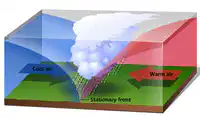
Stationary Front
A stationary front is a boundary where warm and cold air masses meet. It is characterized by little to no movement, resulting in prolonged periods of precipitation. This weather phenomenon can lead to unpredictable and severe storms, making it an important concept in meteorology. Understanding stationary fronts is crucial for weather forecasting and predicting local climate conditions.
14
Understanding Occluded Fronts
15
Multiple Choice
What is an occluded front?
A front that occurs when a cold front overtakes a warm front
A front that occurs when a warm front overtakes a cold front
A front that occurs when warm air mass is lifted off the ground
A front that occurs when cold air mass is lifted off the ground
16
Occluded Front
An occluded front occurs when a cold front overtakes a warm front. This collision creates a unique weather pattern, often bringing strong winds, heavy precipitation, and rapid temperature changes. It is a fascinating phenomenon to study in meteorology!
Unleashing the Power of Air Masses and Weather Fronts
Understanding the dynamics of air masses and weather fronts and their impact on weather patterns.
Show answer
Auto Play
Slide 1 / 16
SLIDE
Similar Resources on Wayground

14 questions
Metric System Part 1 & 2 Review
Presentation
•
5th - 8th Grade
16 questions
Fossils
Presentation
•
6th - 8th Grade
11 questions
PHYSICAL AND CHEMICAL PROPERTIES
Presentation
•
6th - 8th Grade
14 questions
Kinetic Energy
Presentation
•
6th - 8th Grade
12 questions
Circulatory and Respiratory System
Presentation
•
5th - 8th Grade
13 questions
Quarter 2 Mini-Lesson: The Water Cycle and Weather and Climate
Presentation
•
6th - 8th Grade
11 questions
METABOLISM
Presentation
•
7th Grade
11 questions
Balancing Equations: Practice
Presentation
•
6th - 8th Grade
Popular Resources on Wayground
15 questions
Grade 3 Simulation Assessment 1

Quiz
•
3rd Grade
22 questions
HCS Grade 4 Simulation Assessment_1 2526sy
Quiz
•
4th Grade
16 questions
Grade 3 Simulation Assessment 2
Quiz
•
3rd Grade
19 questions
HCS Grade 5 Simulation Assessment_1 2526sy
Quiz
•
5th Grade
17 questions
HCS Grade 4 Simulation Assessment_2 2526sy
Quiz
•
4th Grade
20 questions
Equivalent Fractions
Quiz
•
3rd Grade
24 questions
HCS Grade 5 Simulation Assessment_2 2526sy
Quiz
•
5th Grade
20 questions
Math Review
Quiz
•
3rd Grade
Discover more resources for Science
20 questions
8th Grade Science STAAR Review
Quiz
•
8th Grade
16 questions
Interactions within Ecosystems
Presentation
•
6th - 8th Grade
20 questions
Earth Day
Quiz
•
3rd - 12th Grade
20 questions
Rocks and The Rock Cycle
Quiz
•
6th Grade
20 questions
genetics, punnett squares, heredity
Quiz
•
7th Grade
16 questions
Photosynthesis and Cellular Respiration Review
Quiz
•
7th Grade
20 questions
Abiotic & Biotic Factors
Quiz
•
7th Grade
52 questions
iLearn Science Review
Quiz
•
6th Grade