
Osmosis Lab

Presentation
•
Science
•
9th - 12th Grade
•
Hard

Joseph Anderson
FREE Resource
9 Slides • 1 Question
1
Open Ended
Define osmosis and explain why water movement is important for cells.
2
3
Vocab in a Minute:
hyper: more (prefix)
hypo: less (prefix)
4
1. Diffusion
Definition: The movement of molecules from an area of high concentration to an area of low concentration until equilibrium is reached.
Key Concept: Molecules move down the concentration gradient (from high to low).
Does Not Require Energy: Diffusion is a type of passive transport, meaning no energy (ATP) is required.
Examples:
Oxygen and carbon dioxide moving in and out of cells during respiration.
Perfume spreading throughout a room.
5
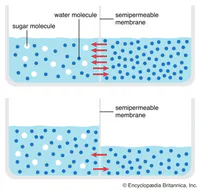
2. Osmosis
Definition: The movement of water molecules across a semipermeable membrane from an area of low solute concentration to an area of high solute concentration.
Key Concept: Water moves to balance solute concentrations on both sides of the membrane.
Passive Process: Osmosis is also a form of passive transport and does not require energy.
Tonicity Terms:
Hypertonic: Higher solute concentration outside the cell → water moves out of the cell, causing the cell to shrink.
Hypotonic: Lower solute concentration outside the cell → water moves into the cell, causing the cell to swell.
Isotonic: Equal solute concentration inside and outside the cell → water moves equally in and out, and the cell stays the same size.
6
3. Similarities Between Osmosis and Diffusion
Both Are Passive Transport: Neither requires energy (ATP).
Movement from High to Low: In both processes, molecules move down their concentration gradient (for osmosis, water moves towards a higher solute concentration).
Achieve Equilibrium: Both processes continue until the concentrations are equal on both sides of the membrane.
7
4. Differences Between Osmosis and Diffusion
Osmosis: Only involves the movement of water through a semipermeable membrane.
Diffusion: Involves the movement of any type of molecule (solids, liquids, gases) across a concentration gradient.
8
5. Importance in Cells
Diffusion: Helps cells take in oxygen and nutrients and remove waste products like carbon dioxide.
Osmosis: Regulates the water balance in cells, maintaining proper cell function and preventing damage from dehydration or swelling.
9
You have until the end of class.
10
Define osmosis and explain why water movement is important for cells.
Show answer
Auto Play
Slide 1 / 10
OPEN ENDED
Similar Resources on Wayground

9 questions
Science Parent Letter
Presentation
•
9th - 12th Grade
8 questions
MLA Format In Text Citations
Presentation
•
9th - 12th Grade
10 questions
Chemistry
Presentation
•
10th - 12th Grade
9 questions
Nucleic Acids
Presentation
•
9th Grade - University
7 questions
Enzymes Biology Review
Presentation
•
9th - 12th Grade
7 questions
Hydraulic Cycle
Presentation
•
9th - 12th Grade
7 questions
Hydrologic Cycle and Natural Resources
Presentation
•
9th - 12th Grade
7 questions
Learn OC.6c Vocabulary
Presentation
•
9th - 12th Grade
Popular Resources on Wayground
10 questions
How much do you know about our Portrait of an Eagle?

Quiz
•
10th Grade
10 questions
Fast Food Slogans
Quiz
•
6th - 8th Grade
21 questions
Continents and Oceans
Quiz
•
6th Grade
20 questions
Parts of Speech
Quiz
•
5th Grade
16 questions
Subject & Predicate
Quiz
•
5th Grade
25 questions
Multiplication Facts
Quiz
•
5th Grade
12 questions
Map Skills
Quiz
•
3rd Grade
22 questions
Continents and Oceans
Quiz
•
5th Grade
Discover more resources for Science
10 questions
Exploring Chemical and Physical Changes

Interactive video
•
6th - 10th Grade
20 questions
Atomic Structure
Quiz
•
9th Grade
10 questions
Decoding the Periodic Table of Elements
Interactive video
•
6th - 10th Grade
10 questions
Exploring the Periodic Table
Interactive video
•
6th - 10th Grade
14 questions
Physical and Chemical Changes
Quiz
•
10th Grade
22 questions
Periodic Table Review
Quiz
•
9th - 12th Grade
20 questions
Observation vs. Inference
Quiz
•
7th - 9th Grade
14 questions
Periodic Trends
Interactive video
•
11th Grade