Search Header Logo
  1. Resource Library
  2. Math
  3. Algebra
  4. Exponential Equations
  5. Parts Of Exponential Equations
Parts of Exponential Equations

Parts of Exponential Equations

Assessment

Presentation

•

Mathematics

•

9th - 12th Grade

•

Hard

Created by

Joseph Anderson

FREE Resource

4 Slides • 15 Questions

1

Equations of Exponential Functions

Slide image

2

Equations of Exponential Functions

  •  f(x)=a(b)xf\left(x\right)=a\left(b\right)^x  

  • a: represents the y-intercept  (0,a)

  • b: represents the base

  • Exponential Growth: if base is greater than 1, the graph will be increasing

  • Exponential Decay: if base is less than 1, the graph will be decreasing

3

Example

 f(x)=4(5)xf\left(x\right)=4\left(5\right)^x  

  • y-intercept: (0,4)

  • base: 5 

  • exponential growth because the base 5 is greater than 1

4

Example

 g(x)=2(13)xg\left(x\right)=2\left(\frac{1}{3}\right)^x  

  • y-intercept: (0,2)

  • base: 1/3 

  • exponential decay because the base 1/3 is less than 1

5

Multiple Choice

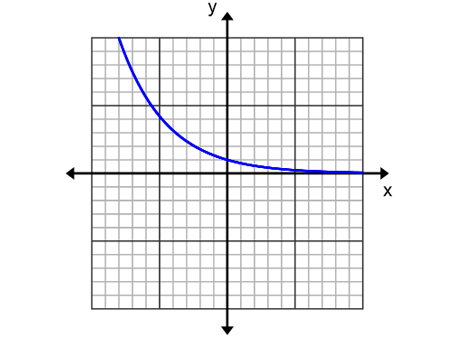
Question image

Is the pictured graph growth, decay, or linear or none?

1

Exponential Growth

2

Exponential Decay

3

Linear

4

None

6

Multiple Choice

Is the function an example of exponential growth or decay?

f(x)=12(6)xf\left(x\right)=\frac{1}{2}\left(6\right)^x  

1

Exponential Growth

2

Exponential Decay

7

Multiple Choice

Is the function an example of exponential growth or decay?

f(x)=7(23)xf\left(x\right)=7\left(\frac{2}{3}\right)^x  

1

Exponential Growth

2

Exponential Decay

8

Multiple Choice

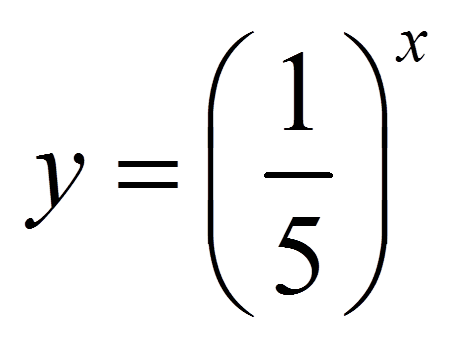
Question image

Is this an example of exponential growth or decay?

1

Exponential Growth

2

Exponential Decay

9

Multiple Choice

Is the function an example of exponential growth or decay?

f(x)=2(54)xf\left(x\right)=2\left(\frac{5}{4}\right)^x  

1

Exponential Growth

2

Exponential Decay

10

Multiple Choice

Pick the equation that is exponential decay

1

f(x)=200(0.88)xf\left(x\right)=200\left(0.88\right)^x

2

g(x)=5(1.88)xg\left(x\right)=5\left(1.88\right)^x

11

Multiple Choice

Pick the equation that is exponential growth

1

f(x )=2(0.5)x

2

g(x) = 0.5(2)x

12

Multiple Choice

What type of function is

f(x)=2(17)xf\left(x\right)=2\left(\frac{1}{7}\right)^x  

1

Exponential Growth

2

Linear

3

Exponential Decay

4

None of the Above

13

Multiple Choice

Question image

Is this exponential growth or decay?

1

Growth

2

Decay

14

Multiple Choice

What is the y-intercept represented by the equation e(x) = 10(5)x

1

(0,5)

2

(5,0)

3

(10,0)

4

(0,10)

15

Multiple Choice

What is the y-intercept represented by the equation

f(x)=3(7)xf\left(x\right)=3\left(7\right)^x  

1

(0,3)

2

(3,0)

3

(7,0)

4

(0,7)

16

Multiple Choice

What is the y-intercept represented by the equation

f(x)=13(2)xf\left(x\right)=\frac{1}{3}\left(2\right)^x  

1

(0,2)

2

(0,1/3)

3

(1/3,0)

4

(2,0)

17

Multiple Choice

What is the y-intercept represented by the equation

g(x)=(4)xg\left(x\right)=\left(4\right)^x  

1

(0,4)

2

(4,0)

3

(0,0)

4

(0,1)

5

(1,0)

18

Multiple Choice

Question image

Is the pictured graph growth, decay, or linear or none?

1

Exponential Growth

2

Exponential Decay

3

Linear

4

None

19

Multiple Choice

Which the following graphs shows an exponential decay equation?

1
2
3
4
pattern-tertiary

Equations of Exponential Functions

Slide image

Show answer

Auto Play

Slide 1 / 19

SLIDE