Search Header Logo
Plate Tectonics Unit Review

Plate Tectonics Unit Review

Assessment

Presentation

Science

8th Grade

Hard

Created by

Joseph Anderson

FREE Resource

10 Slides • 34 Questions

1

Plate Tectonics Review

By : Ms. Bailey*

Slide image

2

Multiple Choice

Who came up with the theory of Pangaea?

1

Werner

2

Wegener

3

Newton

4

Darwin

3

Multiple Choice

This was the supercontinent that existed 500 million years ago

1

Gondwala

2

Pandora

3

Pangaea

4

Panama

4

5

Multiple Choice

Question image

What type of boundary is shown?

1

convergent

2

divergent

3

transform

6

Multiple Choice

Question image

What type of boundary is shown

1

convergent

2

divergent

3

transform

7

Multiple Choice

Question image

What type of plate boundary is shown?

1

convergent

2

divergent

3

transform

8

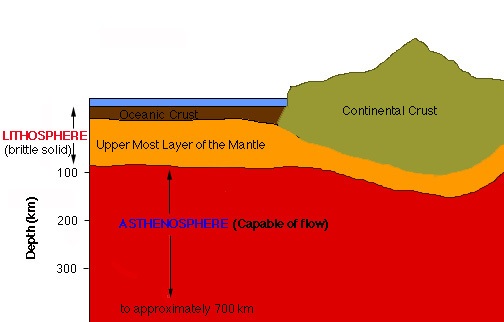
The lithosphere is broken into Tectonic Plates

  • The lithosphere is made from the crust and the uppermost part of the mantle

  • The lithosphere is rigid, brittle rock

  • These plates float on the asthenosphere

Slide image

9

Slide image

10

How do the plates ACTUALLY MOVE?

  • Convection currents in the asthenosphere drive the movement of lithospheric plates

Slide image

11

Slide image

12

How does a convection cell occur?

  • Hot magma in the asthenosphere begins to rise, similar to the way hot air rises.

  • As it rises to the top of the asthenosphere, it cools and becomes more dense.

  • This cooler, dense magma then sinks again. As it sinks, it gets warmer, until the process begins again

  • This movement of magma is what drives the plates to move.

Slide image

13

Multiple Choice

When two plates converge and subduction happens, it tends to form

1

earthquakes

2

volcanoes

3

mountains

4

rift valleys

14

Multiple Choice

An earthquake occurs at a:

1

convergent boundary

2

divergent boundary

3

transform boundary

15

Multiple Choice

Tectonic plates are made of the:

1

lithosphere

2

asthenosphere

3

mesosphere

4

crust

16

Multiple Choice

This causes plate tectonics

1

conduction in the mantle

2

radiation from the Sun

3

convection in the outer core

4

convection in the mantle

17

Multiple Choice

At this type of boundary, plates collide with each other

1

convergent

2

divergent

3

transform

18

Multiple Choice

At this type of boundary, plates slide past each other

1

convergent

2

divergent

3

transform

19

20

Multiple Choice

The San Andreas Fault, where strong earthquakes occur, is an example of a

1

convergent boundary

2

divergent boundary

3

transform boundary

21

Multiple Choice

When one layer of crust (usually oceanic) sinks back into the mantle because of differences in density, it is called:

1

subtraction

2

density

3

volcanoes

4

subduction

22

Multiple Choice

At this type of boundary, plates move away from each other

1

convergent

2

divergent

3

transform

23

Multiple Choice

This tectonic plate slips past each other nor creating or destroying land formations: _____________

1

Divergent boundary

2

Transform boundary

3

Convergent boundary

4

Mid-Ocean boundary

24

Multiple Choice

This tectonic plate boundary creates mountain ranges: ____________________

1

Divergent boundary

2

Convergent boundary

3

Transform boundary

4

Mid-oceanic boundary

25

Multiple Choice

This plate boundary moves land apart, creating an ocean trench or a valley on land : ________________________

1

Divergent boundary

2

Transform boundary

3

Convergent boundary

4

Mid-Ocean voundary

26

Multiple Choice

Oceans plates sink back into the mantle at _______________ zones, keeping the crust the same size.

1

Mid-ocean ridges

2

Ocean trenches

3

Subduction

4

Transforming

27

Multiple Choice

We live closer to the _________________ mid- ocean ridge.

1

Atlantic

2

Pacific

3

North American

4

Californian

28

29

Multiple Choice

Other evidence include __________________ that plate tectonics does occurr in the crust of the Earth.

1

Rock formation, weather, fossils

2

Mountain formation, fossils, climate

3

Land features, fossils, climate

4

Valleys, Ocean trenches, climate

30

Multiple Choice

The evidence is in ______________________, where coastlines and mountain ranges appear to fit together like a puzzle all over the world

1

Continental drift

2

Plate Tectonics

3

The Rock Cycle

4

Divergent boundaries

31

Multiple Choice

Plate Tectonics supports the idea that all continents were once fused together called _____________ .

1

The rock cycle

2

Supercontinent

3

The crust

4

Pangea

32

Multiple Choice

The rock cycle is driven in part by _________________.

1

The Earth's mantle

2

The Earth's core

3

The Earth's tectonic plates

4

The Earth's rock cycle

33

Multiple Choice

The Andes Mountains formed when the Nazca plate and the South American plate:

1

converged

2

diverged

3

transformed

34

Multiple Choice

The San Andreas Fault, where strong earthquakes occur, is an example of a

1

convergent boundary

2

divergent boundary

3

transform boundary

35

Multiple Choice

Question image

What type of boundary is shown

1

convergent

2

divergent

3

transform

36

Multiple Choice

Question image

What type of boundary is shown?

1

convergent

2

divergent

3

transform

37

38

Multiple Choice

What is a smaller earthquake that follows a larger earthquake?
1
Aftershock
2
Liquefaction
3
Seismic Gap
4
Tsunami

39

Multiple Choice

Which is the fastest type of seismic wave?

1

p-waves

2

s-waves

3

surface waves

40

Multiple Choice

The instrument used to record earthquakes is a(n)________.

1

Richter magnitude

2

Modified Mercalli

3

Seismograph

4

Seismogram

41

Multiple Choice

What scale is used to measure the strength of an earthquakes?
1
Modified Mercalli Intensity
2
Gap hypothesis
3
Seismicgraph
4
Richter magitude

42

Multiple Choice

The epicenter of an earthquake is the point on Earth's surface directly below the focus.

1

False

2

True

43

Multiple Choice

Divergent motion is a type of plate motion.
1
True
2
False

44

Multiple Choice

_________ is another word for an earthquake's strength.

1

Intensity

2

Frequency

3

Magnitude

4

Pressure

Plate Tectonics Review

By : Ms. Bailey*

Slide image

Show answer

Auto Play

Slide 1 / 44

SLIDE