

Poetry Lesson: The Rose That Grew from Concrete

Presentation
•
English
•
9th - 10th Grade
•
Hard

Joseph Anderson
FREE Resource
4 Slides • 10 Questions
1

2
Multiple Choice

Directions: For the following questions, choose the best answer or respond in complete sentences.
PART A: Which of the following identifies a main theme of the text?
All living things need support from others in order to grow.
We must learn and grow from our failures.
People can overcome difficulties and succeed.
Nature can overcome problems better than people.
3
Multiple Choice
PART B: Which detail from the poem best supports the answer to Part A?
"Did u hear about the rose that grew" (Lines 1)
"learned 2 walk without having feet" (Lines 3-4)
"Long live the rose that grew from concrete" (Line 7)
"when no one else even cared!" (Line 8)
4
Open Ended
What does the phrase "the rose that grew from concrete" mean figuratively as used in this poem? (Think about the environment in which flowers grow)
5
6
Multiple Choice
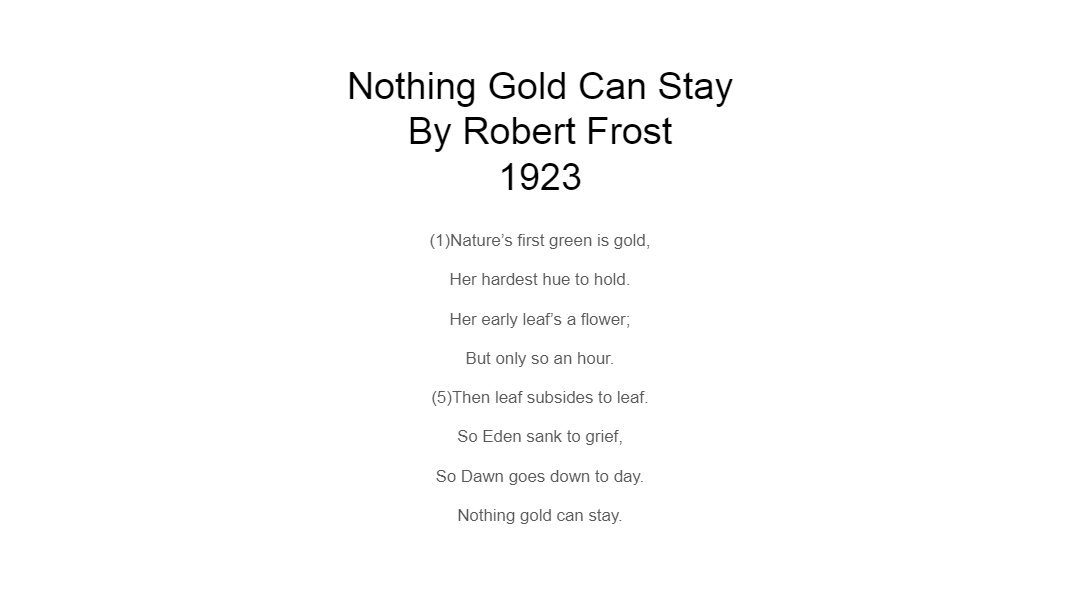
Which of the following best identifies a theme of the poem?
Love is unpredictable and inconsistent.
The most beautiful moments of life are brief.
Perfection and paradise are unattainable.
It is dangerous to forget that we will all die at some point.
7
Multiple Choice
What does the color "gold" most likely represent in the poem?
the speaker's greed
the speaker's dreams
the slow passage of time
the fleeting nature of beauty
8
Open Ended
How do lines 6-7 contribute to the development of the theme that beautiful moments in life are brief?
"So Eden (Garden of Eden) sank to grief,
So Dawn goes down to day." (6-7)
9

10

11
Multiple Choice
PART A: Which of the following identifies the central idea of the text?
Students are more likely to appreciate their accomplishments if they had to struggle to achieve them.
Students who are open about their failures show that they have the ability to grow and be successful in college and beyond.
While educators want to have perfect students on their college campuses, they understand that not all students can achieve perfection.
If students cannot fail gracefully, they will not be able to handle the harsh environment of higher education.
12
Multiple Choice

PART B: Which detail from the text best supports the answer to Part A?
"Even the sacrifice of staying up late to do something unrelated to school, they see as a risk to my academic work and college success." (Paragraph 2)
"When I was traveling in China last fall and asked a student what she did for fun, she replied: 'I thought I wasn't supposed to tell you that?'" (Paragraph 3)
"Students try their best to hide factors they perceive to be negative and only tell us things they believe we will find impressive." (Paragraph 5)
"The ability to bounce back is a fundamental life skill students have to learn on their own. The lessons of failure can't be taught in a classroom; they are experienced and reflected upon." (Paragraph 7)
13
Multiple Choice
PART A: How does the example of the student who failed precalculus in paragraphs 7-8 contribute to the development of ideas in the article?
It gives an example of a student who failed and turned it into a positive experience.
It emphasizes the point that failing is something that all students experience.
It shows how strongly students are affected by perceived failures.
It gives an example of a student who has the perfect college application.
14
Multiple Choice

PART B: Which section from the text best supports the answer to Part A?
"The ability to bounce back is a fundamental life skill students have to learn on their own." (Paragraph 7)
"During my weekend of interviews, another student told me, 'I'm ashamed to admit I failed precalculus'" (Paragraph 7)
"'I realized that I can't let a grade define my success. I also learned that if you want anything bad enough, you can achieve it.'" (Paragraph 7)
"I smiled as I wrote his words down on the application-review form. This kid will thrive on my campus." (Paragraph 8)
Show answer
Auto Play
Slide 1 / 14
SLIDE
Similar Resources on Wayground

9 questions
Appositives and Appositives Phrases
Presentation
•
10th Grade
13 questions
Sentence Structure Lesson
Presentation
•
9th - 10th Grade
10 questions
Personal Narrative
Presentation
•
9th Grade
12 questions
Descriptive Text
Presentation
•
10th Grade
12 questions
Diction
Presentation
•
9th - 11th Grade
11 questions
Narrative Writing
Presentation
•
9th - 10th Grade
8 questions
Bronx Masquerade Anticipation Guide
Presentation
•
9th - 10th Grade
12 questions
Introduction Paragraph - Writing Bootcamp
Presentation
•
9th - 10th Grade
Popular Resources on Wayground
10 questions
GPA Lesson
Presentation
•
9th - 12th Grade
7 questions
Albert Einstein

Quiz
•
3rd Grade
31 questions
Bridge A Review
Quiz
•
3rd Grade
6 questions
Blue Sue and Red Ruth
Quiz
•
3rd Grade
8 questions
(Day12 HW) Inverse Trig Ratios
Quiz
•
9th Grade
20 questions
Summer Geometry QUIZ (Week3)
Quiz
•
9th Grade
16 questions
Theme Practice
Quiz
•
7th Grade
20 questions
Taxes
Quiz
•
9th - 12th Grade
Discover more resources for English
10 questions
GPA Lesson
Presentation
•
9th - 12th Grade
8 questions
(Day12 HW) Inverse Trig Ratios
Quiz
•
9th Grade
20 questions
Summer Geometry QUIZ (Week3)
Quiz
•
9th Grade
20 questions
Taxes
Quiz
•
9th - 12th Grade
16 questions
Warm Up: Basics of Geometry
Quiz
•
9th Grade
16 questions
Translations and Reflections
Quiz
•
9th - 10th Grade
17 questions
High School Survival Guide
Presentation
•
9th - 12th Grade
20 questions
Banking
Quiz
•
9th - 12th Grade