

Precipitation and Temperature

Presentation
•
Science
•
6th Grade
•
Hard

Joseph Anderson
FREE Resource
19 Slides • 17 Questions
1

2

3

4

5
Multiple Choice
What is Temperature?
The clouds when it rains
the long-term weather patterns in an area
How cold something gets
How hot or cold something is
6
Multiple Choice
How do Ocean Currents affect temperature?
The temperature from the currents doesn't affects the air above it which then comes onto the land
The temperature from the currents affects the air above it which then comes onto the land
It makes the weather patterns have high temperatures always
It makes the air extra salty
7
Multiple Choice
8

9

10
Multiple Choice
What is Precipitation?
Latitude and altitude put together
When a convection currents expands
When things from the ocean depressurize
any liquid or frozen water that forms in the atmosphere and falls back to the earth.
11
Multiple Choice
What is wind?
movement of air
movement of water
movement of fire
movement of space
12

13

14

15
Multiple Choice
What are Prevailing Winds?
Winds the only go over the ocean
winds that usually blow in multiple directions
winds that usually blow in one direction
winds that blow longitude
16
Multiple Choice
How do Prevailing Winds affect precipitation
The amount of of water vapor in the air masses influences how much rain or snow might fall.
The amount of hot air in the air masses influences how much rain or snow might fall.
The amount of cold air the air masses influences how much rain or snow might fall.
The amount mild air pressure in the air masses influences how much rain or snow might fall.
17

18

19

20

21
Multiple Choice
What is a Mountain Range?
a series of mountains or hills not connected
a series of mountains or hills arranged in a line and connected by high ground.
a series of mountains or hills not connected underwater
a group of rain clouds connected together
22
Multiple Choice
How do mountain ranges affect precipitation?
Warm moist air will travel be forced to travel up the mountain, rising air cools and condenses, only dry air is on the other side
Warm moist air will travel be forced to travel up the mountain and it will rain on the other side of the mountain
Warm moist air will travel be forced to travel up the mountain and be warm on the other side
Mountain ranges do not affect precipitation
23

24

25

26

27
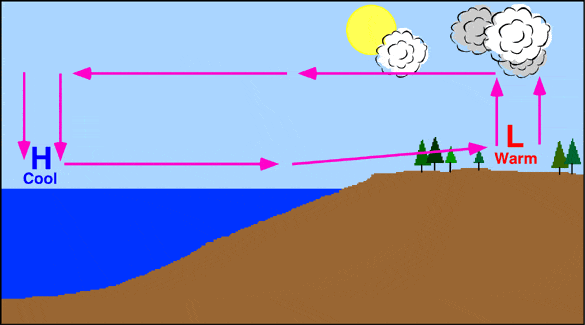
How does sea and land breeze affect precipitation?
"Land and sea breezes help move air and moisture between the ocean and land. Sea breezes can bring rain to coastal areas, while land breezes are usually dry and less likely to cause precipitation."
28
Multiple Choice
What is land breeze?
the wind blows off the water toward the land
the wind blows off the land toward the opposite side of the land
the wind blows off the land toward the water
When the land shakes and makes a breeze
29
Multiple Choice
What is sea breeze?
the wind blows off the land toward the water
The water moves so hard it shakes the land
The wind blows the water towards the water
the wind blows off the water toward the land
30
Multiple Choice
How do land/sea breezes affect precipitation?
It increases or decreases the temperature which causes hurricanes to come and make it rain
It makes clouds not form to make snow
It makes the land breezy and cold
It increases or decreases the temperature which causes clouds and precipitation to form
31
Let's Apply OUr Learning!
32
Multiple Choice
33
Multiple Choice
34
Multiple Select

How does the windward side differ from the leeward side?
A. The windward side receives more precipitation than leeward side.
B. The leeward side has more vegetation than the windward side.
C. The windward side receives more heat than the leeward side.
D. The leeward side receives more precipitation than the windward side.
35
Multiple Choice
Chicago experiences cooler summers and warmer winters than Nebraska because Chicago
is located closer to the equator
is higher in elevation
is closer to a large body of water
has a greater average yearly rainfall
36
Multiple Select
How do you feel about today's lesson
LEVEL 4: I am ready for the test
Level 3: I get it but I need more practice
Level 2: I only understood 50% of what you said. I need help
Level 1: I am so lost!!! I guessed the whole time. PLEASE HELP ME NOW!
Show answer
Auto Play
Slide 1 / 36
SLIDE
Similar Resources on Wayground

27 questions
Ocean Currents and Prevailing Winds
Presentation
•
6th Grade
32 questions
Symbiotic Relationships, Food Webs, & Energy Pyramid
Presentation
•
6th Grade
34 questions
Earth Systems
Presentation
•
6th Grade
34 questions
Balanced and Unbalanced Forces
Presentation
•
6th Grade
32 questions
Module F Unit 1 Lesson 1: Water and Its Properties
Presentation
•
6th Grade
32 questions
Weather Fronts
Presentation
•
6th Grade
33 questions
Cell Structures
Presentation
•
6th Grade
33 questions
Science Tools and Measures
Presentation
•
6th Grade
Popular Resources on Wayground
10 questions
HCS SCI 03 Summer School Assessment 1

Quiz
•
3rd Grade
15 questions
HCS SCI 05 Summer School Assessment 1 Review
Quiz
•
5th Grade
22 questions
Day 9 Equations and Inequalities Review
Quiz
•
9th Grade
10 questions
Writing and Identifying Ratios Practice
Quiz
•
5th - 6th Grade
7 questions
PYRAMID PERSPECTIVES part 1
Presentation
•
9th - 12th Grade
12 questions
Understanding the Fourth of July
Quiz
•
9th Grade
15 questions
Soccer World Cup Quiz Questions
Quiz
•
7th Grade