Sun, Moon, Planets Videos
Presentation
•
Science
•
6th - 8th Grade
•
Hard

Joseph Anderson
FREE Resource
20 Slides • 51 Questions
1
2
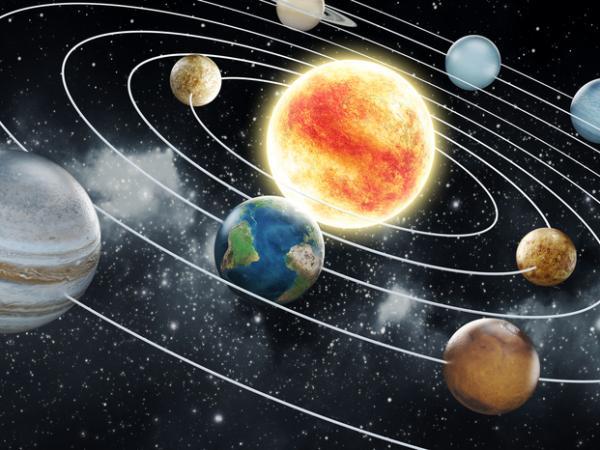
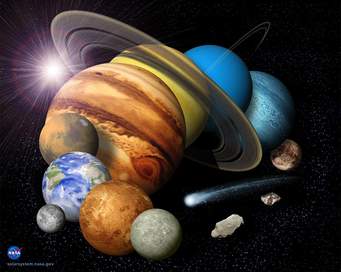
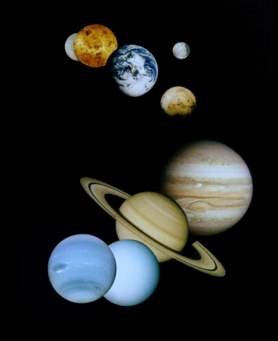
The sun, the planets and their moons, and other objects that move around the sun make up THE SOLAR SYSTEM. The sun is the center of our solar system. All of the objects in the solar system orbit the sun.
There are 8 planets with their moons in our solar system.
3
Multiple Choice
What is the solar system made up of?
Only stars
The sun, planets, and constellations
The sun, planets and their moons, and other objects that move around
4
Multiple Choice
What is at the centre of the solar system?
Mr. Swamy
The Sun
The Earth
The Moon
5
Multiple Choice
All objects in our Solar System orbit the Sun
True
False
6
Multiple Choice
How many planets are there in the solar system?
6
8
10
12
7
My Very Excited Mother Just Served Us Nachos
There are 4 inner planets, and 4 outer planets
8
9
Multiple Choice
What is the third planet of the Solar System?
Mars
Venus
Earth
Saturn
10
The inner planets are Mercury, Venus, Earth, and Mars
These planets are rocky (meaning if you landed, you could stand on the surface - although you may not survive long)
These planets also have very few moons: Mercury and Venus has 0, Earth has 1, Mars has 2
These planets are much smaller than the outer planets
11
The outer planets are Jupiter, Saturn, Uranus, and Neptune
These planets are gas planet (meaning if you landed, you could not stand on the surface)
These planets have A LOT of moons: Jupiter has 53, Saturn has 79, Uranus has 27, Neptune has 14
These planets are much larger than the inner planets
12
Multiple Choice
Which planet is not an inner planet?
Mercury
Venus
Neptune
Earth
13
Multiple Choice
Which planet is the largest? Hint: Think inner vs outer planet.
Mars
Earth
Venus
Saturn
14
Is how long it takes a planet to orbit (make one full circle) around the sun
The further a planet is from the sun, the longer it will take to orbit.
15
16
Multiple Choice
Say you are 60 years old on Earth. If it took Saturn 30 years to orbit the sun, what would your age on Saturn be?
2 years old
30 years old
60 years old
1800 years old
17
You are tiny.
18
PMA Review
19
Multiple Choice
What determines the length of a planet's year?
the time it takes to rotate on its axis
the time it takes to revolve around the
Earth
the time it takes to revolve around the sun
the time it takes to rotate around the sun
20
Multiple Choice
Which planet would most likely have a longer year - the one closer or farther from the sun?
the closer to the sun, the longer the year
the farther away, the longer the year
neither, it depends on the rotation
the distance from the sun would not matter
21
22
23
Multiple Choice
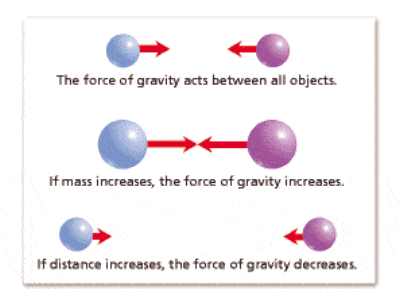
Which model has greater gravitational attraction (if any)
Model A
Model B
Both Model A and Model B (same gravity)
24
Multiple Choice
As mass increases, what happens to gravitational force?
increases
decreases
stays the same
i don't know
25
Multiple Choice
What two things determine the gravity of an object?
mass & weight
mass & distance
density & mass
volume & distance
26
27
28
29
30
Multiple Choice
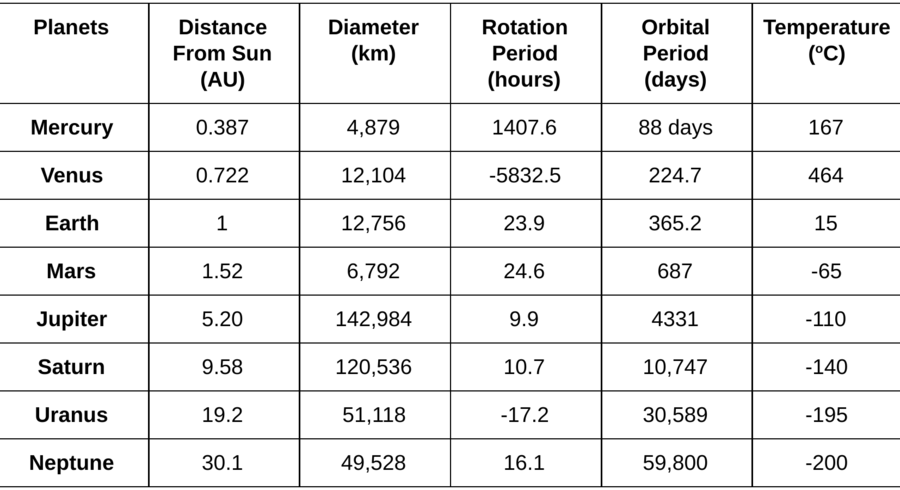
Why is Mercury not the hottest planet when it is the one closest to the sun??
it has a large ozone layer
it has no liquid water
it has hardly any atmosphere to insulate it
it has a very heavy atmosphere
31
Multiple Choice
Which unit of measurement is used to measure distances within our solar system?
inches
kilometers
miles
Astronomical units
32
Multiple Choice
The distance light can travel in one year is ______________
15,000 kilometers
1 light-year
15 Astronomical Units
6,000 miles
33
34
35
36
Multiple Choice
The chart below displays the names of different stars and their colors. Which of the groups below best orders the stars from hottest to coolest?
A. Antares, Spica, Sun, Aldebaran
B. Sun, Spica, Antares, Aldebaran
C. Spica, Sun, Aldebaran, Antares
D. Antares, Aldebaran, Sun, Spica
37
Multiple Choice
38
Multiple Choice
39
Multiple Choice
Stars that are very bright, large & burn at the highest temperature
Blue Giant stars
Red Giant
White dwarves
Proton stars
40
​

41
Multiple Choice
The types of planets are
Rock, liquid and solid
Gas, terrestrial and solid.
Gas, terrestrial and dwarf.
Gas, terrestrial and rock.
42
Multiple Choice
Galaxies are:
gropus of Asteroids
Groups of planets
Groups of stars, gas and dust.
Group of satellites
43
Multiple Choice
44
Multiple Choice
The Universe is a group of:
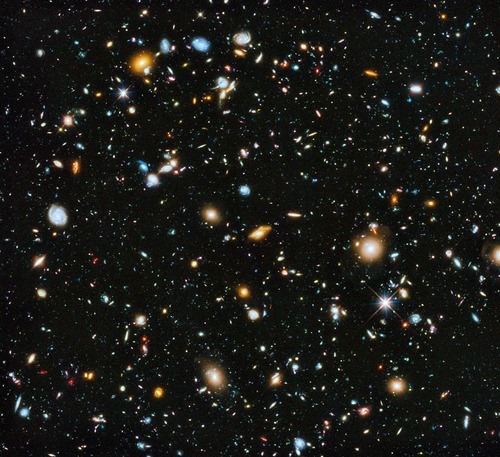
Celest bodies, matter and energy that are in the space.
Gas, dust and millions of stars
A great ball of gas that proyects light.
The MIlky way
45
Multiple Choice
46
Multiple Choice
47
Multiple Choice
What is the Moon?
It is a planet
It is a satellite
It is a star
It is a comet
48
Multiple Choice
49
Multiple Choice
50
Multiple Choice
51
Multiple Choice
52
Multiple Choice
53
Multiple Choice
54
Multiple Choice
55
Multiple Choice
56
Multiple Choice
57
Multiple Choice
58
Multiple Choice
59
Multiple Choice
60
Multiple Choice
61
Multiple Choice
How long does it take the moon to Orbit the Earth?
Less than a month
2 Days
24 Hours
Never
62
Multiple Choice
The earth________ around it's axis (another word for spin)?
Revolves
Jumps
Rotates
Skips
63
Multiple Choice
Which answer only applies to Earth?
Has an atmosphere
Has Rings
Has DRINKABLE water
Is made of rocky surfaces
64
Multiple Choice
The coldest planet is?
Neptune
Earth
Mercury
Jupiter
65
Multiple Choice
The hottest planet is?
Saturn
The Sun
Venus
Mercury
66
Multiple Choice
Earth is colder than Mars.
True
False
67
Multiple Choice
Mercury is the smallest planet in the Solar System.
True
False
68
Multiple Choice
what is the planet ?
Uranus
Venus
Saturn
69
Multiple Choice
What´s the red planet ?
Mars
Saturn
Venus
70
Multiple Choice
What is the planet ?
Mars
Earth
Pluton
71
Multiple Choice
What is the planet ?
Mars
Earth
Pluton
Show answer
Auto Play
Slide 1 / 71
SLIDE

Similar Resources on Wayground
67 questions
Chemical vs Physical Changes
Presentation
•
6th - 8th Grade
64 questions
Surface Water
Presentation
•
6th - 8th Grade
64 questions
Climate Change and Ocean Currents
Presentation
•
6th - 8th Grade
63 questions
7TH -The Digestive System 5.1
Presentation
•
6th - 8th Grade
64 questions
Energy Transfer
Presentation
•
6th - 9th Grade
64 questions
Operations with scientific notation
Presentation
•
6th - 8th Grade
61 questions
Rock Cycle (lesson)
Presentation
•
6th - 8th Grade
66 questions
Lab Safety and Procedures
Presentation
•
6th - 8th Grade
Popular Resources on Wayground
10 questions
Safety Day 2026 – Student Review
Quiz
•
9th Grade
21 questions
Continents and Oceans
Quiz
•
6th Grade
20 questions
Parts of Speech
Quiz
•
5th Grade
16 questions
Subject & Predicate
Quiz
•
5th Grade
25 questions
Multiplication Facts
Quiz
•
5th Grade
12 questions
Map Skills
Quiz
•
3rd Grade
22 questions
Continents and Oceans
Quiz
•
5th Grade
15 questions
Rounding Decimals
Quiz
•
5th Grade
Discover more resources for Science
20 questions
Newton's Laws of Motion
Quiz
•
8th Grade
20 questions
Elements, compounds, and mixtures
Quiz
•
6th Grade
10 questions
6.6D - Relative Density Review
Quiz
•
6th Grade
15 questions
potential and kinetic energy
Quiz
•
8th Grade
21 questions
Newton's Laws of Motion
Quiz
•
8th Grade
20 questions
Elements, Compounds and Mixtures
Quiz
•
8th Grade
10 questions
Exploring Chemical and Physical Changes
Interactive video
•
6th - 10th Grade
20 questions
CONDUCTION,CONVECTION AND RADIATION
Quiz
•
6th Grade