
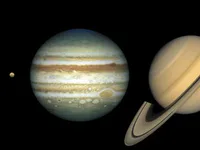
Terrestrial and Gaseous Planets

Presentation
•
Science
•
2nd Grade
•
Hard

Joseph Anderson
FREE Resource
11 Slides • 5 Questions
1
Embark on a journey to discover the awe-inspiring wonders of our solar system. From the majestic rings of Saturn to the fiery volcanoes of Venus, explore the mysteries and beauty of our neighboring planets. Join us on this extraordinary adventure!
2
Introduction to Planets
3
Multiple Choice
What are the two main types of planets?
Rocky and Gas
Terrestrial and Gas Giants
Solid and Composed
Hydrogen and Helium
4
Types of Planets
Trivia: Did you know that there are two main types of planets in our solar system? They are called Terrestrial and Gas Giants. Terrestrial planets, like Earth, are rocky and have a solid surface. Gas Giants, like Jupiter, are mostly made up of gases like hydrogen and helium.
5
Exploring Inner Planets
6
Multiple Choice
Which planet is known as the 'Red planet' and has the potential for life?
Mercury
Venus
Earth
Mars
7
The Red Planet: Mars
Mars is known as the 'Red planet' due to its rusty surface. It is the fourth planet from the Sun and has the potential for life. Scientists have found evidence of water on Mars, making it a possible candidate for future human colonization. Curiosity, a rover sent by NASA, has been exploring the planet since 2012.
8
Earth: Our Home Planet
9
Multiple Choice
What percentage of Earth's surface is covered by oceans?
50%
60%
71%
80%
10
Oceans Cover 71%
Did you know? The Earth's surface is mostly covered by water, with oceans accounting for approximately 71% of the total surface area. That's a lot of water! It's no wonder why Earth is often referred to as the 'Blue Planet'. Protecting our oceans is crucial for the health of our planet and all its inhabitants.
11
Exploring Outer Planets
12
Multiple Choice
Which planet is known for its unique blue-green color?
Jupiter
Saturn
Uranus
Neptune
13
Uranus: The Blue-Green Planet
Did you know? Uranus gets its unique blue-green color from the presence of methane gas in its atmosphere. It is the seventh planet from the Sun and is known for its extreme tilt, causing it to rotate on its side. Uranus was discovered by William Herschel in 1781. Fun fact: Uranus has 27 known moons!
14
Jupiter: The Giant
15
Multiple Choice
Which planet is the largest in our solar system?
Mars
Venus
Saturn
Jupiter
16
Jupiter: The Largest Planet
Jupiter is the largest planet in our solar system. It is so massive that it could fit all the other planets combined inside it. Jupiter is known for its iconic Great Red Spot, a giant storm that has been raging for centuries. It also has more than 75 moons, including four large ones called the Galilean moons.
Embark on a journey to discover the awe-inspiring wonders of our solar system. From the majestic rings of Saturn to the fiery volcanoes of Venus, explore the mysteries and beauty of our neighboring planets. Join us on this extraordinary adventure!
Show answer
Auto Play
Slide 1 / 16
SLIDE
Similar Resources on Wayground

12 questions
Helping verbs-is,am,are,was were
Presentation
•
2nd Grade
12 questions
Punctuations _Grade 2
Presentation
•
2nd Grade
12 questions
الإيمان بالرسل: سيدنا نوح عليه السلام
Presentation
•
2nd Grade
11 questions
magnets
Presentation
•
2nd Grade
12 questions
Comparing Insect Life Cycles
Presentation
•
2nd Grade
12 questions
the moon
Presentation
•
1st - 2nd Grade
11 questions
present perfect
Presentation
•
2nd Grade
11 questions
Life Cycle of a Butterfly
Presentation
•
2nd Grade
Popular Resources on Wayground
10 questions
Safety Day 2026 – Student Review

Quiz
•
9th Grade
21 questions
Continents and Oceans
Quiz
•
6th Grade
20 questions
Parts of Speech
Quiz
•
5th Grade
16 questions
Subject & Predicate
Quiz
•
5th Grade
25 questions
Multiplication Facts
Quiz
•
5th Grade
12 questions
Map Skills
Quiz
•
3rd Grade
22 questions
Continents and Oceans
Quiz
•
5th Grade
15 questions
Rounding Decimals
Quiz
•
5th Grade
Discover more resources for Science
10 questions
Severe Weather Around Us
Quiz
•
2nd Grade
4 questions
K-2 Force and Motion Lesson
Presentation
•
KG - 2nd Grade
10 questions
Weather Data: Measure and Graph
Quiz
•
2nd Grade
10 questions
Identifying Physical and Chemical Changes

Interactive video
•
1st - 5th Grade
5 questions
All About Maps
Presentation
•
1st - 5th Grade
15 questions
Force and Motion Review
Quiz
•
2nd Grade
10 questions
Exploring the Conservation of Mass in Everyday Life
Interactive video
•
1st - 5th Grade
8 questions
Water Cycle
Presentation
•
1st - 5th Grade