Search Header Logo
Wave Properties Lesson

Wave Properties Lesson

Assessment

Presentation

Physics

12th Grade

Hard

Created by

Joseph Anderson

FREE Resource

14 Slides • 16 Questions

1

T3L1- Properties of Waves

by PAE 4

2

media

​Recap: The parts of a wave

3

Multiple Choice

Question image

Name the missing part of the wave

1

Amplitude

2

Wavelength

4

Multiple Choice

Question image

Name the missing part of the wave ....?

1

Wavelength

2

Amplitude

5

media
media
media

​The wavelength is the length of a complete wave cycle. Here it is the distance between the crests.

​The period ,(T) is the time it takes to complete one wavelength.

​Can you measure the period here? What's the best way?

6

media
media

​Here are two types of waves... can you remember what they are called?

7

Multiple Choice

Question image

This type of wave is called a...

1

Longitudinal wave, because it's particle motion is parallel to direction of wave travel

2

Transverse wave, because it's particle motion is perpendicular to the direction of wave travel

8

Multiple Choice

Question image

This type of wave is called a...

1

Longitudinal wave, because it's particle motion is parallel to direction of wave travel

2

Transverse wave, because it's particle motion is perpendicular to the direction of wave travel

9

Frequency is a measure of how often something happens in a given time period.

​For example, if you go shopping every Monday. Your frequency of shopping is once per week.

​If you go shopping every Monday and Friday, then your frequency is twice per week.

​Let's talk about frequency...

media

10

​A wave's frequency (f) is the amount of wavelengths that pass a point in a certain amount of time.

​It is most often represented in units of 'per second' or '1/second' or Hertz (Hz)

media

​So, if 1 complete wavelength passes a point at every second, its frequency is '1 per second' or '1 Hertz'.

​And if 320 wavelengths pass a point at every second, its frequency is 320 Hz.

11

​A wave's frequency (f) is the amount of wavelengths (λ) that pass a point in a certain amount of time.

​It is most often represented in units of 'per second' or '1/second' or Hertz (Hz)

​So, if 1 complete wavelength passes a point at every second, its frequency is '1 per second' or '1 Hertz'.

​And if 320 wavelengths pass a point at every second, its frequency is 320 Hz.

media

12

Multiple Choice

Question image

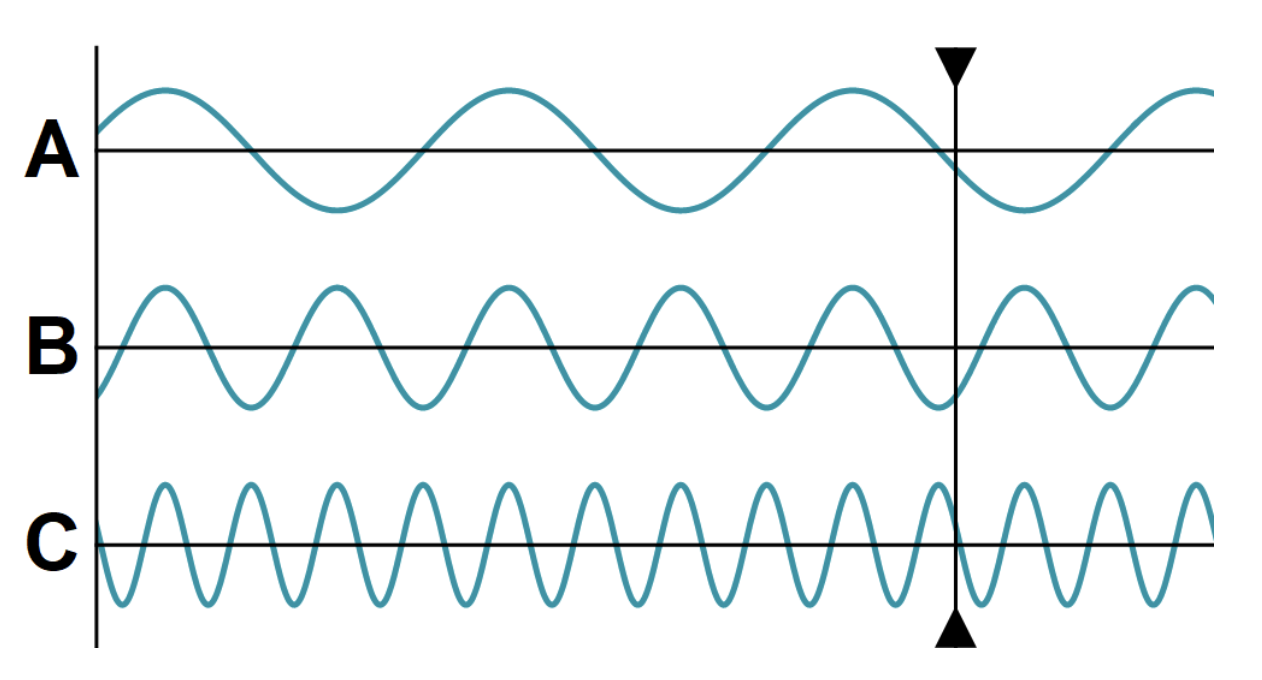
Which of the following travelling waves has a higher frequency?

1

A

2

B

3

C

13

​There is an important relationship between, speed, wavelength and frequency.

media
media

​Suppose that the 2 lanes above are moving with the same velocity. Will there be more cars or trucks passing the arrow after a given amount of time?

14

media

​Like the cars and trucks, these waves are propagating at the same speed.

​What can you conclude about the relationship between wavelength, λ and frequency­, f ?

15

Multiple Choice

Question image

What can you conclude about the relationship between wavelength and frequency by observing them?

1

Wavelength and frequency are unrelated

2

When wavelength increases, the frequency decreases.

3

When wavelength increases, the frequency also increases.

16

​The speed that a wave propagates is called the wave speed, v

​Wave speed

​How could we represent the wave speed using wavelength λ and period T?

17

Multiple Choice

Question image

​How could we represent the wave speed using wavelength λ and period T?

1

v=λTv=\frac{\lambda}{T}  

2

v=Tλv=\frac{T}{\lambda}  

3

v=λTv=\lambda\cdot T  

18

​So, now... we know that wave speed is:

​From the previous slides, we also know that frequency f is the number of waves that pass a point per unit time. And that it is represented by '1/sec' or Hz.

​But now, if instead of seconds, we replaced the time with the period T, the frequency f becomes...

​Now we can replace the period T in the formula for wave speed with frequency f ...

19

​That's a wrap...

20

media

​Use the following image to answer questions 3-6

21

Multiple Choice

Question image

What is labeled "A" in Gabriella's model?

1

Amplitude

2

Crest

3

Trough

4

Wavelength

22

Multiple Choice

Question image

What is labeled "B" in Gabriella's model?

1

Amplitude

2

Wavelength

3

Trough

4

Crest

23

Multiple Choice

Question image

What is labeled "C" in Gabriella's model?

1

Amplitude

2

Wavelength

3

Trough

4

Crest

24

Multiple Choice

Question image

What is labeled "D" in Gabriella's model?

1

Amplitude

2

Wavelength

3

Trough

4

Crest

25

Multiple Choice

When modeling waves, a transverse wave moves______ to the particle motion. A longitudinal wave moves in the same direction as the particle in motion

1

parallel

2

perpendicular 

26

Multiple Choice

When modeling waves, a transverse wave moves perpendicular to the particle motion. A _____ wave moves in the same direction as the particle in motion

1

taller

2

longitudinal

27

media

​Use the following chart to answer questions 10-15

28

Multiple Choice

Question image

Armando used yarn to create waves on sheets of graph paper. He recorded his wave data in the table.

Which heading in the table describes wavelength?

1

Wave

2

Number of crests

3

distance between crests

4

height of crests

29

Multiple Choice

Question image

The height of the crest represents the____ of a wave. Based on the evidence in the table, the height of the wave is not dependent on the frequency 

1

frequency

2

wavelength

3

amplitude

30

Multiple Choice

Question image

The height of the crest represents the amplitude  of a wave. Based on the evidence in the table, the height of the wave is not dependent on the ____.

1

wave speed

2

frequency

T3L1- Properties of Waves

by PAE 4

Show answer

Auto Play

Slide 1 / 30

SLIDE