

Mutations Review & Mendelian Genetics

Presentation
•
Biology
•
10th Grade
•
Easy
Standards-aligned

TalaShandria Allen
Used 8+ times
FREE Resource
25 Slides • 28 Questions
1
&
Mendelian genetics
By TalaShandria Allen


2
Constructed response
Write the following question (on the next slide) and your response on your constructed response sheet. You will have 3 min to complete this task. After 3 minutes, we will have 1:30 minutes to share with our table. Be sure to pick a spokesperson for your group.
3
Constructed response questions
What is the difference between a chromosomal mutation and a point (gene) mutation. Which point(gene) mutation is the most lethal and why?
4
Lets see what you remember from our previous lesson. All questions are timed so be sure to lock in your answers. All mutation notes should be put away.
5
SWBAT:
identify and describe the different gene and chromosome mutations through analyzing diagrams and scenarios.
use codon charts/wheels to transcribe and translate gene sequences in order to analyze the effect the mutation has on the amino acid sequence.
6
Multiple Choice
A mutation is defined as:
A change in the cell's structure
Anything that changes in an embryo
Any change in the physical features of a human
A change in the DNA sequence
7
Match
Match the chromosome mutation with its picture
answer option
Deletion
Duplication
Translocation
Inversion
Deletion
Duplication
Translocation
Inversion
8
Multiple Choice
Which mutation would be more harmful for an organism?
Point mutation (substitution)
Frameshift (insertion/Deletion)
9
Multiple Choice
Why would a frameshift be more harmful?
It changes all the code downstream
Only one nucleotide is changing
All mutations are harmful
It can't correct iself
10
Multiple Choice
THE BIG FAT RED CAT SAT is normal, what is this:
THE BIG FAT RED ATS AT
Substitution
Insertion
Deletion
11
Multiple Choice
What mutation has occurred here?
T-G-A-C-C-A
T-G-A-G-C-A
Substitution
Deletion
Insertion
Frameshift
12
Multiple Choice

Which mutation will cause translation to stop?
Mutations 1 and 3 only
Mutation 1 only
Mutation 2 only
Muations 1, 2, 3
13
ON CANVAS, YOU HAVE A REINFORCEMENT HOMEWORK ASSIGNMENT ON QUIZIZZ OVER PROTEIN SYNTHESIS & MUTATIONS. BE SURE TO GET IT COMPLETED.
END OF Review LESSON
14
COMPLETE DOMINANCE
15
For this lesson you will need:
Note-taking handout
Highlighters/color pens, etc
Pencil/pen
Laptop
16
SWBAT:
identify and define the terms associated with understanding and completing monohybrid crosses for complete dominance inheritance patterns in Mendelian Genetics
predict possible outcomes of various genetic combinations using monohybrid crosses using Mendelian Genetics complete dominance inheritance patterns.
17
ENGAGE: CONSTRUCTED RESPONSE
Write the following question (on the next slide) and your response on your constructed response sheet. You will have 3 min to complete this task. After 3 minutes, we will have 1:30 minutes to share with our table. Be sure to pick a spokesperson for your group.
18
ENGAGE: CONSTRUCTED RESPONSE QUESTION
What are genes and how do we get them? Our genes are expressed as which major biomolecule?
19
DNA is the molecule that carries instructions for life, genes are specific sections of DNA that determine traits, and chromosomes are structures made of DNA that hold many genes and help organize them in cells.
Genes, DNA, & The Chromosome


20
known as Father of Genetics
studied thousands of pea plants and came up with the basic ideas of simple genetics (simple dominance and simple recessiveness)
His experiments led him to conclude that each trait was controlled by two factors
Concluded that traits were only either dominant or recessive and that there was no blending of traits-complete dominance
What is Genetics?
Genetics is the study of heredity, which is the passing of traits from one generation to another: from parents to offspring
21
Turn to the person next you and explain what is genetics and the difference between DNA, genes, and chromosomes.
Turn & Talk
You have 1:30 minutes. If you have a table of 3, you will talk as a table.
22
Alleles are different possibilities forms for a given trait.
Every trait has two alleles. One from mother and one from father.
Ex: B, b, T, t, R, r -alleles for traits are represented by letters.
Alleles?
Traits are specific characteristics that varies from one individual to another.
Blue eyes
Brown hair
Tall
Traits?
23
The trait that is hidden. An organism with a recessive allele combination will only exhibit that trait when the dominant allele isn't present.
Represented by a lowercase letter " r "
Recessive
The trait that can be seen due to the gene being expressed the most
Alleles are represented by a capital letter "R"
Dominant
*Letters are chosen based on the Dominant trait and the letter it starts with.
24
Match
Match the following terms.
Trait that can always be seen and is expressed the most
Trait that is masked by a dominant trait
Specific characteristics
Different forms of a gene
Dominant trait
Recessive trait
Traits
Allele
Dominant trait
Recessive trait
Traits
Allele
25
Match
Match the terms to the correct example.
Dominant
Recessive
Alleles
T
t
B,b,T,R,r,E,e
T
t
B,b,T,R,r,E,e
26
Open Ended
If you are solving genetics problems, you must assign letters to represent the alleles for the traits. If you are working with eye color and Brown is dominant and blue is recessive, what will the letter be to represent the dominant and recessive alleles?
27
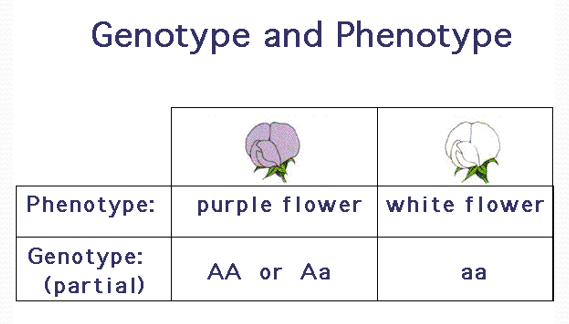
vs
Phenotypes
Genotype: The genetic makeup of an organism. The gene (or allele) combination an organism has.
Examples: Tt, SS, Bb, aa
Phenotype: The physical characteristics of an organism
Examples: Tall or short, Straight hair or wavy hair...
28
Homozygous - Term used to refer to an organism that has two IDENTICAL alleles for a particular trait. Considered as purebred! EXAMPLE: TT or tt
HOMOZYGOUS Dominant- TT
HOMOZYGOUS Recessive- tt
Heterozygous - Term used to refer to an organism that has two DIFFERENT alleles for a particular trait. Considered as hybrids or carriers.
EXAMPLE: Tt
29
Multiple Choice
Identify the homozygous dominant genotype:
FF
Ff
ff
30
Multiple Choice
Which of these is homozygous recessive?
Rr
RR
Ba
bb
31
Multiple Choice

An organism's physical appearance or visible traits. (what it looks like)
phenotype
genotype
32
Multiple Choice
An organism's allele combination for its traits.
phenotype
genotype
33
Multiple Choice
In pea plants, the tall allele is dominant to the short allele. What key would demonstrate this?
Tall = T
Short = S
Tall = t
Short = T
Tall = T
Short = t
Tall = TT
Short = tt
34
Now that we have learned Learning Objective 1:
identify and define the terms associated with understanding and completing monohybrid crosses for complete dominance inheritance patterns in Mendelian Genetics..........
Now it's time for us to move on to Learning Objective 2:
predict possible outcomes of various genetic combinations using monohybrid crosses using Mendelian Genetics complete dominance inheritance patterns.
35

36

Think-Pair-Share
On your note-taking sheet, you will have a 1:30 minutes to write down the things you notice about this Punnett Square. Then you will have 1:30 minutes to pair up with the person next to you and share. If you have a table of 3, you will be a trio.
37

38

Genotypic Ratios are always written in the following order:
# Homozygous Dom : #Heterozygous : # Homozygous Recessive
Phenotypic Ratios are always written in the following order:
# Dominant appearance : # Recessive appearance
Sometimes it can be written as a percentage or fraction. Example: 1/4 or 25% 1/2 or 50% Each box is 25%.
39

Look at the following example. Notice how the ratios are written.
40
Multiple Choice
In a certain species of plant, the color purple (P) is dominant to the color white (p). One parent is heterozygous dominant and the other parent is homozygous dominant.
What is the probability of an offspring being white?
41
Multiple Choice
In a certain species of plant, the color purple (P) is dominant to the color white (p). One parent is heterozygous dominant and the other parent is homozygous dominant.
What is the genotypic ratio?
2:2:0
2:0:1
1:2:1
42
Multiple Choice
In a certain species of plant, the color purple (P) is dominant to the color white (p). One parent is heterozygous dominant and the other parent is homozygous recessive.
What is the probability of an offspring being purple?
43
Multiple Select
In a certain species of plant, the color purple (P) is dominant to the color white (p). One parent is heterozygous dominant and the other parent is homozygous recessive.
What is the phenotypic ratio?
2:2
3:1
1:1
2:1
44
Multiple Choice

What allele combination should go in the missing box?
aa
AA
Aa
None
45
Multiple Choice

What is the phenotype of the offspring? (A-Brown hair; a-blond hair)
50 % Brown Hair and 50% Blond Hair
75 % Brown Hair and 25% Blond Hair
25 % Brown Hair and 75% Blond Hair
0% Brown Hair and 100% Blond Hair
46
Multiple Choice
Which of the following genotypes is heterozygous?
GG
hh
T
Aa
47
Match
Match the following.
genes are the same
genes are different
T - tall
t - short
the study of heredity
homozygous
heterozygous
dominant allele
recessive allele
genetics
homozygous
heterozygous
dominant allele
recessive allele
genetics
48
Match
homozygous dominant genes
heterozygous dominant genes
homozygous recessive genes
genetic material of an orgnism (DNA)
physical characteristics of an organism
AA
Hh
bb
genotype
phenotype
AA
Hh
bb
genotype
phenotype
49
Multiple Choice

In the punnett square below, what belongs in the missing square
50
Multiple Choice

51
Multiple Choice

What is the genotypic ratio represented by the punnett square?
1:1
3:1
1:3
1:2:1
52
Multiple Choice

53
PUT AWAY ALL NOTES AND PREPARE FOR YOUR DOL. NO OTHER TABS SHOULD BE OPEN ON YOUR LAPTOP. THE JOIN CODE WILL BE DISPLAYED AT THE END OF THE TIMER.
END OF LESSON
&
Mendelian genetics
By TalaShandria Allen
Show answer
Auto Play
Slide 1 / 53
SLIDE
Similar Resources on Wayground

45 questions
Unit 2 Exam Review
Presentation
•
10th Grade
48 questions
Earth's layers & Continental Drift
Presentation
•
9th - 10th Grade
47 questions
Mutations
Presentation
•
9th - 10th Grade
47 questions
The Body's Support and Control Systems
Presentation
•
10th Grade
51 questions
willowridge. Photosynthesis. Energy Conversion.
Presentation
•
9th - 10th Grade
45 questions
Commonly Confused Words
Presentation
•
10th - 11th Grade
46 questions
Exploring Angle Pairs
Presentation
•
10th Grade
50 questions
Unit 9- Lesson 1
Presentation
•
10th Grade
Popular Resources on Wayground
10 questions
How much do you know about our Portrait of an Eagle?

Quiz
•
10th Grade
10 questions
Fast Food Slogans
Quiz
•
6th - 8th Grade
21 questions
Continents and Oceans
Quiz
•
6th Grade
20 questions
Parts of Speech
Quiz
•
5th Grade
16 questions
Subject & Predicate
Quiz
•
5th Grade
25 questions
Multiplication Facts
Quiz
•
5th Grade
12 questions
Map Skills
Quiz
•
3rd Grade
22 questions
Continents and Oceans
Quiz
•
5th Grade
Discover more resources for Biology
20 questions
Characteristics of Life
Quiz
•
9th - 10th Grade
10 questions
Exploring the 4 Major Macromolecules and Their Functions

Interactive video
•
9th - 12th Grade
20 questions
Cell organelles and functions
Quiz
•
10th Grade
20 questions
Cell Transport
Quiz
•
9th - 12th Grade
20 questions
Macromolecules
Quiz
•
10th Grade
16 questions
Population Ecology
Quiz
•
9th - 12th Grade
16 questions
AP Biology: Unit 1 Review (CED)
Quiz
•
9th - 12th Grade
10 questions
Quick 10Q: Carbohydrates
Quiz
•
9th - 12th Grade