Search Header Logo
Earthquakes Quick Notes Lesson 2025

Earthquakes Quick Notes Lesson 2025

Assessment

Presentation

•

Science

•

6th - 8th Grade

•

Medium

•
NGSS
MS-ESS3-2, MS-PS4-1, MS-ESS2-2

+2

Standards-aligned

Created by

Kwinsi Bridges

Used 6+ times

FREE Resource

21 Slides • 20 Questions

1

media

2

Multiple Choice

How do volcanoes start earthquakes?

1

Volcanoes start earthquakes by releasing gas into the atmosphere from the crater.

2

Volcanoes cause earthquakes by cooling lava rapidly as it leaves the crater.

3
Volcanoes trigger earthquakes by creating tsunamis in nearby oceans.
4

Volcanoes cause pressure in surrounding rocks due to rising magma.

3

Multiple Choice

lEarthquakes are randomly distributed over the globe.

1

True

2

False

4

Multiple Choice

What is the name of Mississippi's fault line?

1
New Madrid Fault Line
2
Charleston Fault Line
3
Hayward Fault Line
4
San Andreas Fault Line

5

Fill in the Blank

______ causes the plates to get stuck, building ________ and when the pressure if ________, an earthquake occurs.

,
,

6

Match

Match the defintions with the terms.

The plate that doesn’t move during an Earthquake.

The plate that moves during an Earthquake.

The area along the break between two plates occurs.

It is in the surface of the Earth caused by the fault plane.

Foot Wall

Hanging Wall

Fault plane

Fault line

7

media

8

media

9

media

10

media

11

media

12

media

13

Match

Match the following

Normal Fault

Reverse Fault

Strike-slip Fault

hanging wall moves down

hanging wall moves up

blocks move opposite of one another

14

Match

Match the following:

Normal Fault

Reverse (thrust) Fault

Strike-Slip Fault

15

media

16

media

17

media

18

media

19

media

20

media

21

media

22

Multiple Choice

Which type of wave arrives first during an earthquake?
1

Primary (p-wave) waves

2

Secondary (s-wave) waves

3

Surface Waves

23

Multiple Choice

Question image

Which Seismic Wave is pictured?

1

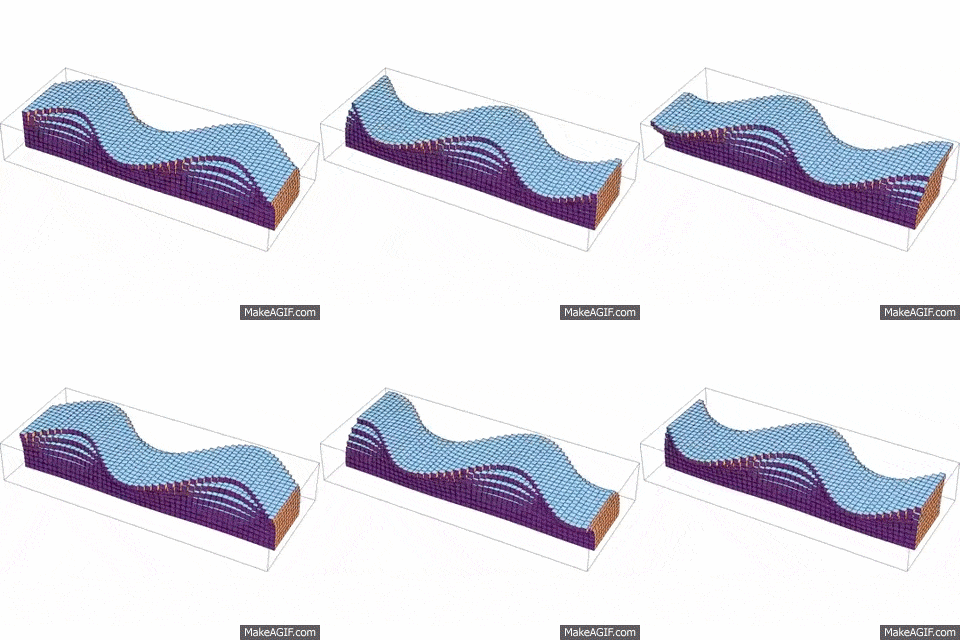
P-Wave

2

S-Wave

3

Surface Wave

24

Multiple Choice

Question image

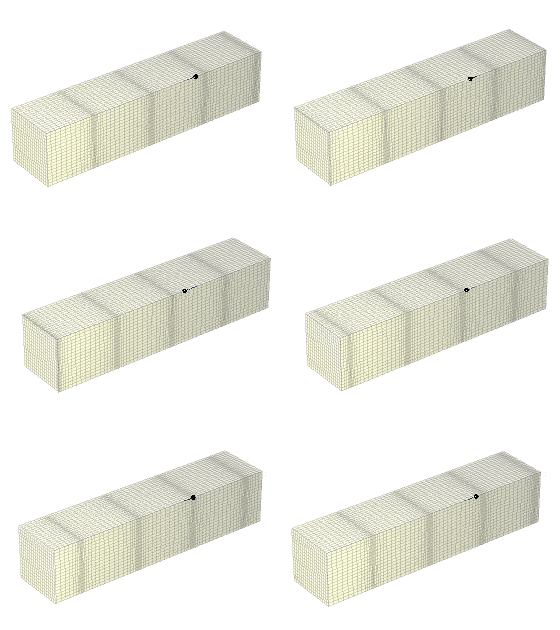
Which type of Seismic Wave is pictured?

1

P-Wave

2

S-Wave

3

Surface Wave

25

Multiple Choice

Which is the location of an earthquake ON EARTH'S SURFACE?

1

Landslide

2

Seismic

3

Epicenter

4

Focus

26

Multiple Choice

Question image

Which of the following statement correctly identifies the focus and epicenter of an earthquake in the given illustration?

1

Point A is the focus and Point B is the epicenter.

2

Point A is the epicenter and Point C is the focus

3

Point A is the epicenter and Point B is the focus.

4

Point A is the focus and Point C is the epicenter.

27

Match

Question image

Match the following.

Focus

Epicenter

Wave

Energy starts here.

Energy ends here.

Transfers the energy.

28

media

29

media

30

media

31

media

32

media

33

Multiple Choice

Describe the moment magnitude scale, and explain why it is useful in measuring earthquakes.
1
It measures nearby earthquakes.
2
It measures earthquakes total energy of earthquakes near or far
3
It tells us how dangerous an earthquake was
4
It measures the size of the largest wave.

34

Multiple Choice

Question image

Which seismogram represents a city that is far from the epicenter of an earthquake?

1

New York, NY

2

Nome, Alaska

3

Guadalajara, Mexico

35

Multiple Choice

Earthquake A has a magnitude of 5.4 on the Richter scale.

Earthquake B is 10 times as powerful as Earthquake A.

What is the magnitude of Earthquake B?

1

54

2

15.4

3

5.5

4

6.4

36

media

37

Multiple Choice

Question image
These seismic waves are slower and arrive last but causes severe damage:
1
p-waves
2
s-waves
3
surface waves
4
z-waves

38

media

39

Multiple Choice

How are tsunamis generated according to the lesson?

1

By strong winds over the ocean

2

When earthquakes under the ocean floor displace the ocean floor rock and then displace the water on top

3

By sudden changes in atmospheric pressure

4

By volcanic eruptions under the sea

40

Multiple Choice

What process occurs when an earthquake's shaking turns loose soil into mud?
1
aftershocks
2
tsunamis
3
liquefaction
4
deformation

41

Match

Match the type of earthquake damage to its description.

Shaking

Liquefaction

Aftershocks

Tsunamis

Vibrations caused by seismic waves

Soil losing strength and behaving like a liquid

Secondary tremors following the main shock

Large ocean waves caused by underwater earthquakes

media

Show answer

Auto Play

Slide 1 / 41

SLIDE