

4.2.5 Specialization

Presentation
•
Social Studies
•
4th Grade
•
Practice Problem
•
Medium

Sierra Scaggs
Used 1+ times
FREE Resource
6 Slides • 3 Questions
1
Specialization
Learners can:
identify at least two benefits of specialization and division of labor
Vocabulary: specialization-special skills needed to do a job
labor-to work
People and businesses work together.
People in the community depend on businesses to provide jobs for them.
Businesses depend on people to work for them and to buy their products or services.
Communities have many types of businesses, including grocery stores, factories, offices, and restaurants.
When Milo is older, he wants to be a veterinarian.
He wants to help the animals in his community.
2
Industrialization
In the past, many items were made by hand and took a long time. Today, because of industrialization, products are made faster and in larger quantities. Industrialization is the process of manufacturing goods in factories.
In the United States, industrialization began during the Industrial Revolution.
The Industrial Revolution was a period when economies changed from buying and selling handcrafted items to machine-made products.
It began in England in the mid-1700s. By the early 1900s, the United States was the world's leading industrial nation.
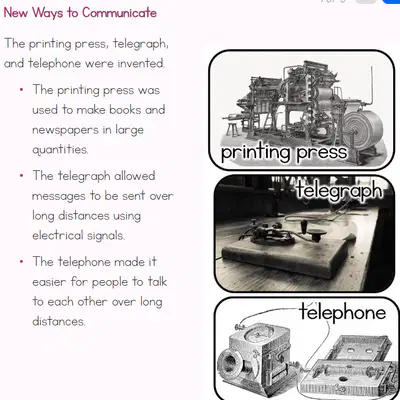
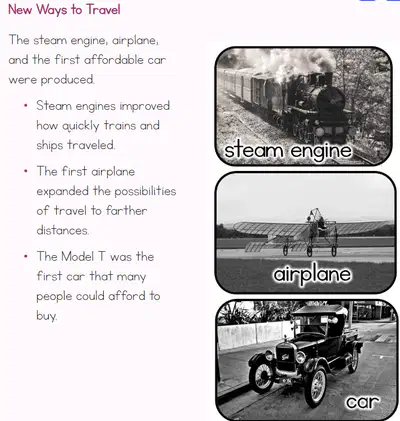
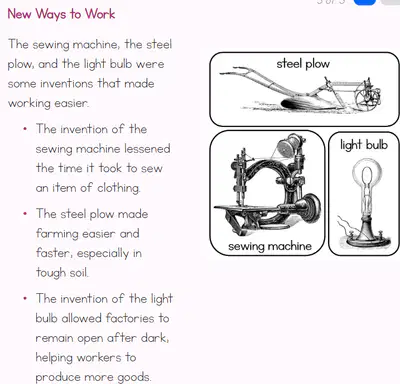
Major changes during the Industrial Revolution included new or improved ways to: communicate; travel; and work.
3
The new inventions of the Industrial Revolution changed how goods were produced. Many factories were built in cities, encouraging people to move to cities in search of jobs. This growth of cities changed the way people lived, worked, and interacted.
The Industrial Revolution also led to the globalization of trade, as new transportation systems like railroads and steamships made it easier to move goods across long distances. The Industrial Revolution brought major changes to the economy. The invention of new machines allowed goods to be produced faster and in larger quantities.
Factories
As industrialization spread, many factories began making products using identical parts in an assembly line.
An assembly line is an arrangement of machines, tools, and workers in which a product is assembled by each performing a specific job.
When a worker has a specific task that requires special skills to complete the job, it is called specialization.
Henry Ford was an American inventor best known for founding the Ford Motor Company.
He is known for using assembly lines to mass-produce cars.
Assembly lines in factories are one of the first examples of specialization in America.
To make goods, factories rely on specialization in an assembly line to distribute tasks and quickly produce goods.
In an assembly line, workers are assigned to perform a specific, repetitive task as part of a larger production process.
Specialization allows workers to focus on specific tasks in factories, becoming more skilled and efficient. As a result, production increased, and goods became cheaper. EDIO VIDEO PAGE 5
4
Multiple Choice
How did the Industrial Revolution change the economy?
it made goods more expensive by slowing production
it reduced global trade and limited access to resources
it slowed down the production of goods by focusing on handmade items
t introduced machines and factories, increasing the speed of production
5
Multiple Choice
What is one advantage of the division of labor in a factory?
It reduces the need for tools and machines.
Workers must perform every task in the production process themselves.
It slows down production by dividing work into smaller steps.
Workers can focus on mastering one specific task, making production faster and more efficient.
6
The Benefits of Specialization
There are many benefits to specializing in a skill or task.
You already learned that specialization allows workers to perfect their skills in one area, or task, leading to higher-quality work.
They can focus on the details to ensure each product meets quality standards.
Production becomes cheaper when workers become more efficient and skilled at their tasks. This can lead to lower costs for businesses, which might be passed on to consumers through lower prices.



Specialization boosts efficiency, quality, and production, helping businesses and workers to become more productive and successful.
An assembly line worker is not the only example of specialization. Many businesses specialize, too!
7
Businesses That Specialize
Businesses specialize, too.
Many businesses only manufacture one type of product, such as businesses that manufacture cars or computers.
Milton Hershey is well-known for having a specialized business. Today, he is known for specializing in making milk chocolate. However, he did not begin his journey in making milk chocolate. EDIO VIDEO PAGE 7
Since the age of 15, Milton Hershey had a passion for sweet treats. He spent his life specializing in becoming an expert candy maker, developing unique skills and knowledge that few people have. Today, his business is a worldwide success.
8
Open Ended
What are at least 2 benefits of specialization and the division of labor?
9
Today, you learned about specialization and the division of labor.
Specialization allows workers to focus on specific tasks in factories, becoming more skilled and efficient. As a result, production increased, and goods became cheaper.
Great job today!
Specialization
Learners can:
identify at least two benefits of specialization and division of labor
Vocabulary: specialization-special skills needed to do a job
labor-to work
People and businesses work together.
People in the community depend on businesses to provide jobs for them.
Businesses depend on people to work for them and to buy their products or services.
Communities have many types of businesses, including grocery stores, factories, offices, and restaurants.
When Milo is older, he wants to be a veterinarian.
He wants to help the animals in his community.
Show answer
Auto Play
Slide 1 / 9
SLIDE
Similar Resources on Wayground

7 questions
Estimating
Presentation
•
4th Grade
9 questions
4.7C and 4.7D - Measuring and Drawing Angles
Presentation
•
4th Grade
6 questions
IPAS KELAS 4 SD
Presentation
•
4th Grade
9 questions
The Early Settlers
Presentation
•
3rd Grade
7 questions
Double Bar Graphs
Presentation
•
4th Grade
7 questions
Mountains and Basins Region Test
Presentation
•
4th Grade
7 questions
afggg
Presentation
•
4th Grade
Popular Resources on Wayground
6 questions
Secondary Safety Quiz
Presentation
•
9th - 12th Grade
10 questions
Afterschool Activities & Sports

Quiz
•
6th - 8th Grade
19 questions
ROAR Week 2026
Quiz
•
9th - 12th Grade
20 questions
Lab Safety Quiz
Quiz
•
6th Grade
15 questions
Cool Tool:Chromebook
Quiz
•
6th - 8th Grade
22 questions
would you rather
Quiz
•
3rd - 11th Grade
21 questions
Continents and Oceans
Quiz
•
6th Grade
20 questions
Parts of Speech
Quiz
•
5th Grade
Discover more resources for Social Studies
22 questions
Geography Knowledge
Quiz
•
4th Grade
21 questions
Virginia's Bordering States
Quiz
•
3rd - 5th Grade
17 questions
Personal Finance Review
Quiz
•
4th Grade
12 questions
Personal Finance- GCPS
Quiz
•
4th Grade
36 questions
Personal Finance
Quiz
•
4th Grade
6 questions
Rules and Laws Comparison
Quiz
•
1st - 5th Grade
10 questions
Alabama Dailies Quiz 1
Quiz
•
4th Grade
18 questions
Personal Finance - 4th
Quiz
•
4th - 5th Grade