
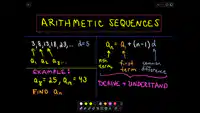
Arithmetic Sequences Lesson

Presentation
•
Mathematics
•
9th - 12th Grade
•
Easy
+2
Standards-aligned

Victoria Colbert
Used 1+ times
FREE Resource
9 Slides • 24 Questions
1
Sequences
A sequence is an ordered list of numbers. Each number in a sequence is called a term. Each term an has a specific position n in the sequence.
example: 5, 10, 15, 20, 25,…an

2
Arithmetic Sequence
An arithmetic sequence is a sequence where you add a constant number to find the next term, similar to the constant rate of change in a linear function.
In an arithmetic sequence we only add to find the next number (term). This number can be positive or negative.

3
Term
In a sequence each number is called a term.
The dots at the end mean the sequence continues forever.
a1 is the first term
a2 is the second term
a3 is the third term and so on...
an is the nth term (we will find the equation for the nth term in the next lesson)

4
Common Difference
The number you add/subtract to find the next term in a sequence is called the common difference.
Subtract two terms to find the common difference. d is used to define the common difference

5
Ready to try some examples?
Remember in an arithmetic sequence, each number is found by adding a common difference, which can be positive or negative.

6
Multiple Choice
Identify the common difference.
10, 20, 30, 40, ...
5
10
15
20
7
Multiple Choice
The next two terms of the sequence 12,17,22,27 are
28 and 33
29 and 34
32 and 37
30 and 35
8
Multiple Choice
9
Multiple Choice
Find the common difference: 29, 21, 13, 5, ...
Remember, the common difference is the difference between the numbers.
d = -10
d = -9
d = -8
d = -7
10
Multiple Choice
11
Multiple Select
Which sequences are arithmetic?
(hint: select 2)
2, 4, 6, 8, 10 ...
5, 10, 20, 40, 80, 100 ...
1, 3, 7, 9, 15, 20 ...
4, 8, 12, 16, 20, 24 ...
12
Fill in the Blanks
13
Multiple Choice
If the first term of an arithmetic sequence is 5 and the common difference is 6, what are the first five terms?
5, 11, 17, 23, 29
6, 11, 16, 21, 26
5, 10, 15, 20, 25
5, 11, 15, 20, 26
14
Multiple Choice
Which sequence has a common difference of 4?
4, 6, 8, 10, 12...
1, 5, 9, 13, 17....
4, 4, 4, 4, 4...
4, 14, 24, 34, 44...
15
Fill in the Blanks
16

17
Multiple Choice
We will start with the explicit formula. Given the following sequence, state the first term and common difference.
Example 1: 4, 7, 10, 13, 16, …
a1 = 3, d = 4
a1 = 16, d = 3
a1 = 4, d = 3
a1 = 16, d = 13
18
Multiple Choice
Now, write the explicit formula for the given sequence.
Example 1: 4, 7, 10, 13, 16, …
an = 4 + (n − 1)(3)
an = 3 + (n − 1)(4)
an = 7 + (n − 1)(3)
an = 16 + (n − 1)(4)
19
Multiple Choice
Write an explicit rule to model the following sequence:
Example 2: 21, 19, 17, 15, …
an = 21 +(n − 1)(2)
an = −21 +(n − 1)(2)
an = −21 +(n − 1)(−2)
an = 21 +(n − 1)(−2)
20
Multiple Choice
Write and explicit rule to model the following sequence:
Example 3: -12, -7, -2, …
an = 5 + (n −1)(−12)
an = −12 + (n −1)(5)
an = −5 + (n −1)(12)
an = 12 + (n −1)(−5)
21
Multiple Choice
22
Fill in the Blanks
23
Multiple Choice
Now, let's go backwards!!! Given the explicit formula, list the first five terms in order.
an = 3 + (n − 1)(2)
2, 5, 8, 11, 14, ...
3, 1, -1, -3, -5, ...
3, 6, 9, 12, 15, ...
3, 5, 7, 9, 11, ...
24
Now, let's simplify the explicit formula even further
an = 4 + (n - 1)(-2) **What do you see that we can do to this equation?
Some text here about the topic of discussion
25
Now, our equation is an = -2n + 6
an = -2n + 6 **How does this resemble linear equation in slope- intercept form?
y = mx + b Slope-Intercept Form
Some text here about the topic of discussion
26
Arithmetic Sequences Model Linear Functions!!!
an = -2n + 6 **The common difference is the same as the slope!
y = mx + b **The y-intercept is the difference of the first term
and the common difference... or b = a1 - d
Some text here about the topic of discussion
27
Multiple Choice
2, 8, 14, ...
(Hint: Write your formula and then simplify it.)
an = 6n + 2
an = 6n - 6
an = 6n - 4
an = -6n + 4
28
Multiple Choice
29
Multiple Choice
-3, -33, -63, -93, ...
30
Multiple Choice
-23, -16, -9, -2, ...
31
Multiple Choice
14, 22, 30, 38, ... a22
32
Multiple Choice
14, 214, 414, 614, ... a30
33
Multiple Choice
an = 14 + (n-1)9
which equation is equivalent
Sequences
A sequence is an ordered list of numbers. Each number in a sequence is called a term. Each term an has a specific position n in the sequence.
example: 5, 10, 15, 20, 25,…an
Show answer
Auto Play
Slide 1 / 33
SLIDE
Similar Resources on Wayground

25 questions
Solve Absolute Value Inequalities
Presentation
•
9th - 11th Grade
28 questions
Transformations of Exponential & Logarithmic Functions
Presentation
•
9th - 12th Grade
24 questions
Translations and Reflections Quiz Review
Presentation
•
9th - 12th Grade
24 questions
Properties of Rhombuses, Rectangles, and Squares
Presentation
•
9th - 12th Grade
28 questions
Graphing Exponential Functions with Shifts
Presentation
•
9th - 12th Grade
27 questions
Triangle Congruence Practice
Presentation
•
9th - 11th Grade
27 questions
Intro to Polynomials
Presentation
•
10th - 12th Grade
23 questions
Quadratic Functions: Parent, Vertex, Axis of Symmetry
Presentation
•
9th - 12th Grade
Popular Resources on Wayground
24 questions
PBIS-HGMS Day 10

Quiz
•
6th - 8th Grade
10 questions
HCS SCI 03 Summer School Review 3
Quiz
•
3rd Grade
11 questions
Home Scope
Quiz
•
7th - 8th Grade
15 questions
HCS SCI 05 Summer School Assessment 3 Review
Quiz
•
5th Grade
35 questions
Lufkin Road Middle School Student Handbook & Policies Assessment
Quiz
•
7th Grade
18 questions
Geo 11.3 Area of Circles and Sectors
Quiz
•
9th - 11th Grade