
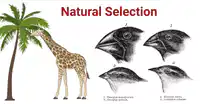
Key Ideas Presentation: How Populations Change 7.13D

Presentation
•
Science
•
7th Grade
•
Practice Problem
•
Medium
+6
Standards-aligned

Miricle Hawkins
Used 43+ times
FREE Resource
7 Slides • 11 Questions
1

2

3

4
Open Ended
What do the plants in this image have in common?
5

6

7
Multiple Choice

The dogs in the image are all one species. Many dog breeds have been produced through artificial selection.
How were different traits introduced into the different breeds?
The traits were acquired in random fashion.
The traits were added by scientists in a lab.
The traits were inherited to help dogs survive.
The traits were selected for in breeding pairs.
8

9
Open Ended
Why do you think the penguin flipper and goose wing in the images look different?
10

11
Multiple Choice
Natural selection acts on populations. How do traits in a population of plants or animals change in this process?
The traits change so that the population becomes more desirable to people.
The traits change so that the population is better suited for its environment.
The traits change so that the population can survive in all environments.
The traits change so that all populations of that species can breed.
12
Multiple Choice
__________ selection occurs when traits of plants and animals selected by people are passed from parents to offspring. _______ selection occurs when traits of plants and animals that help them to survive are passed from parents to offspring.
Average; Artificial
Natural; Artificial
Artificial; Natural
Random; Average
13
Multiple Choice
Which statement is true for both artificial selection and natural selection of plants and animals?
The offspring of the population are better adapted to their environment.
People control the selection of traits in the parent population that will be passed on to the offspring.
Plants and animals become more useful for people.
Traits of plants and animals change over time.
14
Multiple Choice
The coqui frog lives in trees and is the symbol of Puerto Rico
The coqui frog has decreased in size over several generations as average temperature has risen. Identify and describe the process that resulted in the change in size of the coqui frog.
What has happened to the average size of the coqui frog over several generations?
It has increased
It has stayed the same
It has decreased
It changes randomly every year
15
Multiple Choice
The coqui frog lives in trees and is the symbol of Puerto Rico
The coqui frog has decreased in size over several generations as average temperature has risen. Identify and describe the process that resulted in the change in size of the coqui frog.
What environmental change has affected the coqui frog population?
Decrease in rainfall
Increase in predators
Rising temperatures
Lack of food
16
Multiple Choice
The coqui frog lives in trees and is the symbol of Puerto Rico
The coqui frog has decreased in size over several generations as average temperature has risen. Identify and describe the process that resulted in the change in size of the coqui frog.
What process best explains how the traits of the coqui frog changed over generations?
Inherited instinct
Selective breeding
Natural selection
Genetic mutation
17
Multiple Choice
The coqui frog lives in trees and is the symbol of Puerto Rico
The coqui frog has decreased in size over several generations as average temperature has risen. Identify and describe the process that resulted in the change in size of the coqui frog.
Why might smaller frogs have been more successful as temperatures increased?
They made better sounds
They could hide more easily
They needed less food
They were better able to survive in warmer conditions
18
Open Ended
A horse ranch in Texas has three new horses. Two of the horses are females and one is a male. One of the female horses is a much faster runner than the other female horse.
If you were raising these horses, how could you try to have more fast horses in future generations?
Show answer
Auto Play
Slide 1 / 18
SLIDE
Similar Resources on Wayground

12 questions
Tropisms
Presentation
•
7th Grade
14 questions
Circulatory and Respiratory Systems
Presentation
•
7th Grade
12 questions
Skeletomuscular System
Presentation
•
7th Grade
15 questions
Rocks and Minerals
Presentation
•
7th Grade
11 questions
Dichotomous Keys & Taxonomy
Presentation
•
7th Grade
11 questions
Photosynthesis
Presentation
•
7th Grade
13 questions
Speed v. Velocity
Presentation
•
8th Grade
13 questions
ALL ABOUT ME
Presentation
•
7th Grade
Popular Resources on Wayground
6 questions
Secondary Safety Quiz
Presentation
•
9th - 12th Grade
10 questions
Afterschool Activities & Sports

Quiz
•
6th - 8th Grade
19 questions
ROAR Week 2026
Quiz
•
9th - 12th Grade
20 questions
Lab Safety Quiz
Quiz
•
6th Grade
15 questions
Cool Tool:Chromebook
Quiz
•
6th - 8th Grade
22 questions
would you rather
Quiz
•
3rd - 11th Grade
21 questions
Continents and Oceans
Quiz
•
6th Grade
20 questions
Parts of Speech
Quiz
•
5th Grade
Discover more resources for Science
20 questions
💯4. Quiz: Safety in the Science Lab
Quiz
•
7th Grade
20 questions
Lab Safety
Quiz
•
5th - 8th Grade
15 questions
Lab Safety
Quiz
•
7th Grade
17 questions
Variables in Science Experiments: Practice!
Quiz
•
7th Grade
10 questions
Lab Safety Essentials

Interactive video
•
6th - 10th Grade
20 questions
Semester 1: Unit 1: Characteristics of Life
Quiz
•
6th - 8th Grade
20 questions
Lab Safety
Quiz
•
7th Grade
14 questions
Science Variables
Quiz
•
7th Grade