

11.04.2025

Presentation
•
English
•
9th - 12th Grade
•
Practice Problem
•
Hard

Katarzyna R
Used 2+ times
FREE Resource
18 Slides • 0 Questions
1
27.06.2025
By Katarzyna R
2
warm-up
3
4
5
6
7
8
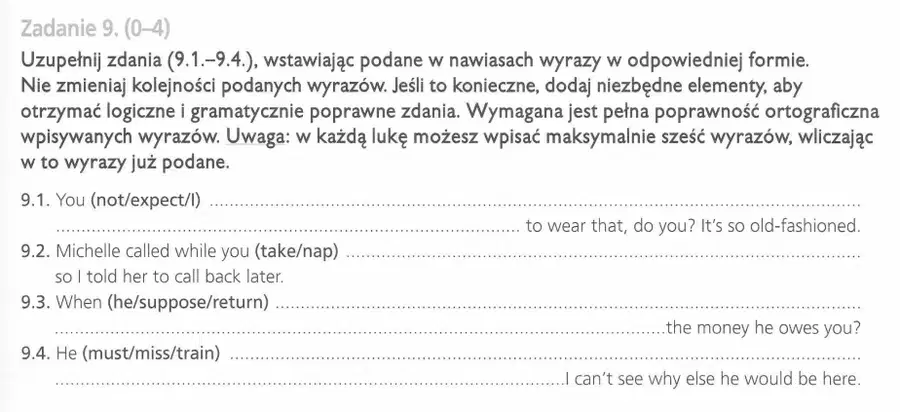
By the time you arrive, we will have finished the meal and the speeches.
I will have read every magazine in the waiting room before I see the dentist.
Where will the guests have gathered by the time we arrive?
By this time tomorrow, we will have signed the deal.
I won't have left before midday.
9
10
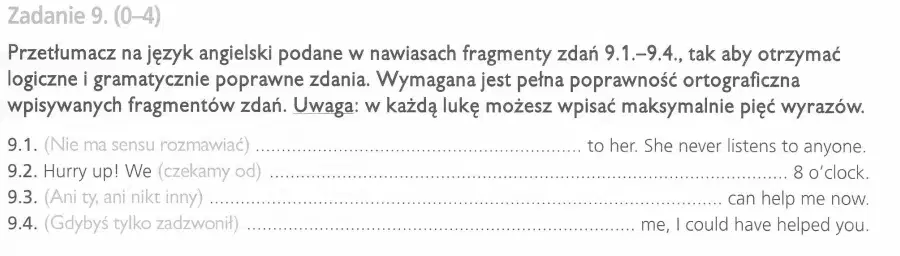
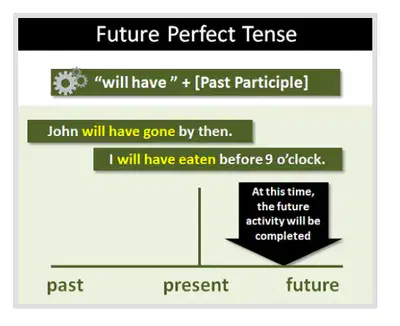
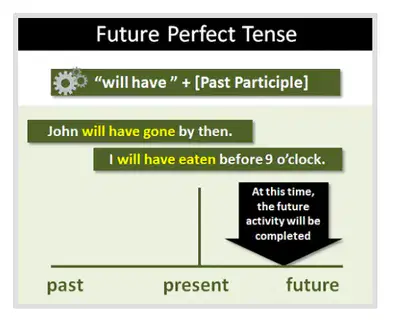
In English, we use the future perfect simple to describe an event in the future that will be completed by a specified time (I will have finished work by the time you call).
Czas Future Perfect stosowany jest do opisu czynności, która będzie wykonana - zakończona przed określonym momentem w przyszłości. Moment ten powinien być zdefiniowany. W tym celu często stosuje się przyimki: before oraz by (the time).
Moment odniesienia w przyszłości często określony jest przy pomocy innej czynności opisanej zdaniem czasowymCzas Future Perfect może określać, ile razy dana czynność zostanie wykonana - powtórzona do danego momentu w przyszłości np.
Ronald will have had three operations by the end of this year.
Before it returns to Earth, the probe will have orbited Mars four times.
W powyższych zdaniach zamiast czasu Future Perfect można także zastosować czasowniki modalne w formie dokonanej. Znaczenie jakie wyrażają w tym przypadku odnosi się do przyszłości np.
Before we reach the peak of the mountain, it may have started raining.
The spy could have destroyed all evidence by the time he is captured.
By next term, Harry should have retaken all his exams.
11
John will have been baking a cake.
They will have been painting the fence.
By six o'clock, John will have been baking a cake for an hour.
They will have been painting the fence for two days by Saturday.
12
13
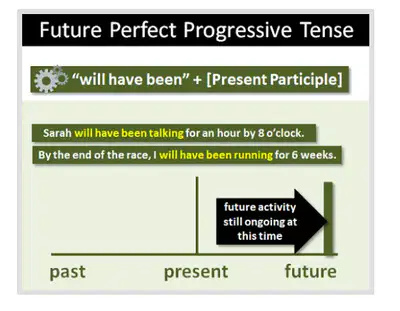
Future Perfect Progressive
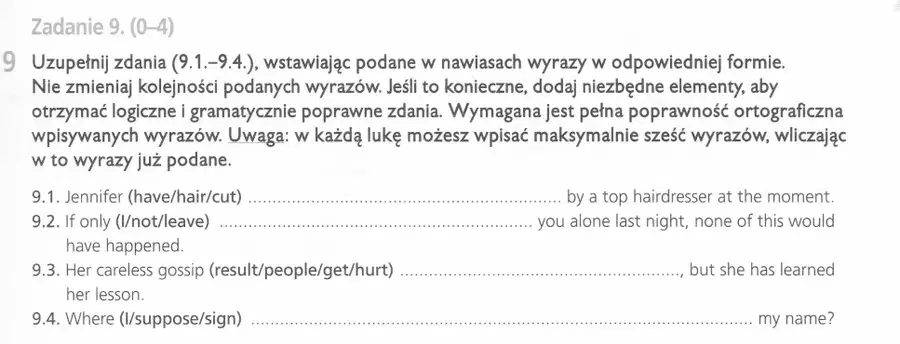
The future perfect progressive tense is used for an ongoing action that will be completed at some specified time in the future.The future perfect progressive tense is typically used with two time expressions: one specifying a time in the future and one stating the length of the activity.
I will not have been playing poker for 30 years by then.
In July next year, will you have been studying for 3 years?
14
Czas Future Perfect Continuous opisuje jak długi okres czasu upłynie w określonym momencie w przyszłości, od kiedy dana czynność jest wykonywana. Oznacza to, iż w momencie odniesienia opisywana czynność będzie nadal wykonywana. Moment odniesienia w przyszłości musi być zdefiniowany i podobnie jak w czasie Future Perfect jest on najczęściej opisany przy użyciu przyimków by (the time) lub before. Długość trwania lub wykonywania takiej czynności opisana jest zwykle przy użyciu przyimka for.
By the end of July, Dave will have been working for us for six months.
By one o’clock, I will have been waiting for my dinner for half an hour.
Before the clock strikes eleven, my baby will have been sleeping for four hours.
15
Powyższe czynności można także opisać przy użyciu czasu Future Perfect, jednakże czas Future Perfect Continuous w bardziej zdecydowany sposób podkreśla ciągłość wykonywanej czynności. Mówiąc o tym, ile razy dana czynność zostanie wykonana - powtórzona do momentu odniesienia w przyszłości, nie należy stosować czasu Future Perfect Continuous, lecz Future Perfect np.
- By the end of this year, Billy will have taken part in seven marathons.
- The man says that before the time runs out, he will have eaten fifteen hamburgers.
-We will have produced a thousand more cars before the factory is closed for good.
16
W czasie Future Perfect Continuous nie stosuje się czasowników z grupy state
verbs. Za wyjątkiem szczególnych znaczeń ( 1.2. str. 9), można je stosować tylko w
czasie Future Perfect. Do grupy tej należą m.in.:
ache, assume, be, believe, belong to, bet, consist of, cost, depend, disagree, doubt,
feel, guess, hate, have, have to, hope, know, like, look, love, matter, mean, own,
possess, prefer, realise, resemble, understand, see, seem, smell, suppose, suspect,
taste, think, want, weigh, wish
-On October 20th, I will have owned the villa for three years.
-How long will Samantha have had the cat by the end of this month?
-We will have known each other for seven months by the end of this year.
-On his next birthday, Jules will have depended on his parents for twenty two years.
17
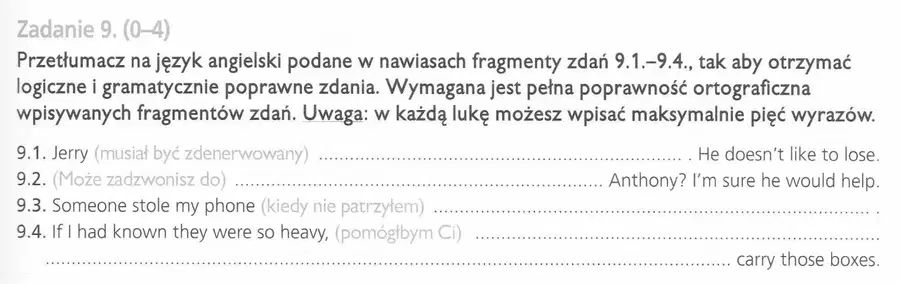
1. I cannot see you at five. I ………………… my doctor at the time.
a) will have been seeing c) will see b) am seeing d) will be seeing
2.2. Before he turns eighteen, Jack ………………… his place of stay at least three times.
a) will change c) is going to change b) will have changed d) will have been changing
3. I don’t know if I ………………… to solve the puzzle. It seems to be really difficult. a) will manage c) will have managed b) am managing d) am going to manage
4. How long ………………… that scar on your cheek before the surgeons remove it? a) will you be having c) will you have been having b) will you have d) will you
have had
5. ………………… anywhere tonight or can I visit you?
a) Will you be going c) Are you going to go b) Will you have gone d) Do you go
18
6. Simone is much better at maths than I am. She ………………… the answer to your question.
a) will have known c) will be knowing b) will know d) is going to know
7. ………………… the Browns at the weekend? Could I ask you to give them this letter from me?
a) Will you have been visiting c) Will you be visiting b) Are you going to visit d) Are you visiting
8. We ………………… through Coventry as usual, so we can drop in for a cup of coffee. Does three p.m. suit you?
a) will drive c) are going to drive b) will have driven d) will be driving
9. Tomorrow at eight, I ………………… professor Hansen’s lecture in sociology.
a) will have been attending c) attend b) am going to attend d) will be attending
10. By the end of this summer, Graham ………………… the young dolphins for a year.
a) will have trained c) will be training b) is training d) will have been training
27.06.2025
By Katarzyna R
Show answer
Auto Play
Slide 1 / 18
SLIDE
Similar Resources on Wayground

12 questions
Word Choice,: Figurative, Connotative, and Impact
Presentation
•
9th - 12th Grade
14 questions
Parts of Speech/Usage
Presentation
•
9th - 12th Grade
11 questions
Teenager 5 Session 22: Pronunciation & Speaking
Presentation
•
KG
16 questions
Parts of Speech- Part 2
Presentation
•
9th - 12th Grade
14 questions
Making Inferences
Presentation
•
9th - 11th Grade
10 questions
Grammar and Punctuation Review #1
Presentation
•
9th - 12th Grade
11 questions
Number the Stars Chapter 13
Presentation
•
KG - University
14 questions
Rhetorical Devices
Presentation
•
9th - 12th Grade
Popular Resources on Wayground
11 questions
Hallway & Bathroom Expectations

Quiz
•
6th - 8th Grade
10 questions
HCS SCI 03 Summer School Assessment 2
Quiz
•
3rd Grade
11 questions
Home Scope
Quiz
•
7th - 8th Grade
12 questions
2026 TAP Technology in the Classroom
Presentation
•
Professional Development
15 questions
HCS SCI 05 Summer School Assessment 2 Review
Quiz
•
5th Grade
15 questions
HCS SCI 04 Summer School Review 2
Quiz
•
4th Grade
59 questions
Geometry Unit 3 Review
Quiz
•
9th - 12th Grade
14 questions
FAST ELA READING SMAPLE TEST MATERIALS

Passage
•
3rd Grade