
Standard 3C.1 DNA, Replication
Presentation
•
Biology
•
9th - 12th Grade
•
Medium
Standards-aligned
Chelsea Davis
Used 3+ times
FREE Resource
32 Slides • 28 Questions
1
2
3
4
5
6
7
8
9
10
11
Multiple Choice
12
Multiple Choice
13
Multiple Choice
14
Multiple Choice
15
Multiple Choice
Where in a cell is DNA found?
Cell Wall
Mitochondria
Chloroplast
Nucleus
16
Multiple Choice
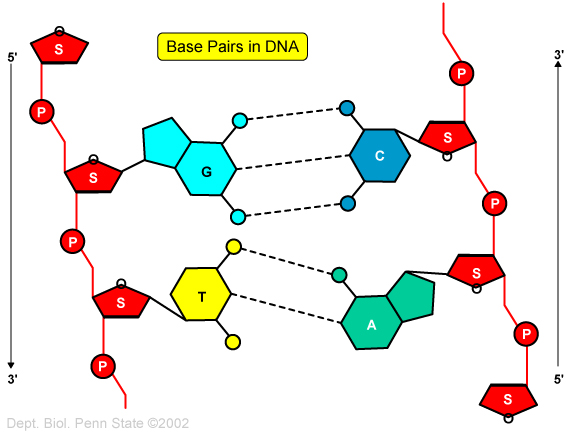
Match he nucleotide with its complementary nucleotide. (DNA to DNA).
Adenine -
Thymine
Guanine
Cytosine
17
Labelling
Label the nucleotide
Phosphate
Sugar
Nitrogenous base
18
Labelling
Label the following parts in the DNA molecule .
phosphate
Nucleotide
nucleotide
Hydrogen Bond
nitrogenous base
deoxyribose
hydrogen bond
Nitrogenous Base
Deoxyribose
19
Multiple Choice
20
Multiple Choice
21
Multiple Choice
Built models to determine that DNA was a double helix shape with base pairs A-T and G-C in rungs between the sugar/phosphate backbone of DNA.
James Watson & Francis Crick
Rosalind Franklin
Maurice Wilkins
Linus Pauling
Erwin Chargaff
22
23
24
25
26
27
Multiple Choice
Bundles of tightly coiled DNA
Chromosome
Genes
Traits
Nucleus
28
Multiple Choice
The material that exists in every cell in your body that holds your genetic code. It Is like your body’s cookbook.
Gene
DNA
Chromosome
Trait
29
Multiple Choice
Sections of DNA that contain the set of instructions that control how our body grows and works and controls many of our characteristics.
Chromosome
Nucleus
Genes
Cell
30
Labelling
Label the following terms: Cell, DNA, Chromosome, Nucleus, Gene
nucleus
chromosome
cell
gene
DNA
31
32
33
34
35
36
37
38
Multiple Choice
1. Recoil
2. Straightens the double helix
3. Breaks Hydrogen bonds
4. Adds Free nucleotides
39
Multiple Choice
40
Multiple Choice
DNA replication results in
2 completely new DNA molecules
2 DNA molecules that each contain a strand of the original
1 new DNA molecule and 1 old
1 new molecule of DNA
41
Multiple Choice
42
Multiple Choice
43
Multiple Choice
The picture below shows the steps of DNA replication beginning with step one and ending with step three.
Because you are reusing the old, or parent, DNA strand DNA replication is said to be
Semi- Conservative
Semi-discontinuous
Continuous
Fully-Conserveative
44
Multiple Choice
45
46
47
48
49
50
51
52
53
54
55
Multiple Choice
56
Fill in the Blanks
57
Fill in the Blanks
58
Fill in the Blanks
59
Fill in the Blanks
60
Multiple Choice
Using this DNA sequence ATA CGA GGA TTT, what is the complementary RNA sequence will be
UAU GCU CCU AAA
UAU GCU CCU TTT
TAT GCT CCT AAA
TAT GCT CCT TTT
Show answer
Auto Play
Slide 1 / 60
SLIDE

Similar Resources on Wayground
57 questions
Mitosis vs Meiosis
Presentation
•
9th - 12th Grade
51 questions
photo & cell notes 25
Presentation
•
9th - 12th Grade
53 questions
Quizizz Slides: Genetics Part 2
Presentation
•
9th - 12th Grade
55 questions
Nutrition Facts Labels
Presentation
•
8th - 12th Grade
54 questions
Probability Recap
Presentation
•
9th - 12th Grade
Popular Resources on Wayground
20 questions
Math Review
Quiz
•
3rd Grade
15 questions
Fast food
Quiz
•
7th Grade
20 questions
Context Clues
Quiz
•
6th Grade
20 questions
Inferences
Quiz
•
4th Grade
19 questions
Classifying Quadrilaterals
Quiz
•
3rd Grade
20 questions
Figurative Language Review
Quiz
•
6th Grade
20 questions
Equivalent Fractions
Quiz
•
3rd Grade
10 questions
Identify Fractions, Mixed Numbers & Improper Fractions
Quiz
•
3rd - 4th Grade
Discover more resources for Biology
15 questions
Biology EOC Review P2
Quiz
•
10th Grade
20 questions
Biology EOC Review 1
Quiz
•
10th Grade
33 questions
Sustainability Unit Review
Quiz
•
9th Grade
36 questions
Biology Regents Review
Quiz
•
9th - 10th Grade
50 questions
NC EOC Biology Review part 1
Quiz
•
9th - 12th Grade
144 questions
Bio 2nd Semester Final Review
Quiz
•
9th Grade
60 questions
Biology Regents Review
Quiz
•
9th Grade
40 questions
Biology EOC Review
Quiz
•
11th Grade