Review for Science FSA
Presentation
•
Science
•
6th Grade
•
Medium
+16
Standards-aligned
Felicia Powers
Used 8+ times
FREE Resource
13 Slides • 24 Questions
1
Science FSA is tomorrow!
By Felicia Powers
2
3
Match
Butter bean seeds were placed in dishes lined with moist paper towel for 5 days at different temperatures & germination was measured. Match the variables.
Controlled Variable
Independent Variable
Dependent Variable
Number of seeds
Temperature
Germiniation
Number of seeds
Temperature
Germiniation
4
Multiple Choice
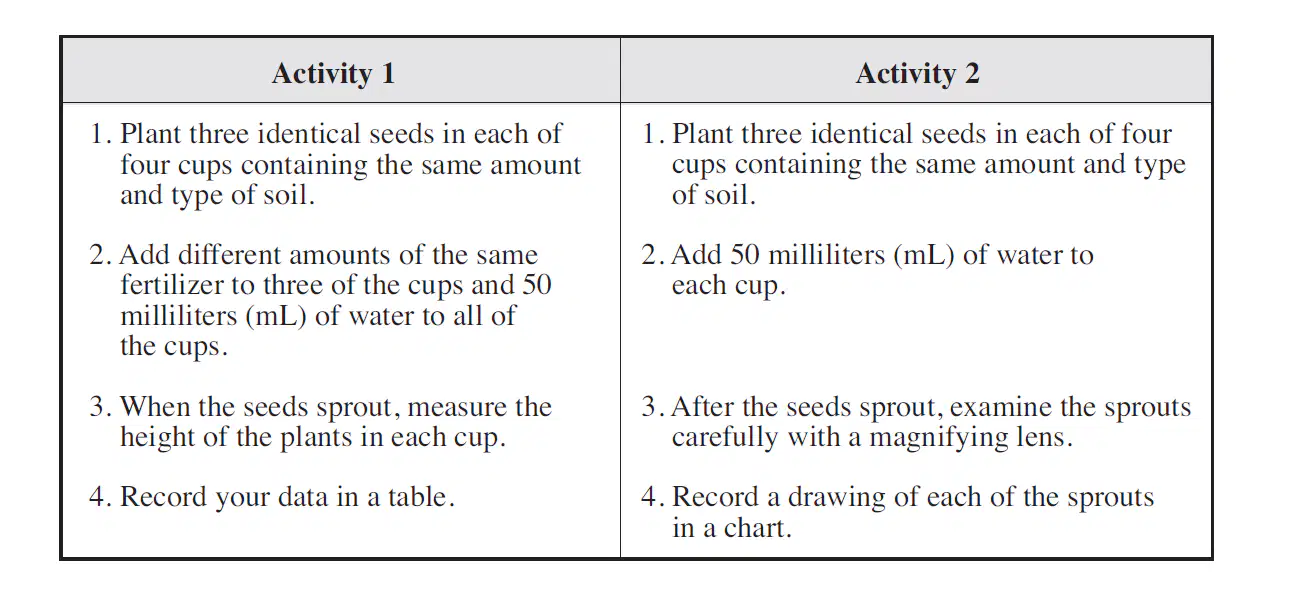
Brittany is investigating plant growth. She completes the following
activities in class.
Which statement best describes why activity 1 is an experiment and
activity 2 is an investigation?
Only activity 1 has a control and variables.
Only activity 1 requires the adding of fertilizer.
Activity 1 requires more trials than activity 2 does.
Activity 1 takes more time to set up than activity 2 does.
5
Multiple Choice
What should NOT be included in your evidence?
Observations from an investigation.
Numbers from your data table.
Opinions about the scientific data.
6
Multiple Choice
In 1980, a scientific journal published an article describing the
observations that led to a hypothesis. The hypothesis stated that an
asteroid striking Earth brought about the extinction of the dinosaurs.
Which of the following would best provide support for a scientific
hypothesis?
opinions and personal beliefs
new evidence and personal opinions
new evidence and additional observations
additional observations and informed predictions
7
8
Multiple Choice
Scientific theories are developed over time in all areas of science.
Which statement best describes scientific theories?
They are based on scientific laws that came first.
They are pieces of scientific evidence that support a hypothesis.
They are explanations of scientific events that may change based on
continuous research.
They are predictions of events that usually remain constant because
scientific ideas rarely change.
9
Multiple Choice
Scientists create both scientific theories and scientific laws as they make observations and conduct experiments about the natural world. Which of the following statements most accurately compares the difference between scientific theories and scientific laws
science laws are based on evidence while science theories are not
science theories involve only biology, while laws involve all types of science
science theories involve mathematical equations, while science laws are based on observations
science theories are ideas that explain natural events, while science laws predict what will happen in a natural event.
10
11
12
Multiple Choice
Match the description to the graph:
"The car is coming back."
13
Multiple Choice
In which of the following graphs below did one runner overtake (run past) the other?
14
Multiple Choice
Mandy applies the brakes on her bicycle and stops quickly to avoid
hitting a basketball that bounces into the street. Which of the following
best explains what happens to the bicycle’s kinetic energy?
It increases because the tires make a screeching noise.
It is destroyed because Mandy stops the bicycle quickly.
It remains the same because Mandy is the source of energy.
It is transformed to heat because the tires are slowed by friction.
15
Multiple Choice
Two Olympic cyclists rode their bicycles on an oval track. The graph
below represents the number of 500-meter laps they completed.
Based on the graph, which statement best describes the motion of the
cyclists as they rode their bicycles?
Both cyclists made stops about halfway through their rides.
Both cyclists rode their bicycles at about the same speed.
Cyclist 1 rode about twice as fast as Cyclist 2.
Cyclist 2 made more stops than Cyclist 1.
16
17
Reorder
Order the following from least energy to most energy
Microwave
Infrared
Visible Light
Ultraviolet
18
Multiple Choice
The table below shows the range of frequencies, in Hertz (Hz), for part
of the electromagnetic spectrum.
Which of the following types of radiation has the longest wavelength?
Infrared
Ultraviolet
X-Rays
Gamma Rays
19
20
21
Match
Reflection
Refraction
Absorption
(Also Reflection)
Absorption
(Converted in a different energy)
Bouncing of light
Bending of light
Light being taken in by an object
Light being converted to heat energy
Bouncing of light
Bending of light
Light being taken in by an object
Light being converted to heat energy
22
Multiple Choice
Sound waves need to travel through something made of atoms or molecules in order to keep moving. They travel at different speeds through different materials. Through which of the following would they be likely to travel fastest?
Air
Water
Wood
Vacuum of space
23
Multiple Choice
Cassandra flashes a beam of white light toward a prism. The prism
separates the white light into different colors. Which of the following
causes the separation of the white light?
The white light is concentrated.
The white light is absorbed.
The white light is refracted.
The white light is reflected.
24
Plate Tectonics
What do each plate boundaries form?
How are the plate moving?
25
Evidence for the Theory of Plate Tectonics
What evidence supports the theory of plate tectonics?
26
Multiple Choice
Scientists have collected large amounts of evidence that support the idea
shown in the illustration.
Which of the following is a scientific theory that is best supported by
this evidence?
Evolution
Law of Superpostion
Plate tectonics
Universal gravitation
27
Multiple Choice
The diagram shows two hypotheses for the same process that occurs beneath Earth’s surface.
Which of the following processes is represented by these hypotheses?
convection current movement in Earth’s mantle
plate movements in Earth’s outer core
layer separation in Earth’s inner core
rock formation in Earth’s lithosphere
28
Wind is caused by uneven heating of Earth . CONVECTION!
29
Multiple Choice
30
31
Multiple Choice
The core is the central and hottest section of the sun,
True
False
32
Multiple Choice
An astronomer observes a sunspot. Which of the following describes this
feature of the Sun?
a location where heat rises to the Sun’s surface
a location that produces most of the Sun’s heat energy
a location that is cooler than other parts of the Sun’s surface
a location where energy and matter leave the Sun’s atmosphere
33
Multiple Choice
34
35
Multiple Choice
In the image , what does X represent?
1 light-year
1 meter
1 year
1 AU
36
Multiple Choice
The Andromeda Galaxy was previously called the Great Andromeda
Nebula because astronomers thought this patch of light was composed
of glowing gases. In the 1900s, scientists determined the nebula was
actually a spiral galaxy. Which of the following describes the relationship
between this galaxy and other astronomical bodies?
This galaxy is the largest star and is found in the universe.did
This galaxy is surrounded by thousands of stars in the universe.
This galaxy includes a universe that is composed of millions of stars.
This galaxy is one of billions of galaxies in the universe and contains
billions of stars.
37
Labelling
Match the terms to their proper model.
Geocentric
Heliocentric
Science FSA is tomorrow!
By Felicia Powers
Show answer
Auto Play
Slide 1 / 37
SLIDE

Similar Resources on Wayground
33 questions
Energy Transfer
Presentation
•
6th Grade
36 questions
Force and Gravity
Presentation
•
6th Grade
33 questions
Cells & Organelles
Presentation
•
6th Grade
32 questions
#8 Endothemic Vs Exothermic Reactions
Presentation
•
6th Grade
31 questions
Noncontact Forces
Presentation
•
6th Grade
33 questions
Layers of the Earth
Presentation
•
6th Grade
30 questions
Weathering of the Earth's Surface - Richards Earth Science
Presentation
•
6th Grade
27 questions
Balanced and UnBalanced Forces
Presentation
•
6th Grade
Popular Resources on Wayground
10 questions
Factors 4th grade
Quiz
•
4th Grade
10 questions
Cinco de Mayo Trivia Questions
Interactive video
•
3rd - 5th Grade
13 questions
Cinco de mayo
Interactive video
•
6th - 8th Grade
20 questions
Math Review
Quiz
•
3rd Grade
20 questions
Main Idea and Details
Quiz
•
5th Grade
20 questions
Context Clues
Quiz
•
6th Grade
20 questions
Inferences
Quiz
•
4th Grade
19 questions
Classifying Quadrilaterals
Quiz
•
3rd Grade
Discover more resources for Science
16 questions
Interactions within Ecosystems
Presentation
•
6th - 8th Grade
20 questions
Rocks and The Rock Cycle
Quiz
•
6th Grade
20 questions
Moon Phases and Eclipses
Quiz
•
6th - 8th Grade
20 questions
Human Body Systems
Quiz
•
6th Grade
15 questions
Punnett Squares
Quiz
•
6th Grade
20 questions
Cells! Cell Theory and Characteristics of Eukaryotes/Prokaryotes
Quiz
•
6th Grade
10 questions
Exploring Earth's Seasons and Their Causes
Interactive video
•
6th - 8th Grade
10 questions
The Ocean's Role in Weather and Climate
Interactive video
•
6th - 8th Grade