Search Header Logo
BIOLOGY EOC REVIEW

BIOLOGY EOC REVIEW

Assessment

Presentation

Biology

8th Grade

Hard

NGSS
MS-LS1-7, HS-PS1-5, MS-PS1-2

Standards-aligned

Created by

Jason Martin

FREE Resource

105 Slides • 95 Questions

1

media

​Conclusion: Should include sharing with your Peers (other scientists)

2

BOTH Theories and Laws

  • Are viewed as scientific facts

  • Can be adjusted if new information is discovered

  • Are formed from rigorous testing, observations, and support from the scientific community

​THEORY EXPLAINS WHY SOMETHING HAPPENS (HASN'T BEEN PROVED)

LAW TELLS WHAT WILL HAPPEN

3

Identifying Variables, Control and Experimental Groups

media

4

Independent Variable

  • Controlled by experimenter

  • Can be changed or manipulated by the experimenter

  • Not affected by dependent variable

5

How to Identify Independent Variable (Cause)

  • Ask questions

  • What's different in the experiment?

  • What's being tested?

  • What's causing the effect?

6

Multiple Choice

Melissa wanted to know if he could get her flowers to grow, so she planted flowers and watered them daily, then measured the plant height two weeks later. What is causing the change you want to see in the experiment?


​ ​ ​

1

independent variable

2

dependent variable

3

constant

4

controlled variable

7

Constant

  • Does not change

  • Stays the SAME

  • For example: same height, same amount of water are constants

8

Dependent Variable

  • Responds to independent variable

  • Is measured in an experiment or study

9

Multiple Choice

A plant receives the same amount of sunlight and water at the same time each day. What is the constant?

1

different amount of sunlight

2

different plant

3

same amount of sunlight, water and same time

10

How to Identify the Dependent Variable (Effect)

  • Ask questions

  • What is responding to the cause?

  • What is being measured?

11

Experimental Group

  • Receives treatment or test material

  • For example: One plant receives fertilizer

  • Fertilizer is the test material, so this plant is the experimental group.

12

Joshua believed that fertilizer will make the plant grow faster, so he treated one plant with fertilizer and the other plant did not receive fertilizer.

media

13

Multiple Choice

Howard believed that fertilizer will make the plant grow faster, so he treated one plant with fertilizer and the other plant did not receive fertilizer. What is the experimental group?

1

plant receiving fertilizer

2

plant not receiving fertilizer

3

plant receiving water because it needs water to grow

14

Control Group

  • Does not receive the treatment or test material

  • For example: One plant does not receive fertilizer

  • Not receiving the fertilizer makes this plant the control group

15

Multiple Choice

What is the dependent variable? Hint: What was measured?

1

the fertilizer

2

plant growth

3

Desmontae

16

Multiple Choice

Angel believed that fertilizer will make the plant grow faster, so he treated one plant with fertilizer and the other plant did not receive fertilizer. What is the control group?

1

plant receiving fertilizer

2

plant not receiving fertilizer

3

Angel believing the plant will grow faster

17

media

Properties of

Water!

18

media

19

media

HELD TOGETHER BY HYDROGEN BONDS

20

media

21

media

22

media

23

media

24

media

25

media

26

media

27

Multiple Choice

What is the ratio of hydrogen atoms to oxygen atoms in water? (H2O)

1

1:1

2

2:2

3

1:2

4

2:1

28

Multiple Choice

Simply put, Cohesion is water attracted to _____.

1

oil

2

glass

3

water

4

other objects

29

Multiple Choice

Cohesion help water form

1

water droplets

2

steam

3

ice

4

a solution

30

Multiple Choice

Simply put, adhesion is water being attracted to

1

water

2

oil

3

surfaces it is in contact with

4

clouds

31

Multiple Choice

When measuring water in a tube, adhesion creates a ________ which creates a visual curve downward inside the measuring container.

1

dip

2

meniscus

3

drop

4

vortex

32

Multiple Choice

The force of ______________ helps things like bugs be able to walk on water

1

adhesion

2

freezing

3

surface tension

4

melting

33

Multiple Select

Which two forces allows for water to be transported up and down a plant so that all of its cells can get water?

1

Cohesion

2

Transpiration

3

Evaporation

4

Adhesion

34

media

35

media

36

media

37

media

38

media

39

media

40

media

41

media

42

Multiple Choice

Which part of the solution does the dissolving?

1

solute

2

solution

3

solvent

43

Multiple Choice

Which part of the solution is dissolved?

1

solute

2

solution

3

solvent

44

media

45

What the pH Scale is and How to Read It

46

media

47

media

48

Multiple Choice

The pH scale goes from

1

0-7

2

7-14

3

0-14

49

Multiple Choice

On the pH scale, acidic solutions have a pH of

1

0 - 6.9

2

7

3

7.1 - 14

50

Multiple Choice

On the pH scale, basic solutions have a pH of

1

0 - 6.9

2

7

3

7.1 - 14

51

Multiple Choice

On the pH scale, neutral solutions have a pH of

1

< 7

2

7

3

> 7

52

media

53

media

54

Multiple Choice

A solution with a pH of 9.5 would be

1

acidic

2

neutral

3

basic

55

Multiple Choice

A solution with a pH of 3.2 would be

1

acidic

2

neutral

3

basic

56

Multiple Choice

Pure H2O has a pH of 7 so it is

1

acidic

2

neutral

3

basic

57

Multiple Choice

Which pH value below would be the most acidic?

1

2.7

2

0

3

6.9

4

7

5

14

58

Multiple Choice

Which pH value below would be the most basic?

1

0

2

10.7

3

8.1

4

14

5

7.1

59

How Are Sharp and Sudden pH Changes Prevented?

60

media

61

media

62

media

63

Multiple Choice

pH buffers are used to

1

create sharp / sudden changes in pH

2

maintain pH at the exact same level at all times

3

prevent sharp / sudden changes in pH

64

media

65

media

66

media

67

media

68

Multiple Choice

All polymers are made up of...
1

monosaccharides

2

monomers

3

proteins

4

None of these

69

media

70

media

71

Fill in the Blank

What is the monomer of carbohydrates?

72

media

73

media

74

media

75

media

76

Multiple Choice

What is the monomer of lipids

1

Amino Acids

2

Fatty Acids

3

Monosaccharides

4

Nucleic Acids

77

Multiple Choice

What is the main function of lipids?

1

Hold genetic information

2

Variety of specific functions

3

Stores excess energy

4

Provide quick energy

78

Multiple Select

Which elements make up Nucleic Acids? Select all that apply

1

Carbon

2

Potassium

3

Oxygen

4

Hydrogen

5

Nitrogen

79

Multiple Choice

Which biomolecule is found in pasta and bread, and is the source of short term energy?

1

Lipids

2

Nucleic acids

3

Carbohydrates

4

Proteins

80

Multiple Choice

Nucleotides are monomers of
1

Carbohydrates

2

Lipids

3

Proteins

4

Nucleic Acids

81

Multiple Choice

Question image

Which macromolecule is shown?

1

lipid

2

protein

3

nucleic acid

4

carbohydrate

82

Multiple Choice

Question image
Which major macromolecule is being represented in this image? 
1

carbohydrate

2

lipid

3

protein

4

nucleic acid

83

Multiple Choice

Question image

Which macromolecule is being represented in the image?

1

nucleic Acid

2

lipid

3

carbohydrate

4

protein

84

What is a chemical reaction??

85

Define a Chemical Reaction

A process in which one or more elements or compounds are changed into compounds.

86

Sides of a reaction

- Reactants: The substances initially present in a chemical reaction that are consumed during the reaction.

- Products: The chemicals created in a chemical reaction.

media

87

Multiple Choice

Question image

What are the reactants of the chemical reaction?

1
2
3
4

88

Multiple Choice

Question image

What are the products of the chemical reaction?

1
2
3
4

89

Multiple Choice

Which side of the chemical reaction are the reactants found on?

1

Left

2

Right

90

Multiple Choice

Which side of the reaction are the products found on

1

Left

2

Right

91

Enzymes

Biological Catalysts

media

92

Enzymes are Biological Catalysts

  • They are proteins

  • Catalysts speed up chemical reactions

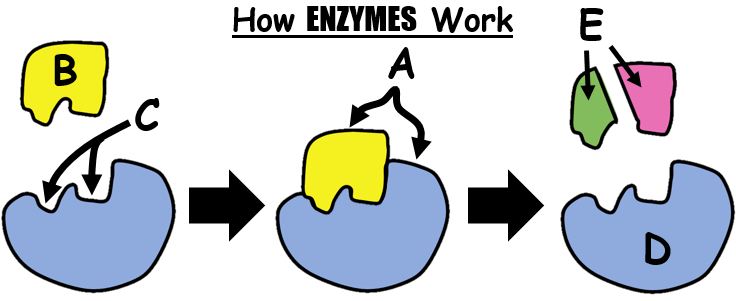
  • Structure = Function: Enzymes are specific to their Substrate (reactants). Active site of the enzymes fits together with the substrate(s)

  • Different reactions require different enzymes

media

93

Enzyme Specificity - The shape of the enzyme (structure) fits it's substrate (function)

media

94

The induced-fit model is the more accurate model

media

95

Multiple Choice

Enzymes are...
1
nucleic acids
2
proteins
3
lipids
4
carbohydrates

96

Multiple Choice

Question image
In the diagram, what is letter A? 
1
product
2
substrate
3
enzyme-substrate complex
4
active site

97

Multiple Choice

Any substance that is acted upon by an enzyme is called a(n)?
1
Coenzyme
2
Substrate
3
Vitamin
4
Polypeptide

98

Multiple Choice

What is a substance called if it speeds up a chemical reaction?
1
reusable
2
catalyst
3
specific
4
fragile

99

Enzymes speed up chemical reactions (Catalysts)

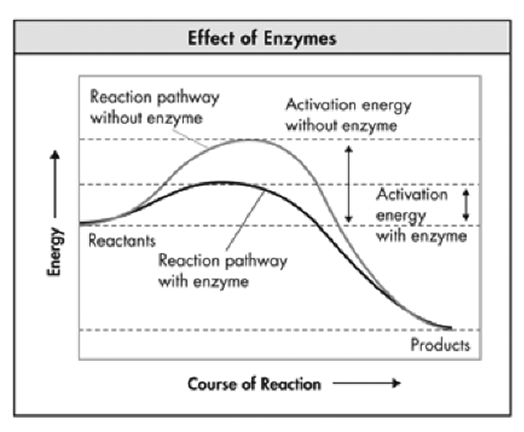
  • Activation energy is the energy needed to start a chemical reaction.

  • The less activation energy needed (smaller hill to climb) the faster the reaction will happen

  • Enzymes speed up reactions by lowering the activation energy

media

100

Multiple Choice

What will most likely happen if an appropriate enzyme is added to a chemical reaction? 
1
The reaction rate will increase.
2
The equilibrium of the reaction will be maintained. 
3
The reaction rate will decrease.
4
The reaction will stop. 

101

Multiple Choice

Which of the following best explains why enzymes are necessary for many cellular reactions?
1
Enzymes supply the oxygen necessary for the reactions
2
 Enzymes change reactants from solid to liquids during the reactions.
3
The reactions take up too much space in the cell if the enzymes are missing.
4
The reactions are too slow to meet the needs of the cell if enzymes are missing. 

102

Multiple Choice

Question image
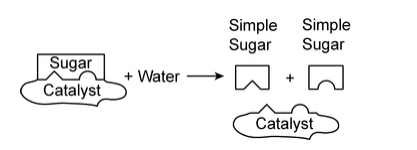
The diagram below illustrates a biochemical process that occurs in organisms. What is another name for the substance labeled "catalyst"?
1
Enzyme
2
inorganic compound
3
Hormone
4
Antibody

103

Multiple Choice

Question image
The graph shows how enzymes affect reactions in cells. Which statement best summarizes the information shown in the graph?
1
Enzymes increase the energy of the reactants.
2
Enzymes decrease the energy level of the products.
3
Enzyme decrease the activation energy of the reaction.
4
Enzymes reverse the direction of the reaction.

104

Multiple Choice

Question image
Which enzyme is most efficient in a basic solution?
1
A
2
B

105

Multiple Choice

What happens when enzymes are heated to a high temperature?
1
The enzymes die.
2
The shapes of the enzyme are altered denature
3
The enzymes' amino acid sequence changes.
4
The enzymes remain the same

106

Multiple Choice

Question image
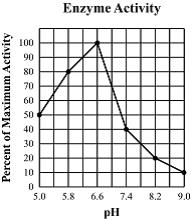
Which of the following conclusions can be drawn from this graph?
1
The optimum pH of the enzyme is 6.6.
2
The optimum pH of the enzyme is 5.8
3
The enzyme’s activity increases as pH increases 5.0 to 9.0
4
The enzyme’s activity is greater around pH of 8.0 .

107

Biotic and abiotic factors

108

Many factors affect the environment both living and nonliving.

Factors that affect the environment

109

media
media

The prefix bio- means "living" Biotic factors are any factors in an ecosystem that are alive or were once alive.

Biotic Factor

​Abiotic factors are factors that were never alive and could never be alive. They still affect the ecosystem, though.

​​Abiotic Factor

110

Multiple Select

Which spheres contain all of the H2O in the Earth System?

1

Hydrosphere

2

Geosphere

3

Cryosphere

4

Atmosphere

5

Biosphere

111

Multiple Choice

Question image
1

biotic

2

abiotic

112

Multiple Choice

Question image
1

biotic

2

abiotic

113

Multiple Choice

Question image
1

biotic

2

abiotic

114

Multiple Choice

Question image
1

biotic

2

abiotic

115

Multiple Choice

Question image
1

biotic

2

abiotic

116

Multiple Choice

Living

1

biotic

2

abiotic

117

Multiple Choice

Dead

1

Biotic

2

Abiotic

118

EQ: How do Earth's Spheres influence each other?

media

119

media

The Earth System is all matter, energy, and processes in and on Earth. It can be divided into five main parts:

  1. Geosphere

  2. Hydrosphere

  3. Cryosphere

  4. Biosphere ​

  5. Atmosphere

Notes: What is the Earth System?

media

120

media

The Geosphere is the solid non-living matter on Earth, from the core to the mountains. It is divided into 3 layers:

  1. the crust

  2. the mantle

  3. the core

Notes: What is the Geosphere?

media

121

media

The Hydrosphere contains all of the liquid water in the Earth System, from the deepest reservoirs underground to the ocean to the clouds of condensation in the sky.

.

The Hydrosphere connects all of the Earth's Spheres through the Water Cycle.

The Water Cycle is the continuous movement of water through evaporation, condensation, precipitation, and runoff.

Notes: What is the Hydrosphere?

media

122

Multiple Choice

What is the main driving source of energy for the water cycle?

1

The Wind

2

The Sun

3

The conductive heat from the ground

4

None of the above

123

Multiple Choice

The process when plants release water vapor from their leaves is called _____________.

1

precipitation

2

evaporation

3

transpiration

4

condensation

124

Multiple Choice

When water vapor is cooled and forms droplets of liquid water

1

Condensation

2

Evaporation

3

Transpiration

4

Runoff

125

Multiple Choice

Precipitation occurs because 
1

the droplets evaporate in the air

2

the droplets are too light for the air to hold

3

the droplets are too heavy for the air to hold

126

media

The homogenous mixture of gases that we commonly refer to as air is the atmosphere. It consists of 78% Nitrogen, 21% Oxygen, and 1% of other gases.

It shields the Earth from radiation and insulates the Earth to regulate our temperature.

It is made up of four layers: The Troposphere (where we live and exist), the Stratosphere (where the Ozone layer is), the Mesosphere (where meteors burn up), and the Thermosphere (where the temperature increases because of the amount of solar radiation that it absorbs).

Notes: What is the Atmosphere?

media

127

Weather vs. Climate

media

128

media

129

Write in science journal.

media

130

media

131

media

132

Write definition in science journal.

media

133

Ch. 4 Ecosystems

4.1 Energy, Producers and Consumers

media

134

Primary Producers

Living things CANNOT create energy

Autotrophs: Organisms that capture energy from nonliving sources and convert it into forms living things can use.​

Primary producers: First producers of energy rich compounds that can be used later by other organisms.​

  • All life depends on primary producers.​

135

​Energy from the Sun

Energy that powers most life on Earth comes from the sun

Photosynthesis: process used by autotrophs to capture light energy and use it to power chemical reactions.

Carbon dioxide + Water ----Light----> Glucose + Oxygen​

136

media
media
media

Plants on land

Algae in freshwater and saltwater

Bacteria- Cyanobacteria

137

Life Without Light

Some organisms can live in total darkness

Chemosynthesis: chemical energy is used to produce carbohydrates.​

Chemosynthetic primary consumers live in a variety of environments

Example: Ocean vents​

138

media

139

Multiple Choice

Organisms that can capture energy from inorganic materials and convert it into forms living cells can use.

1

autotrophs

2

chemotrophs

3

heterotroph

4

consumer

140

Multiple Choice

The process in which autotrophs use chemical energy to produce carbohydrates

1

photosynthesis

2

chemosynthesis

3

heterosynthesis

4

autotrophicsynthesis

141

Multiple Choice

process by which plants and some other organisms use light energy to convert water and carbon dioxide into oxygen and high-energy carbohydrates such as sugars and starches

1

photosynthesis

2

chemosynthesis

3

heterosynthesis

4

autotrophicsynthesis

142

Multiple Choice

first producer of energy-rich compounds that are later used by other organisms

1

primary consumer

2

primary producer

143

Multiple Choice

Which of the following is a raw material of photosynthesis?

1

carbon dioxide

2

oxygen

3

glucose

4

sunlight

144

Multiple Choice

Which of the following is not a product of photosynthesis?

1

oxygen

2

water

3

glucose

4

all of these are products

145

Multiple Choice

Which of the following is not a place where chemosynthesizers exist?

1

ocean vents

2

volcanic vents

3

mud of tidal flats

4

surface water of freshwater lakes

146

Consumers

Many organisms cannot get energy directly from the environment

Heterotrophs: Organisms that obtain food by consuming other living things.​

Consumers: Organisms that rely on other organisms for energy and nutrients.​

Subject | Subject

Some text here about the topic of discussion

147

Types of Consumers

Carnivores: eat other animals

Herbivores: eat vegetation

Omnivores: eat both plants and animals

Scavengers: eat carcasses of dead animals

Decomposers: feed by chemically breaking down organic decaying matter​

Detritus: small pieces of dead and decaying plant and animal remains'

Detritivores: feed by consuming detritus and sometimes decomposers​

Subject | Subject

Some text here about the topic of discussion

148

Symbiosis and Food Webs

media

149

Symbiosis

a relationship between two organisms

media

150

Multiple Choice

Question image

I am a bat that lives in caves. At night, I fly around and locate moths to eat for nutrition.

1

Commensalism

2

Predation

3

Mutualism

4

Parasitism

151

Multiple Choice

Question image

Cleaner wrasse live in “cleaning stations” in a reef. They remove and eat parasites, dead tissue and mucous from reef fish, which helps reef fish stay healthy.

1

Commensalism

2

Mutualism

3

Predation

4

Parasitism

152

Multiple Choice

Question image

The cattle egret, a short bird found foraging in cattle herds, eats insects that have been disturbed when the cattle forage. It doesn’t affect the cattle, but the cattle egret depends on this food source.

1

Commensalism

2

Mutualism

3

Parasitism

4

Predation

153

Multiple Choice

Question image

Head lice live on small amounts of blood in the scalp. The host human feels itchiness in their hair as the lice bite and move around.

1

Parasitism

2

Predation

3

Commensalism

4

Mutualism

154

Food Webs

  • Producers: autotrophs, perform photosynthesis

  • Primary Consumers: heterotrophs, eat producers

  • Secondary Consumers: heterotrophs, eat primary consumers

  • Tertiary Consumers: heterotrophs, eat secondary consumers

  • Decomposers: heterotrophs, break down dead organisms

media

155

Multiple Choice

Question image

What organism is a producer?

1

Greenfly

2

Plantain

3

Rabbit

4

Mouse

156

Multiple Choice

Question image

What organism is a primary consumer?

1

Grasshopper

2

Ladybird

3

Dragonfly

4

Frog

157

Multiple Select

Select two organisms that are competitors

1

Mouse

2

Rabbit

3

Buzzard

4

Frog

158

Multiple Choice

Question image

What will happen to the mouse population if the buzzard population increases?

1

Mouse population will increase

2

Mouse population will decrease

159

Multiple Choice

What will happen to the greenfly population if the butterfly population increases?

1

Greenfly population will decrease

2

Greenfly population will increase

160

Multiple Choice

Question image

Which types of organisms break down other organisms for food?

1

Consumers

2

Producers

3

Decomposers

4

Autotrophs

161

food chain

media

162

What is a food chain

  • a sequence of organisms, each of which uses the next, 

  • lower member of the sequence as a food source1

163

media

164

Important 

  • •In a food chain each organism obtains energy from the one at the level below.

  • •Plants are called producers because they create their own food through photosynthesis3

  • Animals are consumers because they cannot create their own food

165

Four types of consumer

  • Herbivores: animals that eat only plants3

  • Carnivores: animals that eat only other animals3

  • Omnivores: animals that eat animals and plants3

  • Detritivores: Animals that eat dead materials and organic wastes 

166

media

167

Multiple Choice

What do Carnivores eat? 
1
Plants ONLY 
2
Animals ONLY
3
Plants AND Animals

168

Multiple Choice

What do Herbivores eat? 
1
Plants ONLY 
2
Animals ONLY
3
Plants AND Animals

169

Multiple Choice

What do Omnivores eat? 
1
Plants ONLY 
2
Animals ONLY
3
Plants AND Animals

170

Multiple Choice

What is a consumer?

1

Organism that creates their own food.

2

Organism that eat other organisms for energy

3

Organism that eat other dead organisms

171

Detritivore

  • •Worms are common detritivores in many ecosystems including marshes

172

media

173

media

174

Fill in the Blank

Primary producers make up the ____ st trophic level

175

media

176

Fill in the Blank

Pyramids of energy show the relative amount of energy available at each _____ level of a food chain or web.

177

Fill in the Blank

Most remaining energy is released as _______.

178

media

179

Fill in the Blank

What do you multiply a number by to figure out 10% ?

180

media

181

media

182

media

183

media

184

Multiple Choice

What are the 3 main processes of the water cycle?

1
Sublimation, filtration, absorption
2
Condensation, evaporation, filtration
3
Evaporation, condensation, precipitation
4
Precipitation, runoff, infiltration

185

media

186

media

187

Multiple Choice

How is water cycled through the biosphere?

1
Water is cycled through the biosphere by photosynthesis and respiration.
2
Water is cycled through the biosphere only through rivers and lakes.
3
Water is cycled through the biosphere by human consumption and waste.
4
Water is cycled through the biosphere through evaporation, condensation, precipitation, infiltration, and runoff.

188

Multiple Choice

What do producers do within the carbon cycle?

1
Producers consume organic matter to obtain carbon for growth.
2
Producers release carbon dioxide into the atmosphere during respiration.
3
Producers break down organic matter into carbon dioxide through decomposition.
4
Producers absorb carbon dioxide and convert it into organic matter through photosynthesis.

189

Multiple Choice

What is the role of consumers within the carbon cycle?

1
Consumers are the primary producers in the carbon cycle.
2

Consumers release carbon dioxide into the atmosphere through respiration.

3
Consumers do not interact with organic matter in the carbon cycle.
4
Consumers absorb carbon dioxide during photosynthesis.

190

Multiple Choice

What is the role of decomposers within the carbon cycle?

1
Decomposers only affect the nitrogen cycle.
2
Decomposers produce oxygen through photosynthesis.
3

Decomposers recycle carbon by breaking down dead matter.

4
Decomposers store carbon in their bodies for long periods.

191

media

192

media

193

Multiple Choice

How are the carbon and oxygen cycles related in an ecosystem?

1
Carbon and oxygen cycles are independent and do not interact.
2
Photosynthesis releases carbon dioxide without using oxygen.
3
Respiration occurs only in plants, not in animals.
4

Photosynthesis and respiration, where plants and animals exchange carbon dioxide and oxygen.

194

media

195

media

196

media

197

Multiple Choice

How does bacteria contribute to the nitrogen cycle?

1

Bacteria fixes nitrogen in the atmosphere.

2
Bacteria convert sulfur into nitrogen compounds.
3
Bacteria produce oxygen during photosynthesis.
4
Bacteria decompose organic matter into carbon dioxide.

198

media

199

Multiple Choice

How do producers use nitrogen?

1
Producers use nitrogen to synthesize proteins and nucleic acids essential for growth.
2
Producers use nitrogen to absorb sunlight for growth.
3
Producers use nitrogen to create carbon dioxide for respiration.
4
Producers use nitrogen to produce energy through photosynthesis.

200

Multiple Choice

How do decomposers contribute to the nitrogen cycle?

1

Decomposers break down organic matter and release nitrogen in the form of ammonium.

2
Decomposers convert nitrogen gas into organic matter.
3
Decomposers absorb nitrogen directly from the atmosphere.
4
Decomposers prevent nitrogen from entering the soil.
media

​Conclusion: Should include sharing with your Peers (other scientists)

Show answer

Auto Play

Slide 1 / 200

SLIDE