

Introduction to the Periodic Table

Presentation
•
Chemistry
•
8th Grade
•
Easy
+1
Standards-aligned

Hope Fraser
Used 3+ times
FREE Resource
16 Slides • 26 Questions
1
By Hope Fraser
2
Learning Intentions:
I can use the Periodic table to determine the atomic number of elements.
I can state the name and symbols of different elements.
3
Experiment
Record the length of the strip of paper.
Cut the strip of paper in half. Put one half aside. Measure the length of the other half. Record your result.
Cut the measured half, in half again. Again, put one half aside and measure and record the length of the other half.
Predict how many times you will be able to cut the strip in half.
4
Fill in the Blanks
Predict how many times you can cut the piece of paper in half.
Type answer...
5
Number of cuts | Length of strip |
0 | 30cm |
1 | |
2 | |
3 | |
4 | |
5 | |
6 | |
7 | |
8 | 1mm |
18 | 1 micron (1 millionth of a metre, one-thousandth of a millimetre) |
31 | The size of a single atom |
6

Basic building blocks of matter.
An atom is made up of:
Protons
Neutrons
Electrons
Atoms
7
Match
Match the part of an atom to its charge.
PROTON
NEUTRON
ELECTRON
POSITIVE (+)
NEUTRAL (0)
NEGATIVE (-)
POSITIVE (+)
NEUTRAL (0)
NEGATIVE (-)
8
Dropdown
9
A list of all the known elements is called the Periodic Table.
It is organised into columns called groups.
It is also organised into rows called periods.
On your Periodic Table number the groups 1-18 and the periods 1-7.
10

11
Multiple Choice

12
Multiple Choice

13
Multiple Choice
How many periods are on the periodic table?
5
6
7
18
14
Multiple Choice
How many groups are on the periodic table?
5
6
7
18
15
16
17

Reading the Periodic Table
18
Number of protons + number of neutrons in the nucleus.
Number of neutrons = atomic mass - atomic number
Atomic Mass
Number of protons in the element.
The Periodic Table is organised in order of atomic number.
Atomic Number

19
Multiple Choice
The Atomic number is known as the _______
Number of electrons in an atom
Number of protons in an atom
Number of neutrons in an atom
Number of protons and electrons in an atom
20
Multiple Choice
What is Atomic Mass Number ?
Number of Protons
Number of Neutrons
Number of Protons and Neutrons
Number of Protons and Electrons
21
Multiple Choice
The formula used to calculate the number of neutrons is:
Mass Number - Atomic Number
Protons + Electrons
Atomic Number - Mass Number
Protons x2
22
Multiple Choice
How is the Periodic Table organised?
Organised by colour and size
The Periodic Table is organised by increasing atomic number.
23
Each element has a unique name and symbol. The chemical symbols of most elements are very easy to understand. The symbol sometimes starts with the capital letter that is the first letter of the element’s name.
For example:
O = oxygen
C = carbon
N = nitrogen
H = hydrogen
Element Name and Symbol
24
When there is more than one element starting with the same capital letter, a small letter is also used.
The second letter is ALWAYS lowercase.
For example:
Cl = chlorine
Ca = calcium
Cr = chromium
Cu = copper
Element Name and Symbol
25
If an element has a symbol that doesn’t match its modern name, it’s because the symbol is taken from the Greek or Latin name.
For example:
Na = sodium (natrium)
Pb = lead (plumbum)
Hg = mercury (hydro argyros)
Ag = silver (argentum)
K = potassium (kalium)
Fe = iron (ferrum)
Element Name and Symbol
26
Multiple Choice
What is the symbol for Hydrogen?
Hy
27
Multiple Choice
What is the symbol for the element, Oxygen?
Ox
28
Multiple Choice
What is the symbol for the element, Lithium?
L
LI
Li
li
29
Multiple Choice
What is the symbol for the element, Neon?
N
Ne
NE
ne
30
Multiple Choice
Select the element with the symbol:
Na
Sodium
Neon
Narcium
Nitrogen
31
Multiple Choice
Select the element name with the symbol:
S
Silver
Sulfur
Sodium
Silicon
32

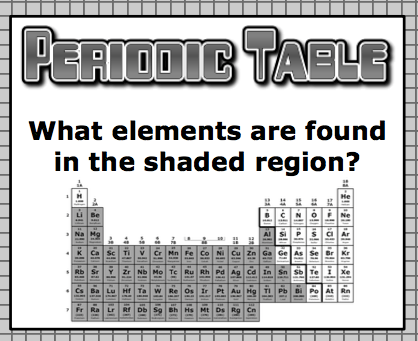
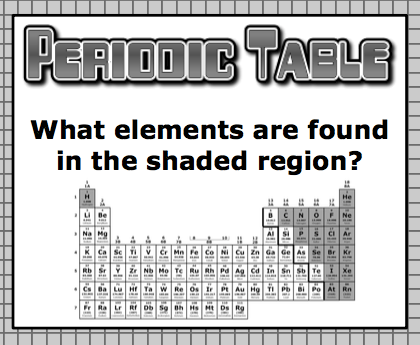
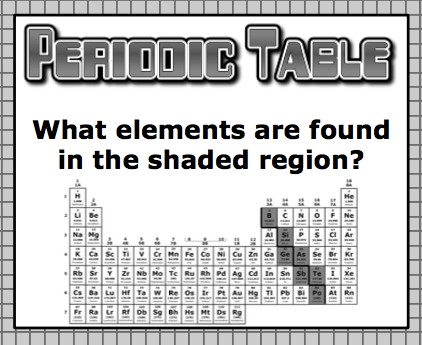
The Periodic Table is separated into metals, nonmetals and metalloids.
Colour your Periodic Table to match.
33

shiny/lustrous
good conductors of heat and electricity
malleable - can be hammered into sheets
ductile - drawn into wires
strong
Metals
Properties of both metals and nonmetals.
Metalloids
dull - NOT shiny/lustrous
POOR conductors of heat and electricity
brittle - likely to shatter
lower melting and boiling points
Nonmetals
34
Multiple Choice

35
Multiple Choice
Which classification of elements are gases or dull brittle solids and poor conductors?
Transition metals
Metals
Nonmetals
Metalloids
36
Multiple Choice
Which classification of elements are shiny, silvery solids and good conductors of heat and electricity?
Transition metals
Metalloids
Nonmetals
Metals
37
Multiple Choice
38
Multiple Choice
Which classification of elements are solids, semi-conductors, and have physical properties like metals and chemical properties like nonmetals?
Metalloids
Nonmetals
Metals
39
Multiple Choice
40
Multiple Choice
41
Poll
How do you feel about the content you have learned today?
Confused!
Okay
Good
Great!
42
Open Ended
Please type any questions you have here:
By Hope Fraser
Show answer
Auto Play
Slide 1 / 42
SLIDE
Similar Resources on Wayground

34 questions
Changes in States of Matter Notes
Presentation
•
8th Grade
40 questions
Causes of the Civil War Part 2 SHEET 2
Presentation
•
8th Grade
38 questions
PA - Linear Vs Nonlinear, That is the Question!
Presentation
•
8th - 9th Grade
35 questions
NC Indian Tribes
Presentation
•
8th Grade
36 questions
Transformations on the Coordinate Plane
Presentation
•
8th Grade
38 questions
Life Cycle of a Star
Presentation
•
8th Grade
35 questions
Modeling Magnetic Force
Presentation
•
8th Grade
36 questions
Chemical Reactions
Presentation
•
10th - 12th Grade
Popular Resources on Wayground
10 questions
Safety Day 2026 – Student Review

Quiz
•
9th Grade
21 questions
Continents and Oceans
Quiz
•
6th Grade
20 questions
Parts of Speech
Quiz
•
5th Grade
16 questions
Subject & Predicate
Quiz
•
5th Grade
25 questions
Multiplication Facts
Quiz
•
5th Grade
12 questions
Map Skills
Quiz
•
3rd Grade
22 questions
Continents and Oceans
Quiz
•
5th Grade
15 questions
Rounding Decimals
Quiz
•
5th Grade
Discover more resources for Chemistry
20 questions
Physical or Chemical Change/Phases
Quiz
•
8th Grade - University
20 questions
Counting Atoms
Quiz
•
8th Grade
33 questions
Quizizz Savvas S3 T6 L3 Changes in Matter Review
Quiz
•
7th - 8th Grade
12 questions
Reading the Periodic Table
Quiz
•
7th - 8th Grade
20 questions
States of Matter
Quiz
•
8th Grade
20 questions
Counting Atoms Practice
Quiz
•
8th Grade
20 questions
Atomic Structure, Valence Electrons, Periods and Groups
Quiz
•
8th Grade
16 questions
Find the Number of Protons, Neutrons, and Electrons
Quiz
•
8th Grade