Search Header Logo
Unit 8: Electrons and the Periodic Table

Unit 8: Electrons and the Periodic Table

Assessment

Presentation

Chemistry

9th - 12th Grade

Easy

NGSS
HS-PS1-1, HS-PS4-1, MS-PS1-1

+5

Standards-aligned

Created by

Meredith Bizragane

Used 2+ times

FREE Resource

8 Slides • 67 Questions

1

Atomic Structure

By Meredith Bizragane

  • ​Nucleus of an atom is central and dense and holds the protons and neutrons.

  • Atomic number = number of protons

  • Atomic mass (mass number) = protons + neutrons

  • Neutral atoms: # of Protons = # of electrons

  • Isotopes: Atoms of the same elements with a different atomic mass.

2

Multiple Choice

What is the atomic number?

1

the number of protons in the nucleus

2

the number of protons and neutrons in the nucleus

3

the number of neutrons in the nucleus

4

the number of protons in the energy levels

3

Multiple Choice

What is the mass number (atomic mass)?

1

the number of protons in the nucleus

2

the number of protons and neutrons in the nucleus

3

the number of neutrons in the nucleus

4

the number of protons and electrons in the atom

4

Multiple Choice

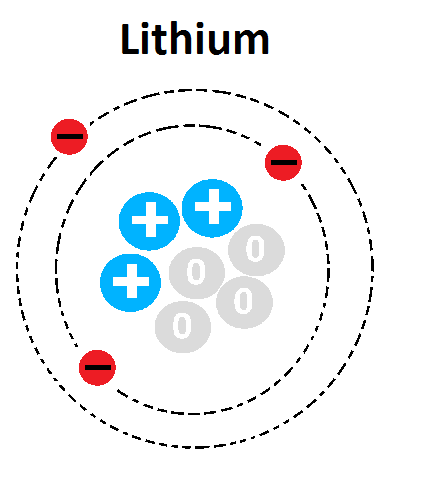
Question image

What is the atomic number of this atom?

1

1

2

3

3

4

4

7

5

Multiple Choice

Most of the mass in an atom is made up of _____________________?
1
protons and electrons
2
protons and neutrons
3
neutrons and electrons
4
electrons and quarks

6

Multiple Choice

In order for an atom to be neutral what has to be true?
1
The atom has more protons than neutrons
2
The atom has more neutrons than protons
3
The atom has the same number of protons and neutrons
4
The atom has the same number of protons and electrons

7

Multiple Choice

How is the number of neutrons in the nucleus of an atom calculated?
1
Add the number of e- and p+ together
2
Subtract the number of e- from p+
3
Subtract the number of p+ from the mass number
4
Add the mass number to the number of e-

8

Multiple Choice

If an atom has 12 positively charged subatomic particles, which of the following must it also have to be considered a neutral atom?
1
12 neutrons
2
12 electrons
3
12 protons
4
24 protons and neutrons

9

Multiple Choice

An atom has 10 protons, 15 neutrons and 10 electrons what is its mass number.

1

20

2

10

3

35

4

25

10

Multiple Choice

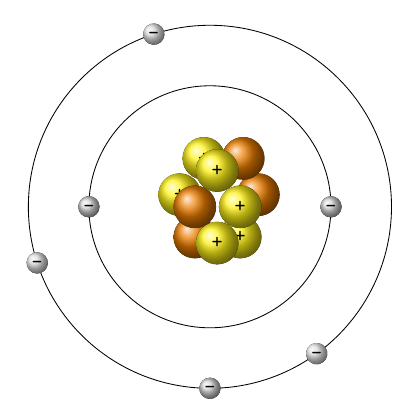
Question image

How many electrons does this atom have?

1

2

2

4

3

6

4

10

11

Multiple Choice

The atomic number of an element that has 9 protons, 9 electrons, and 10 neutrons is _____.
1
9
2
10
3
19
4
28

12

Multiple Choice

An atom has an atomic number of 15 and a mass number of 31. How many protons are there in the atom?
1
15
2
31
3
16
4
47

13

Multiple Choice

Question image
What is the atomic number of the atom pictured? 
1
9
2
10
3
18
4
19

14

Multiple Choice

Isotopes of an element have a different number of...

1

Protons

2

Neutrons

3

Electrons

4

Mass

15

Multiple Choice

Potassium-39 has how many neutrons?

1

19

2

18

3

20

4

21

16

Multiple Choice

Identify the element and its atomic mass:

76 protons and 114 neutrons

1

Osmium-114

2

Osmium-76

3

Osmium-190

4

Osmium-190.23

17

Multiple Choice

An atom of an element with a different number of neutrons and therefore a different atomic mass

1

Isotope

2

Ion

3

Atom

4

Particle

18

Multiple Select

Which of the following have the same MASS NUMBERS? (You must choose more than one answer)

1

scandium - 46

2

sodium - 21

3

titanium -46

4

boron - 11

19

Multiple Choice

Question image

One atom has 56 protons and 18 neutrons.

A different atom has 56 protons and 17 neutrons. These aroms are:

1

different elements

2

isotopes

20

Electrons

  • Bohr Model: electrons orbit the nucleus in energy levels

  • Quantum Mechanical Model: electrons are in s, p, d, and f orbitals

21

Multiple Choice

Question image
What atom matches this electron configuration?
1s22s22p63s23p64s23d10
1
Zinc
2
Copper
3
Nickel
4
Germanium

22

Multiple Choice

Each row on the periodic table represents:

1

an energy level

2

a sublevel

3

an electron

4

an orbital

23

Multiple Choice

How many electrons can the first energy level hold?
1
1
2
2
3
8
4
0

24

Multiple Choice

Question image
What's a valence electron?
1
electrons in the second energy level
2
electrons in the outermost energy level
3
the atomic number
4
electrons in the first level

25

Multiple Choice

What is the noble gas configuration for beryllium?
1
[He]1s2
2
[He]2s2
3
[Li]2s1
4
[Li]2s2

26

Multiple Choice

What atom matches this electron configuration?
1s22s22p63s2
1
Neon
2
Magnesium
3
Aluminum
4
Potassium

27

Multiple Choice

There are 4 different types of subshells (orbitals) s,p,d,f.
1
true
2
false

28

Multiple Choice

What is the noble gas shorthand electron for Sulfur atom?
1
[Ar] 3p4
2
[He] 3s23p4
3
[Ne] 3s23p4
4
[Na] 3s23p4

29

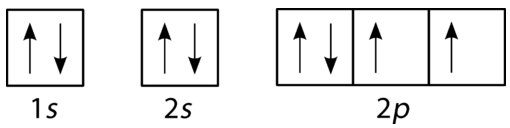
Multiple Choice

Question image
This orbital diagram represents:  
1
C
2
B
3
N
4
O

30

Multiple Choice

Question image
This orbital diagram represents:  
1
C
2
B
3
N
4
O

31

Multiple Choice

Question image
What is incorrect about this orbital diagram?
1
Both arrows in the 2p box should be pointing up
2
There is nothing incorrect with this diagram
3
In the there should only be 1 orbital in the first 2p box and one in the 2nd 2p box
4
All the arrows should be pointing up.

32

Multiple Choice

Question image

Which example shows a violation of Hund's Rule?

1

A

2

B

3

C

4

D

33

Multiple Choice

Question image

Which of the following is written correctly?

1

A

2

B

3

C

4

D

34

Multiple Choice

Question image

What element's orbital notation is pictured here?

1

Ar

2

Br

3

Cu

4

Cl

35

Multiple Choice

Question image

Which element is this?

1

Nickel

2

Neon

3

Sodium

4

Nitrogen

36

Multiple Choice

Question image

This could be the dot diagram of

1

Mg

2

Cl

3

C

4

O

37

Multiple Choice

Question image

This is a correct dot diagram for neon (Ne)

1

true

2

false

38

Multiple Choice

How would you draw a Lewis dot diagram for Magnesium?

1
2
3
4

39

Multiple Choice

Which electron configuration belongs to a Chloride (Cl-) ion?

1

1s2 2s2 2p6 3s2 3p5

2

1s2 2s2 2p6 3s2 3p6

3

1s2 2s2 2p6 3s2 3p7

4

1s2 2s2 2p6 3p7

40

Multiple Choice

What electron configuration matches an oxygen ion?
1
1s22s22p63s2, 3p64s23d104p5
2
1s22s22p4
3
1s22s22p6
4
1s22s22p63s23p64s23d1

41

Multiple Choice

Question image
Write the electronic structure for Mn4+ ion
1
[Ar]4s23d5
2
[Ar]4s23d1
3
[Ar]4s03d2
4
[Ar]3d3

42

Periodic Trends

  • ​Atomic radius decreases across a row since the electrons are on the same energy level but the effective nuclear charge increases as protons are added to the nucleus. This increasing the force of attraction and pulls electrons closer to the nucleus.

  • Atomic radius increases down a column since electrons are added to higher energy levels therefore increasing the distance from the nucleus to the valence electrons. Even though elements farther down the periodic table have more protons the distance outweighs the charge.

43

Periodic Trends

  • ​First ionization energy increases as atomic radius decreases.

    • It is harder to remove an electron from a smaller atom since more energy is required to overcome the stronger force of attraction between electrons and protons in smaller atoms

44

Multiple Choice

What is the relationship between effective nuclear charge and ionization energy?

1

The ionization energy decreases with an increase in effective nuclear charge.

2

There is no relationship between effective nuclear charge and ionization energy.

3

Effective nuclear charge and ionization energy are unrelated.

4

The ionization energy increases with an increase in effective nuclear charge.

45

Multiple Choice

Which element has the highest effective nuclear charge: carbon, nitrogen, or oxygen?

1

oxygen

2

hydrogen

3

nitrogen

4

carbon

46

Multiple Choice

Recap:

Coulomb’s law states that the force between two charged objects will __________ when the magnitude of the object’s charge increases.

Coulomb’s law also states that the force between two charged objects will __________ when the distance between objects increases.

1

increase; increase

2

increase; decrease

3

decrease; increase

4

decrease; decrease

47

Multiple Choice

As you move down a group, atomic radius increases because - 
1
you add more and more neutrons
2
you add more and more protons
3
you add more and more shells (energy levels)
4
you add more atomic mass

48

Multiple Choice

As you move across the periodic table from left to right, the atomic radius decreases.  This is because - 
1
the number of protons increases, so attraction to electrons increases
2
the number of energy levels increases
3
the number of electrons increases
4
the atomic mass increases

49

Multiple Choice

Which of the following will have a larger radius than Zinc?
1
Gallium
2
Aluminum
3
Magnesium
4
Strontium

50

Multiple Choice

Francium (Fr) has the lowest ionization energy in Group 1 because - 
1
it has the smallest number of valence electrons
2
it has the greatest atomic mass
3
it has the greatest number of protons, so it attracts its electrons the strongest
4
its 1 valence electron is very far from the nucleus, so little energy is needed to remove it

51

Electromagnetic Radiation
c=λν E=hν

  • Wavelength (λ): distance between crests of adjacent waves measured in units of meters or nanometers.

  • Frequency (ν): the number of waves that pass a point per second measured in units of Hz or /s

  • Energy (E): Plank's constant times frequency

  • Speed of light (c): 3.00x10⁸m/s

  • Plank's Constant (h): 6.626x10⁻³⁴ Js

  • 1 m = 1x10⁹ nm

52

Electromagnetic Radiation

  • Wavelength is inversely proportional to energy and frequency.

  • Energy and frequency are directly proportional.

  • Visible light is 400 nm (violet) to 700 nm (red).

media

53

Electromagnetic Radiation

When atoms absorb energy, electrons jump to excited states in absorption. This energy is then released as the electron returns to a lower energy state and finally the ground state during emission.

The longer the distance the electron travels, the more energy is involved in the transition.
Higher energies correspond to lower wavelengths.

media

54

Electromagnetic Radiation

Absorption and emission data can be collected and shown on a spectrum. Absorption spectrum show black lines on a colored background and emission spectrum show colored lines on a black background.

Each spectral line corresponds to a specific energy transition.
Since each element has a unique spectrum, element's can be identified in this way.

media

55

Multiple Choice

Calculate the wavelength of the yellow light emitted by the street light, if the frequency of the radiation is 5.10x10¹⁴Hz.

1

5.12 x 10⁻⁷m

2

5.88 x 10⁻⁷ m

3

4.20 x 10¹⁴m

4

3.0 x 10⁸m

56

Multiple Choice

Energy is measured in........

1

Wavelength

2

Meters

3

Joules

4

Frequency

57

Multiple Choice

The symbol for wavelength Is?

1

nu

2

lambda

3

vi

4

meters

58

Multiple Choice

On a wave, the distance between crest to crest is called?

1

amplitude

2

wavelength

3

frequency

4

trough

59

Multiple Choice

Which color in the visible spectrum of light has the longest wavelength?

1

Indigo

2

Red

3

Blue

4

Violet

60

Multiple Choice

Calculate the wavelength of blue light emitted by a mercury lamp with a frequency of 6.88 x 10¹⁴ Hz.

1

3.44 x 10⁻⁶m

2

4.36 x 10⁻⁷m

3

3.0 x 10⁸ m

4

633 m

61

Multiple Choice

What is the frequency of light with a wavelength of

4.8 x 10⁻⁷ meters?

1

5.34 x 10⁻⁹ Hz

2

3.0 x 10⁸ Hz

3

3.21 x 10¹⁷ Hz

4

6.25 x 10¹⁴ Hz

62

Multiple Choice

The unit of measure for frequency is?

1

Seconds

2

Meters

3

Hertz

4

Liters

63

Multiple Choice

The symbol for a frequency of a wave is?

1

Hertz

2

v

3

lambda

4

meters/second

64

Multiple Choice

What does "h" stand for?

1

Speed of Light

2

Plank's Constant

3

Speed of Sound

4

Constant Energy

65

Multiple Choice

What is the units for speed of light?

1

c

2

J

3

m/s

4

Hz

66

Multiple Choice

What does energy have to do with wavelength and frequency?

1

The higher the frequency the less energy the wave has.

2

The lower the frequency the more energy the wave has.

3

The shorter the wavelength the more energy the wave has.

4

The longer the wavelength the more energy the wave has.

67

Multiple Choice

Question image

An astronomer looks at the spectrum of light from a distant star. The spectrum they see is shown in the figure. They compare the emission lines within the spectrum to the emission lines in the spectra of pure elements, which are also shown in the figure, in order to identify which elements are present in the outer layers of the star. State all of the elements that are present in the outer layers of the star.

1

hydrogen, helium, and carbon

2

hydrogen, helium, and boron

3

helium, oxygen , and carbon

4

hydrogen, helium, boron, and carbon

68

Multiple Choice

Question image

The absorption lines in the spectrum for Galaxy B are shifted toward the _____ end of the spectrum when compared to the lines for the Milky Way.

1

red

2

blue

69

Multiple Choice

Question image
Emission of light from an atom occurs when an electron
1
drops from a higher to a lower energy level.
2
   jumps from a lower to a higher energy level.   
3
   moves within its atomic orbital.
4
falls into the nucleus.

70

Multiple Choice

Question image

The ground state is the ______________ energy state of an atom.

1

highest

2

lowest

71

Multiple Choice

Question image
For an electron to change from ground state to an excited stated it must...
1
Absorb energy
2
Release energy

72

Multiple Choice

Question image
When talking about energy levels in an atom, what is an "excited state"?
1
The highest energy state of an atom.
2
Any level higher than the ground state.
3
The lowest energy state of an atom.
4
When an atom loses an electron

73

Multiple Choice

Question image
Why are line emission spectra of elements called "atomic fingerprints"?
1
They are all the same
2
They are all unique
3
They are all similar
4
They all contain colored light

74

Multiple Choice

Question image

If an electron moves from n=4 to n=2 it ____

1

absorbs energy

2

releases energy

75

Multiple Choice

Question image

The emission spectrum of carbon is shown. Which spectral lines is associated with an electron making the largest energy jump?

1

The blue line at 478 nm.

2

The red line at 658 nm.

3

The yellow line at 602 nm.

4

This cannot be determined from an emission spectrum.

Atomic Structure

By Meredith Bizragane

  • ​Nucleus of an atom is central and dense and holds the protons and neutrons.

  • Atomic number = number of protons

  • Atomic mass (mass number) = protons + neutrons

  • Neutral atoms: # of Protons = # of electrons

  • Isotopes: Atoms of the same elements with a different atomic mass.

Show answer

Auto Play

Slide 1 / 75

SLIDE