

Simple Past vs Present Perfect Tense

Presentation
•
English
•
10th Grade
•
Easy
Standards-aligned

Dewi Rahayu
Used 1+ times
FREE Resource
10 Slides • 5 Questions
1
By Dewi Rahayu

2
3
4
Multiple Choice
Andika was sleeping when I ... to his house
come
comes
came
coming
will come
5
Multiple Choice
she didn't ... her homework last night
do
did
done
doing
does
6
Multiple Choice
Did you ... a letter for your teacher?
write
wrote
written
writing
writes
7
Multiple Choice

What did the children do last night?
The children watched the cartoon
The children listened to the music
The children slept on the floor
The children played the hand phone
The children studied together
8
Fill in the Blanks

Kata kerja ke 2 dari aktivitas di gambar...
Type answer...
9
10

11
12
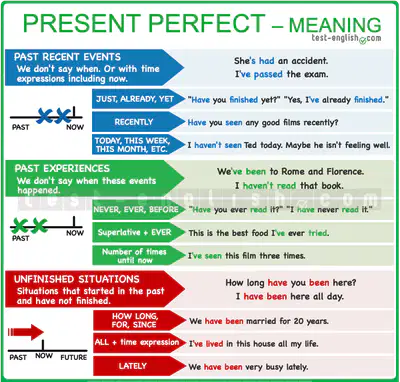
Recent events and news (Just, yet, already)
We often use the present perfect with the words just, yet, already.
We use just in (+) sentences to say that something happened very recently (like minutes ago).
I’ve just seen Peter in the street.
He looks happy because he’s just got married.
We use yet in (-) and (?) sentences. We put it at the end of the sentence.
Have you washed the dishes yet?
I haven’t called him yet.
She hasn’t arrived yet.
We use already in (+) sentences to say that something happened before now (usually earlier than we expected).
I have already finished.
We have already arrived.
13
Life experiences (Never, Ever, Before)
We often use the present perfect to talk about past experiences in our lives. We don’t say when these experiences happened.
When we ask about someone’s life experiences, we often use the word ever.
Have you ever read this book?Have you ever been to India?
When we talk about life experiences, we often use the words never or before.
She has never been late.I think I have seen this film before.
14
Unfinished Actions (How long, for, since)
We use the present perfect with the words how long, for, since to talk about actions or situations that started in the past and still continue or are still true now.
We use how long in questions to ask about the duration of an action or situation.
How long has she been a teacher?How long has she had her car?
We use for + a period of time, e.g. for two weeks, for ten years, for ten days, for a few hours, etc.
We’ve been here for a few hours.They’ve been married for 10 years.
We use since + a moment in the past (the beginning of a period of time), e.g. since I was born, since 10 o’clock, since last Wednesday, etc.
We’ve been here since 4 o’clock.They’ve been married since 2010.
15
Be careful with these common mistakes!
We use the present perfect, and not the present simple for actions or situations that started in the past and are still true now.
We are friends since first grade.We’ve been friends since first grade.
We use for… and NOT since…ago to introduce a period of time.
They’ve been married since 10 years ago.They’ve been married for 10 years.
By Dewi Rahayu
Show answer
Auto Play
Slide 1 / 15
SLIDE
Similar Resources on Wayground

10 questions
Looking Back
Presentation
•
10th Grade
10 questions
How to read year in English?
Presentation
•
10th Grade
10 questions
Pronunciation of ED endings
Presentation
•
10th Grade
10 questions
The Refusal Quiz
Presentation
•
9th - 10th Grade
12 questions
Lessons 9–10 Sea transport and seaports
Presentation
•
10th Grade
10 questions
Narrative Text Legend (Surabaya)
Presentation
•
10th Grade
12 questions
Reading Journal Practice
Presentation
•
10th Grade
11 questions
Context Clues
Presentation
•
10th Grade
Popular Resources on Wayground
10 questions
How much do you know about our Portrait of an Eagle?

Quiz
•
10th Grade
10 questions
Fast Food Slogans
Quiz
•
6th - 8th Grade
21 questions
Continents and Oceans
Quiz
•
6th Grade
20 questions
Parts of Speech
Quiz
•
5th Grade
16 questions
Subject & Predicate
Quiz
•
5th Grade
25 questions
Multiplication Facts
Quiz
•
5th Grade
12 questions
Map Skills
Quiz
•
3rd Grade
22 questions
Continents and Oceans
Quiz
•
5th Grade
Discover more resources for English
20 questions
Context clues
Quiz
•
10th Grade
15 questions
ENG 10 Grammar: 18.1 Prepositions or Adverbs P. 34
Quiz
•
10th Grade
10 questions
Making Inferences and Drawing Conclusions

Interactive video
•
6th - 10th Grade
10 questions
Crafting an Effective Thesis Statement
Interactive video
•
6th - 10th Grade
10 questions
Exploring Coordinating Conjunctions with FANBOYS
Interactive video
•
6th - 10th Grade
10 questions
Distinguishing Theme and Main Idea
Interactive video
•
6th - 10th Grade
20 questions
Subject Verb Agreement
Quiz
•
10th Grade
10 questions
Identifying Simple, Compound, and Complex Sentences
Interactive video
•
6th - 10th Grade