

Magnetic Force Standards Aligned

Presentation
•
Physics
•
7th Grade
•
Practice Problem
•
Hard

Sanidhya Singh
FREE Resource
10 Slides • 11 Questions
1

Magnetic Force
2
Learning Objectives
Define magnetic force, poles, and how they attract/repel.
Explain magnetic fields exert non-contact forces.
Model magnetic fields using field lines.
Describe how magnet arrangement and orientation affect potential energy.
3

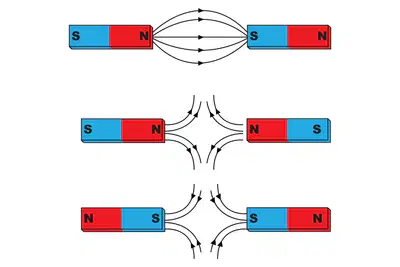
A magnet is an object that attracts iron and iron-containing materials.
Magnetism is the force of attraction or repulsion between magnets.
Magnets have two poles (North/South) and can attract or repel.
Magnetism can be permanent or temporary (induced by strong magnets).
Magnets and Magnetism: The Basics!
4
Multiple Choice
What is magnetism?
The force only between two magnets
The attraction or repulsion involving magnets and magnetic materials
The property of iron only
The energy stored in a magnet
5
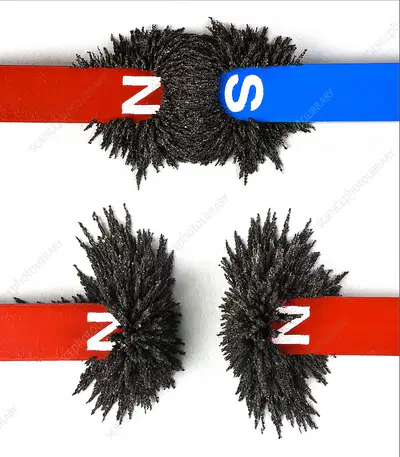
Magnetic force acts at a distance, without touching.
Magnets have two poles: North (N) and South (S).
Like poles repel each other; opposite poles attract.
This force attracts magnetic materials like iron to magnets.
Magnetic Force and Poles

6
Multiple Choice
What happens when the north pole of one magnet is brought near the north pole of another magnet?
They attract each other
They repel each other
Nothing happens
They become one magnet
7
Magnets and Potential Energy
Interacting magnets store potential energy. Its amount depends on their setup.
Work increases potential energy when: separating attracting poles, or pushing repelling poles closer.
Potential energy decreases if magnets move freely, often becoming motion energy.
This energy changes as forces alter the magnets' configuration.
8
Multiple Choice
When does the potential energy of a system of two magnets increase?
When opposite poles are allowed to move closer
When like poles are pushed closer together
When the magnets are removed from the system
When the magnets stop interacting
9

Magnetic fields are areas around magnets or moving charges.
Here, magnets exert forces without any direct touch.
These invisible fields loop from one pole to another.
They are strongest at poles; iron filings show them!
What are Magnetic Fields?

10
Multiple Choice
Where is the magnetic field around a bar magnet typically the strongest?
In the middle of the magnet
Equally strong everywhere
At the North and South poles
Only outside the magnet
11

Visualizing Fields: Single Magnet Field Lines
12
Multiple Choice
Which statement accurately describes magnetic field lines?
They start at the south pole and end at the north pole
They often cross each other where the field is strong
They form complete loops from the north pole to the south pole
They are closest together where the field is weakest
13
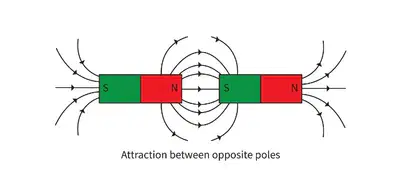
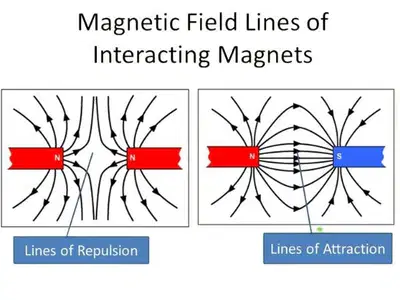
Attraction: Opposite Poles Team Up!
Like poles (N-N or S-S) get close.
Their field lines push apart.
Lines show push; they never cross!
Repulsion: Like Poles Push Apart!
Visualizing Fields: Combined Magnetic Fields
Opposite poles (N-S) get close.
Their field lines connect together.
Lines show pull; they never cross!
14
Multiple Choice
What happens to the magnetic field lines when the south pole of one magnet is placed near the north pole of another?
The field lines push away from each other
The field lines disappear between the magnets
The field lines combine to form a strong field between the magnets
The field lines cross over each other
15
Correction
Magnets can attract AND repel other magnets.
Magnetic forces act at a distance.
Magnetic field lines never cross each other.
Magnet strength depends on material, not just size.
Misconception
Common Misconceptions
Magnets only attract.
Magnetic forces require objects to touch.
Magnetic field lines can cross each other.
Larger magnets are always stronger.
16
Summary
Magnets attract iron, have N/S poles, and exert magnetism.
Magnetic force acts at a distance; like poles repel, opposites attract.
Energy is stored in magnets based on their position and orientation.
Magnetic fields are invisible areas of force, shown by lines.
17
Open Ended
What are the two types of poles every magnet has?
18
Open Ended
Describe what happens to the potential energy when you push the north poles of two magnets together.
19
Open Ended
How do magnetic fields help explain forces between magnets that are not touching?
20
Poll
How confident are you in explaining how magnetic poles interact? (Rate 1-4, 1=Not confident, 4=Very confident)
1
2
3
4
21
Open Ended
What part of today's lesson was most confusing or needs more explanation?
Magnetic Force
Show answer
Auto Play
Slide 1 / 21
SLIDE
Similar Resources on Wayground

17 questions
Solving Two-Step Equations and Inequalities Word Problems
Presentation
•
7th - 8th Grade
14 questions
Light Travel in Straight Line
Presentation
•
7th Grade
17 questions
Flag Football 8.1
Presentation
•
7th - 8th Grade
19 questions
7th grade text evidence lesson
Presentation
•
7th - 8th Grade
16 questions
Bass Clef
Presentation
•
6th - 8th Grade
14 questions
Magnetic Fields
Presentation
•
8th Grade
14 questions
Applying the Five Themes of Geography
Presentation
•
7th Grade
17 questions
Light: Refraction
Presentation
•
7th Grade
Popular Resources on Wayground
20 questions
Math Review

Quiz
•
3rd Grade
15 questions
Fast food
Quiz
•
7th Grade
20 questions
Context Clues
Quiz
•
6th Grade
20 questions
Inferences
Quiz
•
4th Grade
19 questions
Classifying Quadrilaterals
Quiz
•
3rd Grade
20 questions
Figurative Language Review
Quiz
•
6th Grade
20 questions
Equivalent Fractions
Quiz
•
3rd Grade
10 questions
Identify Fractions, Mixed Numbers & Improper Fractions
Quiz
•
3rd - 4th Grade