Lesson 1.B
Presentation
•
Chemistry
•
11th Grade
•
Hard
+3
Standards-aligned
Eve Ablin
FREE Resource
40 Slides • 53 Questions
1
2
Multiple Choice
What are the two classification of matter?
3
Multiple Choice
What is the difference between pure substance and mixtures?
4
Multiple Choice
What is the difference between element and compound?
5
Multiple Choice
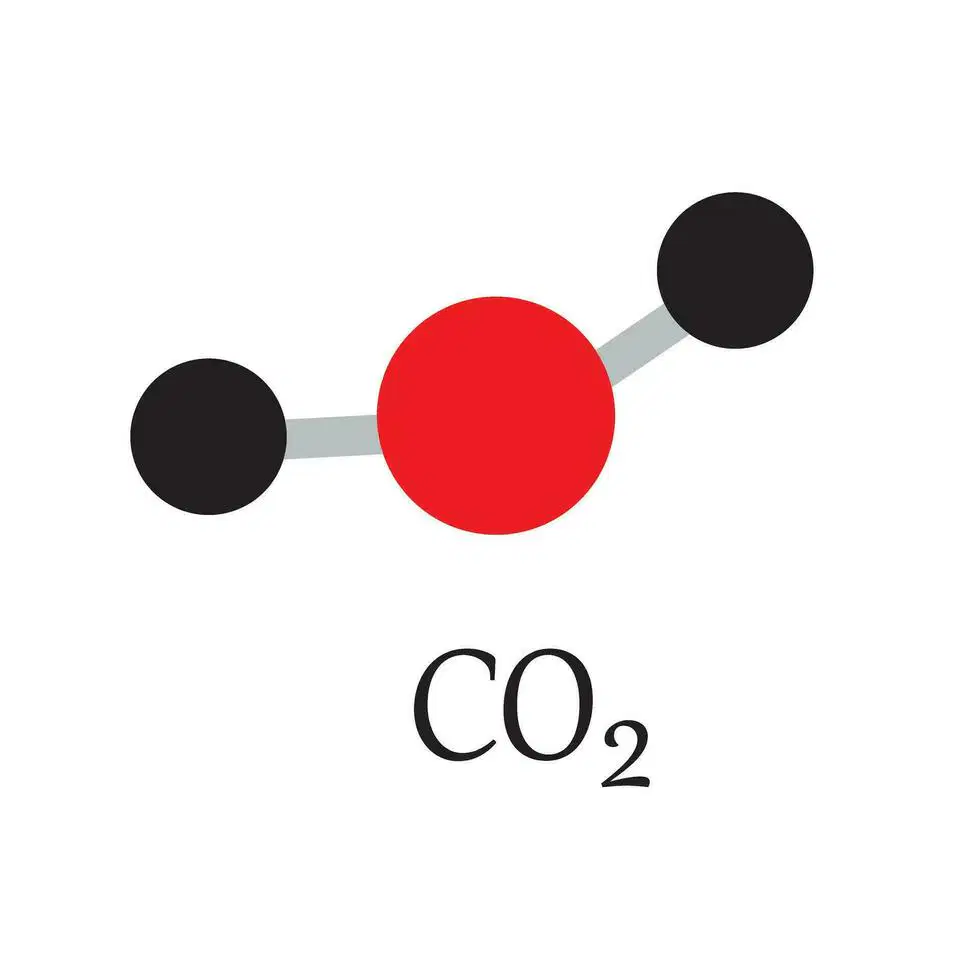
Is this a molecule or a compound?
a molecule only
a compound only
both a molecule and a compound
6
Multiple Choice
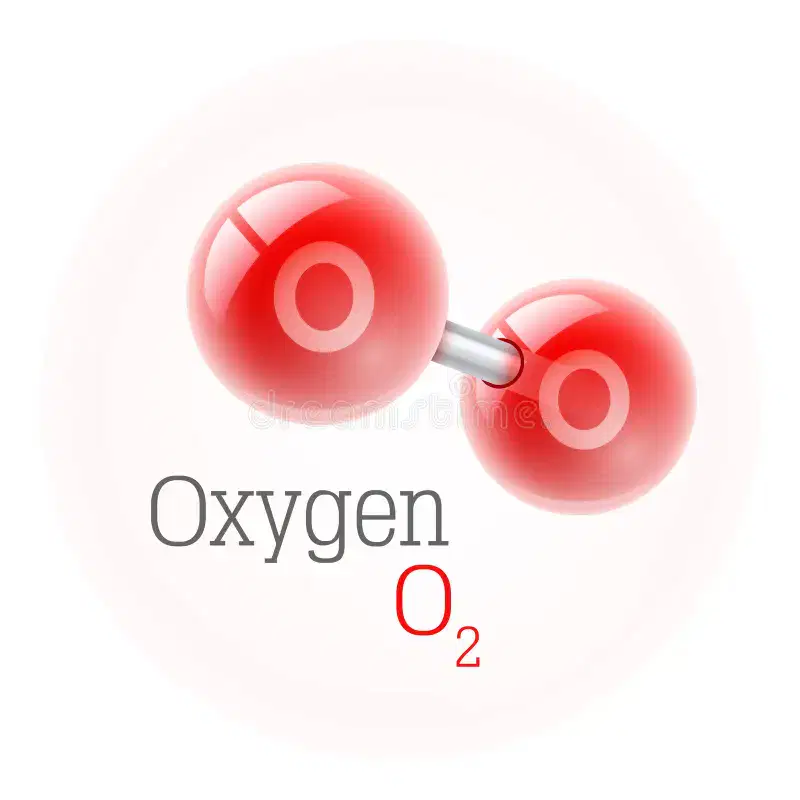
Is this a molecule or a compound?
a molecule only
a compound only
both a molecule and a compound
7
Multiple Choice
Which among the following is a homogeneous mixture?
Sugar
8
Poll
Can you separate mixtures?
YES
NO
9
Separation Techniques
Lesson 1.B.
10
LEARNING TARGET
I can identify different simple separation techniques for mixtures.
I can describe how and when to use each technique.
I can give examples of real-life applications of these techniques.
11
Analyze the scenario then answer the corresponding guide questions.
Science SOS: Separate to Survive!
12
Open Ended
"Your plane suddenly crushed in an island and luckily you survived. The island is full of fruit bearing plants but no source of fresh water."
Guide Questions
1. What would you do to convert the ocean water into potable water? How?
2. Which separating method could be used to separate water and salt from sea
water?
13
ACTIVITY 7. Separating Mixtures at Home
14
Results:
What did you separate in each step? What did you observe?
15
CONCLUSION
What physical property helped in each separation?
What techniques were effective?
What did you learn?
When are you going to use each separation technique? Give explanations to each. Also, give one (1) real life example for each.
16
Multiple Choice
Mr. Santos wants to separate the Rivets that were accidentally thrown in dipper with water. What separation technique should he used for his problem?
Adsorption
Decantation
Centrifugation
Distillation
17
18
Multiple Choice
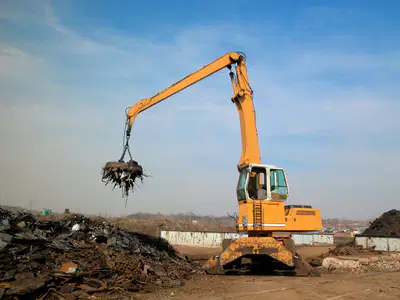
Mrs. Lazada task her students to collect iron fillings in the sand and study their physical properties in her Physics class. What separation technique should be used to collect iron fillings from the sand?
Filtration
Simple distillation
Adsorption
Magnetism
19
20
21
Multiple Choice
Magdalena wants to separate the salt crystals from salt solution, what separation technique is best used for the set-up?
Fractional distillation
Simple distillation
Filtration
Evaporation
22
23
Multiple Choice
Smaller particles pass through a filter paper, larger particles get trapped.
Distillation
Filtration
Decantation
Recrystallization
24
Multiple Choice
Filtrate
Dessicant
Centrifuge
Filtrant
Decanted liquid
25
26
27
Open Ended
Copper oxide is black and copper sulfate solution is blue.
Explain why you would obtain a blue filtrate and a black residue if you filter this mixture.
28
29
Summary
30
Other Separation Techniques
31
Separation methods help us to separate out a mixture
How we separate the mixture depends on what's in the mixture!
32
For example...
Say you went to the beach! You used your bucket to scoop up some water but realised there was a lot of sand in there...
What could you do?!
33
Multiple Choice
Is sand soluble or insoluble?
Soluble
Insoluble
34
Sand is insoluble!
This means that the sand will NOT dissolve in the seawater!
So, you can see and touch the sand in the bucket - so how could you separate this mixture in the lab.
35
Multiple Choice
Describe how you could separate an INSOLUBLE material (e.g. sand) from a solution.
Crystallisation
Filtration
Distillation
Chromatography
36
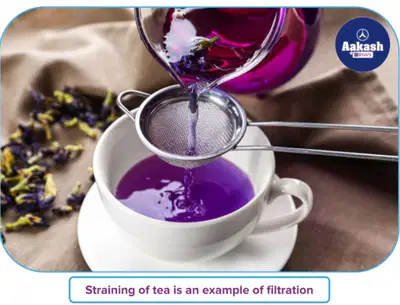
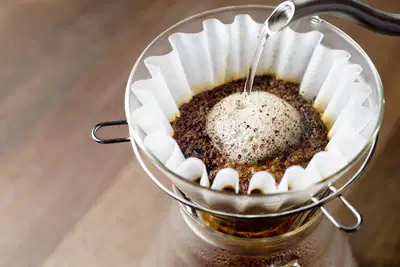
Filtration
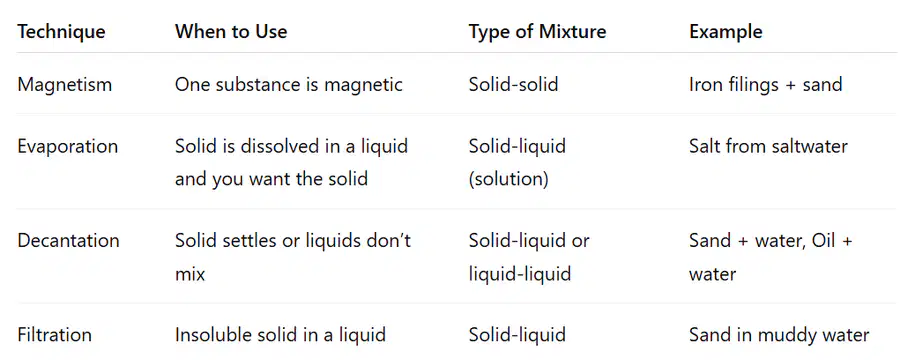
Filtration is used to separate an insoluble substance from a solution.
37
Multiple Choice
Where will the sand be left after filtration?
In the filter paper
In the conical flask
38
Multiple Choice
Where will the seawater be left after filtration
In the filter paper
In the conical flask
39
Success!
You have managed to remove the INSOLUBLE sand from your mixture! All that filtering has made you thirsty, so you decide to take a sip...
40
YUCK!
The water is salty!
41
Multiple Choice
There must be salt dissolved in the water! This means that salt is...
Soluble
Insoluble
42
That's right! Salt is soluble!
Something that is soluble CANNOT be removed by filtration! What should you do now...?
43
Multiple Choice
If I want to keep the salt but get rid of the water I should use...
Filtration
Crystalisation
Distillation
Chromatography
44
Crystallisation!
This helps me evaporate all of the water in a solution and just leaves the soluble material (e.g. salt).
45
46
Fill in the Blanks
Type answer...
47
Fill in the Blanks
48
Fill in the Blanks
49
Fill in the Blanks
50
What if I wanted to keep the water from my salty mixture?
51
Multiple Select
To separate the water from a solution I should use...
Filtration
Crystalisation
Distillation
Chromatography
52
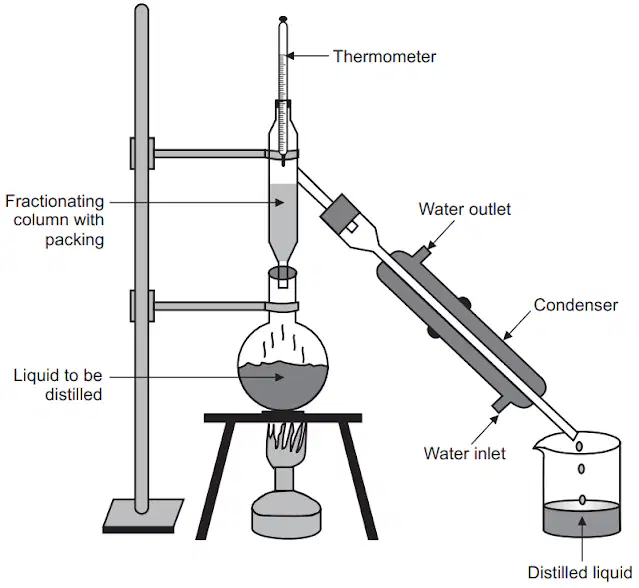
Distillation separates the water from a solution!
53
Multiple Choice
Where is the water being evaporated in distillation?
54
Poll
What technique is this?
Simple Distillation
Fractional Distillation
55
Simple Distillation
Principle:
Based on difference in boiling points between two components.
The component with the lower boiling point evaporates first and is then condensed back to liquid.
56
Principle:
Based on difference in boiling points between two components.
The component with the lower boiling point evaporates first and is then condensed back to liquid.
SIMPLE DISTILLATION
57
Best For:
Separating a liquid from a non-volatile solute or solid, or
Two liquids with very different boiling points (difference of ≥ 25–30°C).
SIMPLE DISTILLATION
58
Multiple Choice
Where is the pure water being collected in distillation?
59
Poll
What technique is this?
Simple Distillation
Fractional Distillation
60
Multiple Choice
Where is the water being condensed in distillation?
61
62
Examples:
Purifying water from saltwater
Separating ethanol (78°C) from a high-boiling impurity
Getting distilled water in labs
SIMPLE DISTILLATION
63
Principle:
Also based on boiling point differences, but uses a fractionating column to allow for repeated vaporization-condensation cycles.
More efficient at separating liquids with close boiling points.
FRACTIONAL DISTILLATION
64
Best For:
Separating mixtures of two or more liquids with small differences in boiling points (less than 25°C).
FRACTIONAL DISTILLATION
65
Examples:
Separating crude oil into gasoline, diesel, kerosene
Separating alcohol and water more precisely
Industrial separation of liquid air (oxygen, nitrogen, etc.)
FRACTIONAL DISTILLATION
66
Multiple Choice
What separation technique is this?
67
68
Multiple Choice
69
70
71
Multiple Choice
72
Multiple Choice
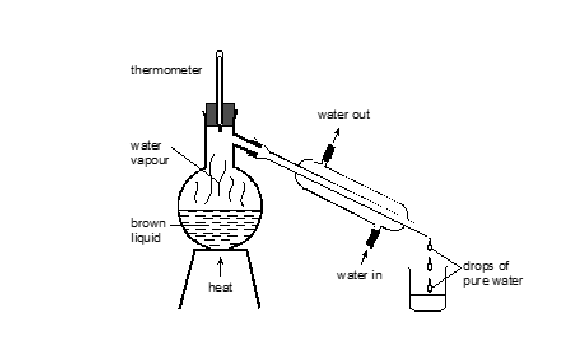
Which separation technique uses the apparatus shown in the diagram?
filtration
evaporation
distillation
chromatography
73
Multiple Choice
74
Multiple Choice
Which of the following pairs of substances may best be separated through through fractional distillation
sand and soil
water and soil
salt and sand
water and alcohol
75
Multiple Choice
Dyes in water soluble markers may be separated by means of
Simple distillation
Crystallisation
Chromatography
Filtration
76
Multiple Choice
77
Multiple Choice
What method is used to obtain copper(II) sulfate crystals from its solution?
Crystallisation
Evaporation to dryness
Paper chromatography
Fractional distillation
78
Multiple Choice
What is the method suitable to obtain pure water from seawater.
Simple distillation
Fractional distillation
Filtration
Evaporation to dryness
79
Multiple Choice
Magdalena wants to separate the salt crystals from salt solution, what separation technique is best used for the set-up?
Fractional distillation
Simple distillation
Filtration
Evaporation
80
Multiple Choice
used to separate magnetic materials from nonmagnetic materials.
MAGNETIC SEPARATION
MANUAL PICKING
DECANTATION
SIEVING
FILTERING
81
Multiple Choice
separates mixtures made of solid components large enough to pick out
MAGNETIC SEPARATION
MANUAL PICKING
DECANTATION
SIEVING
FILTERING
82
Multiple Choice
separates components of mixture with different densities and immiscible liquids
MAGNETIC SEPARATION
MANUAL PICKING
DECANTATION
SIEVING
FILTERING
83
Multiple Choice
What type of separation is used?
MAGNETIC SEPARATION
MANUAL PICKING
DECANTATION
SIEVING
FILTERING
84
Multiple Choice
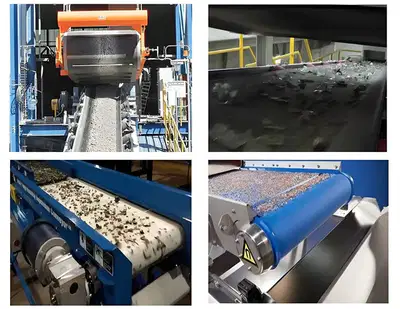
What type of separation is used?
MAGNETIC SEPARATION
MANUAL PICKING
DECANTATION
SIEVING
FILTERING
85
Multiple Choice
How would you separate salt if mixed with sand?
Pour water- Filtration-Decantation
Pour water- Filtration-Evaporation
Manual picking- Sieving- Filtration
86
Exit Ticket: Unlocking Separation Secrets
87
Open Ended
Quick Recall: Name three separation techniques and briefly describe how each works.
88
Open Ended
Application: A mixture of sand, salt, and water needs to be separated. What steps would you take to separate the components? Explain your reasoning.
89
Open Ended
Reflection: What was the most surprising or interesting thing you learned about separation techniques?
90
LEARNING TARGET
I can identify different simple separation techniques for mixtures.
I can describe how and when to use each technique.
I can give examples of real-life applications of these techniques.
91
Poll
I can identify different simple separation techniques for mixtures.
Complete Mastery – "I can confidently explain and apply different separation techniques to real-world scenarios!"
Strong Understanding – "I understand most techniques well but need minor clarifications on a few concepts."
Basic Understanding – "I grasp the general idea but still need more practice and examples."
Limited Understanding – "I recognize some techniques but struggle with their applications."
Needs More Support – "I feel lost and need further explanations to understand separation techniques better."
92
Poll
I can describe how and when to use each technique.
Complete Mastery – "I can confidently explain and apply different separation techniques to real-world scenarios!"
Strong Understanding – "I understand most techniques well but need minor clarifications on a few concepts."
Basic Understanding – "I grasp the general idea but still need more practice and examples."
Limited Understanding – "I recognize some techniques but struggle with their applications."
Needs More Support – "I feel lost and need further explanations to understand separation techniques better."
93
Poll
I can give examples of real-life applications of these techniques.
Complete Mastery – "I can confidently explain and apply different separation techniques to real-world scenarios!"
Strong Understanding – "I understand most techniques well but need minor clarifications on a few concepts."
Basic Understanding – "I grasp the general idea but still need more practice and examples."
Limited Understanding – "I recognize some techniques but struggle with their applications."
Needs More Support – "I feel lost and need further explanations to understand separation techniques better."
Show answer
Auto Play
Slide 1 / 93
SLIDE

Similar Resources on Wayground
84 questions
Decade week
Presentation
•
11th Grade
88 questions
25S1 HE Week 14 Minerals
Presentation
•
12th Grade
87 questions
F5 Life's Great Mysteries L12
Presentation
•
10th Grade
86 questions
Legislative Branch
Presentation
•
10th Grade
93 questions
Circles, radius, inscribed, central, secant, tangents and more
Presentation
•
11th Grade
85 questions
MOY Unit 2/3 Review
Presentation
•
11th Grade
86 questions
Networks Wide Area Networks/The Internet
Presentation
•
10th - 11th Grade
92 questions
Psych 101 Ch. 2 Research
Presentation
•
11th Grade
Popular Resources on Wayground
6 questions
Secondary Safety Quiz
Presentation
•
9th - 12th Grade
10 questions
MyPath Diagnostic Overview
Presentation
•
6th - 8th Grade
20 questions
Lab Safety Quiz
Quiz
•
6th Grade
21 questions
Continents and Oceans
Quiz
•
6th Grade
20 questions
Adding and Subtracting Decimals
Quiz
•
5th Grade
20 questions
Parts of Speech
Quiz
•
5th Grade
16 questions
Subject & Predicate
Quiz
•
5th Grade
21 questions
Lab Safety
Quiz
•
10th Grade
Discover more resources for Chemistry
20 questions
Lab Equipment and Safety Quiz
Quiz
•
10th - 12th Grade
20 questions
Scientific Method
Quiz
•
10th - 12th Grade
20 questions
Metric Conversions
Quiz
•
11th Grade
12 questions
Significant figures
Quiz
•
9th - 12th Grade
20 questions
Lab Safety and Lab Equipment
Quiz
•
9th - 12th Grade
16 questions
ACA Unit 1 Atomic Structure
Quiz
•
9th - 12th Grade
11 questions
Scientific Method
Presentation
•
9th - 11th Grade
20 questions
Scientific Method
Quiz
•
11th Grade