

CNS/PNS

Presentation
•
Science
•
12th Grade
•
Easy
Standards-aligned

Whitney Bass
Used 20+ times
FREE Resource
63 Slides • 28 Questions
1

2

3
Multiple Choice
Which of the following regions of the adult brain contains the thalamus, hypothalamus, and epithalamus?
Cerebral hemisphere
Diencephalon
Cerebellum
Brainstem
4

5
Fill in the Blanks
The surface layer of gray matter in the brain is called the
Type answer...
6

7
Multiple Choice
Which of the following best describes the function of the corpus callosum as shown in the brain diagrams?
It separates the frontal and parietal lobes.
It enables communication between the two hemispheres of the brain.
It controls voluntary muscle movements.
It stores long-term memories.
8

9
Open Ended
What are the main differences between gyri, sulci, and fissures in the structure of the brain?
10
Labeling
Label the parts of the brain listed:
Temporal lobe
Frontal lobe
Brainstem
Cerebellum
Parietal lobe
Occipital lobe
11

12

13

14
Open Ended
Describe the three types of functional areas found in the cerebral cortex and their roles.
15

16
Open Ended
How did the story of Phineas Gage contribute to our understanding of the relationship between brain function and behavior?
17

18
Multiple Select
Which of the following areas are located in the frontal lobe and are involved in motor control?
Primary (somatic) motor cortex
Premotor cortex
Broca’s area
Primary somatosensory cortex
19

20
Fill in the Blanks
The
Type answer...
21

22
Multiple Choice
Which sensory area of the cerebral cortex is responsible for the conscious perception of touch, pressure, pain, and temperature?
Primary somatosensory cortex
Visual areas
Auditory areas
Olfactory cortex
23

24

25

26
Multiple Choice
Which area of the brain is primarily responsible for intellect, decision making, recall, and personality?
Prefrontal cortex
Wernicke's area
Cingulate gyrus
Amygdala
27

28

29
Fill in the Blanks
A lesion in the
Type answer...
30

31

32
Multiple Choice
Which of the following best describes psychosomatic illness as discussed in the context of the limbic system?
Physical symptoms originating from emotional stress
Memory loss due to brain injury
Language deficits from lesions in Broca's area
Loss of motor function due to spinal cord injury
33

34
Open Ended
Discuss how the prefrontal cortex and amygdala contribute differently to the experience and expression of emotions.
35

36
Multiple Choice
Which hemisphere of the brain is primarily responsible for language, math, and logic?
Left hemisphere
Right hemisphere
Both hemispheres equally
Neither hemisphere
37
Multiple Choice
Which hemisphere controls the right side of the body?
Right Side
Left Side
Front side
Back Side
38
39

40
Multiple Choice
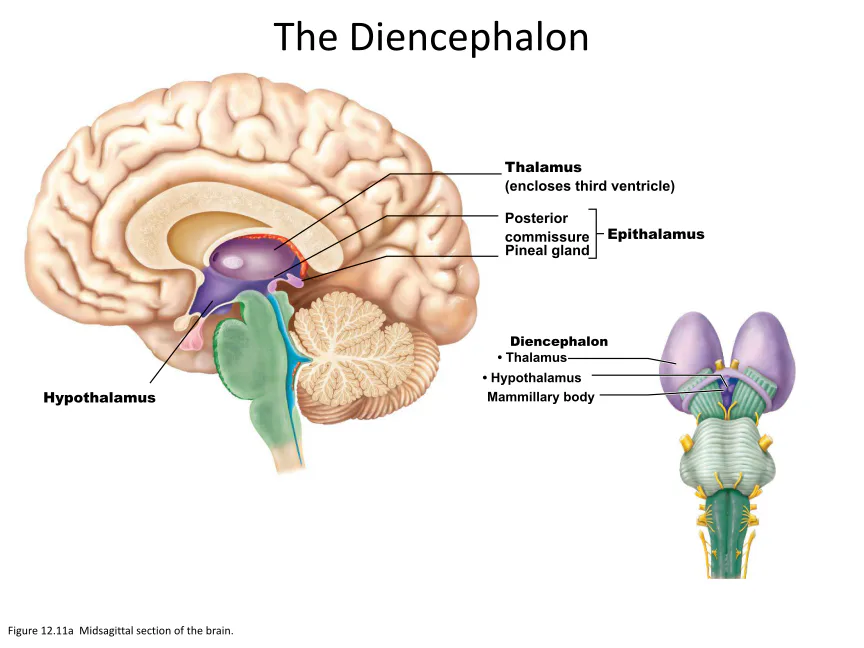
Which structure acts as a relay station into the cortex?
Thalamus
Hypothalamus
Pineal gland
Mammillary body
41
Fill in the Blanks
The pineal gland secretes
Type answer...
42

43
Multiple Select
Which of the following are functions of the hypothalamus?
Regulation of body temperature
Relay station into cortex
Secretion of melatonin
Control of hunger and satiety
44

45

46
Multiple Select
Which structures are part of the brainstem?
Midbrain
Pons
Thalamus
Medulla oblongata
47

48

49

50

51
Fill in the Blanks
The medulla oblongata is know as the
52

53

54

55

56

57
Multiple Choice
What structure in the brain contains ependymal cells that produce CSF?
58

59

60

61
Multiple Choice
Between which layers of the meninges is cerebrospinal fluid (CSF) found?
Dura mater and arachnoid mater
Arachnoid mater and pia mater
Pia mater and the brain tissue
Dura mater and the skull
62

63

64

65

66

67

68
Open Ended
Why is sleep important?
69

70

71
Multiple Choice
Memorizing facts (like in this class) utilizes what type of memory?
72

73

74

75

76

77

78

79

80

81

82

83
Multiple Choice
Which horn of the spinal cord contains sensory fibers?
84

85

86

87

88

89

90
Open Ended
Reflecting on what you have learned about the major regions of the brain, which region do you find most interesting and why?
91
Multiple Choice
What are the main differences between the central nervous system and the peripheral nervous system?
The central nervous system includes the brain and spinal cord, while the peripheral nervous system includes nerves outside the brain and spinal cord.
The central nervous system includes only the brain, while the peripheral nervous system includes the spinal cord and nerves.
The central nervous system controls voluntary actions, while the peripheral nervous system controls only involuntary actions.
The central nervous system is found only in the head, while the peripheral nervous system is found throughout the body.
Show answer
Auto Play
Slide 1 / 91
SLIDE
Similar Resources on Wayground

87 questions
CLASS 1 LESSON PLAN
Presentation
•
University
89 questions
Biomolecules
Presentation
•
11th Grade
84 questions
Anatomy of Root, Stem and Leaves
Presentation
•
11th Grade
90 questions
DP ESS Topic 7.1: Natural resources - uses and management
Presentation
•
12th Grade
85 questions
The Skin (Integumentary System) Part 1
Presentation
•
12th Grade
86 questions
การพัฒนาองค์การฯ 4 การจัดการความเสี่ยง
Presentation
•
12th Grade
87 questions
ESL: My Family (RUS)
Presentation
•
KG
84 questions
heliocentric VS geocentric
Presentation
•
KG
Popular Resources on Wayground
10 questions
Safety Day 2026 – Student Review

Quiz
•
9th Grade
21 questions
Continents and Oceans
Quiz
•
6th Grade
20 questions
Parts of Speech
Quiz
•
5th Grade
16 questions
Subject & Predicate
Quiz
•
5th Grade
25 questions
Multiplication Facts
Quiz
•
5th Grade
12 questions
Map Skills
Quiz
•
3rd Grade
22 questions
Continents and Oceans
Quiz
•
5th Grade
15 questions
Rounding Decimals
Quiz
•
5th Grade
Discover more resources for Science
7 questions
Newton's Laws Video Quiz

Interactive video
•
9th - 12th Grade
35 questions
Cell Transport/Enzyme/Cell/Macro Review
Quiz
•
9th - 12th Grade
13 questions
Explore Enzyme Functions and Interactions
Quiz
•
9th - 12th Grade
10 questions
Fact or Fiction: Microbes
Quiz
•
9th - 12th Grade
10 questions
Understand Cell Functions and Organelles
Quiz
•
9th - 12th Grade
19 questions
Explore Macromolecules in Living Organisms
Quiz
•
9th - 12th Grade
15 questions
Layers of Atmosphere passage

Passage
•
9th - 12th Grade
22 questions
Quiz Review Day 5 Water and Macromolecules
Quiz
•
9th - 12th Grade