

Ocean Atmosphere Climate Variant 1

Presentation
•
Geography
•
6th Grade
•
Practice Problem
•
Hard

Sanidhya Singh
FREE Resource
23 Slides • 22 Questions
1

Ocean, Atmosphere, and Climate: Ocean Currents
2

Key Vocabulary
Average weather conditions in an area over a long period.
Climate


Energy Transfer
Energy moving from one place or object to another. Example: heat transfer.

Ocean Current
Continuous, directed seawater movement. Driven by wind, temperature, and salinity differences.
Latitude
A place's distance north/south of the equator. Usually measured in degrees.

Temperature
Measures how hot or cold something is. Shows average particle kinetic energy.
3

Key Vocabulary
The blanket of gases all around our Earth!
Atmosphere


Density
How tightly stuff is packed in a space.

Solar Radiation
Sunshine power! Energy from the sun reaching Earth.
Salinity
How salty the water is, like in oceans.

Prevailing Winds
Winds that blow mostly from one direction.
4
Learning Objectives
Describe how the Sun's energy unequally heats the Earth's surface.
Explain what ocean currents are and identify key factors that cause them.
Illustrate how ocean currents redistribute thermal energy around the globe, influencing regional climates.
Explain how energy is transferred between the ocean and the atmosphere, and how this interaction affects local air temperatures.
Identify how factors such as distance from the ocean and the origin of ocean currents affect a region's climate.

5
What is Climate?
Climate is long-term average weather in an area (30+ years).
Weather is short-term: rainy today, sunny tomorrow.
Climate includes temperature, precipitation, humidity, wind, and seasons.
Understanding climate helps agriculture, planning, and planet changes.


6
Multiple Choice
What is the main difference between climate and weather?
Climate is about ocean currents, weather is about wind.
Climate describes short-term conditions, weather describes long-term patterns.
Climate describes long-term average conditions, weather describes short-term atmospheric state.
Climate and weather are the same thing.
7
The Sun: Earth's Main Energy Source
The Sun is Earth's ultimate power source for climate!
This energy, called solar radiation (sunlight), travels from the Sun.
Solar radiation journeys through space and warms up our Earth.
Uneven heating by the Sun makes our weather and moves oceans!


8
Multiple Choice
What is the primary source of energy for Earth's climate system?
Geothermal heat from Earth's core
Energy from ocean waves
Solar radiation from the Sun
Wind energy
9
Latitude and Solar Heating
Latitude (distance from Equator) affects an area's solar energy.
Equator areas (low latitudes) get direct sunlight, making them warmer.
Poles (high latitudes) get angled sunlight, making them colder.
This uneven heating causes global air and water movement.


10
Multiple Choice
Why are regions near the Equator generally warmer than regions near the poles?
The Equator is closer to the Sun.
The poles are always covered in reflective ice.
The Equator receives more direct sunlight due to Earth's tilt and curvature.
The poles receive more wind.
11
The Ocean's Big Job: Storing Heat!
The ocean absorbs and stores huge amounts of solar energy from the sun.
Water heats up and cools down much slower than land does.
This makes the ocean a giant heat reservoir, like a big battery.
It releases stored heat, helping to keep coastal climates milder.


12
Multiple Choice
Why does the ocean have a major influence on Earth's climate?
It produces most of the Earth's oxygen.
It is very deep.
It absorbs, stores, and slowly releases large amounts of solar energy.
It is home to many animals.
13
What are Ocean Currents?
Ocean currents are like big rivers of water in the ocean.
They are continuous, predictable, and directed movements of seawater.
Surface currents are wind-driven; deep currents are density-driven.
Currents move heat, nutrients, and organisms worldwide.


14
Multiple Choice
What is an ocean current?
A large wave in the ocean.
The daily rise and fall of sea level.
A continuous, directed movement of seawater.
A type of fish.
15
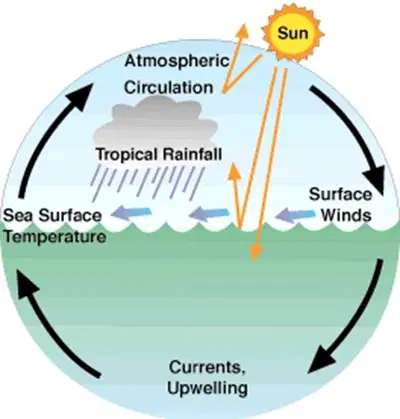
How Wind Drives Surface Ocean Currents
Prevailing winds drive surface ocean currents.
These winds blow consistently in a specific direction.
Wind drags water along due to friction on the surface.
Global winds create large circular currents called gyres.

16
Multiple Choice
What is the main way prevailing winds create surface ocean currents?
By cooling the water surface.
By pushing and dragging the surface water due to friction.
By causing evaporation.
By changing water salinity.
17
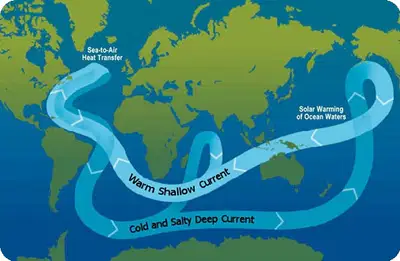
Density: Driving Deep Ocean Currents (Thermohaline Circulation)
Deep ocean currents are driven by water density differences.
Water density depends on temperature (thermo) and salinity (haline).
Cold water is denser. Salty water is denser than freshwater.
Sinking dense water creates the 'global conveyor belt' (thermohaline circulation).

18
Multiple Choice
What are the two main factors that affect water density and drive deep ocean currents?
Wind speed and wave height
Sunlight and air pressure
Temperature and salinity
Depth and latitude
19
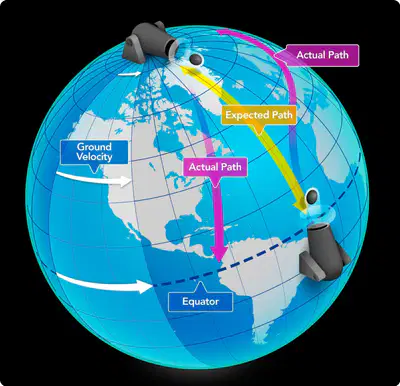
Earth's Rotation and Its Effect on Currents (Coriolis Effect)
Earth's rotation influences ocean currents and winds.
This is the Coriolis effect.
It deflects water right (Northern Hemisphere) & left (Southern Hemisphere).
It steers currents, helping create circular gyres.

20
Multiple Choice
What is the name of the effect caused by Earth's rotation that influences the direction of ocean currents?
The Greenhouse Effect
The Salinity Effect
The Coriolis Effect
The Geothermal Effect
21
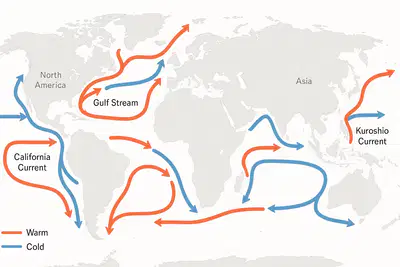
How Continents Shape Ocean Currents
Continents act like barriers, blocking ocean currents.
Currents hitting land are forced to change direction.
They flow along coastlines or into new ocean basins.
This shapes the current patterns observed on maps.

22
Multiple Choice
How do continents affect ocean currents?
They heat up the currents.
They make currents flow faster.
They act as barriers, deflecting and redirecting current flow.
They add salt to the currents.
23
Ocean Currents: Earth's Heat Movers!
Ocean currents move thermal energy, or heat, around our planet.
Warm currents flow from the equator towards the poles.
Cold currents flow from the poles towards the equator.
This heat movement helps balance Earth's overall temperatures.


24
Multiple Choice
What important role do ocean currents play regarding Earth's thermal energy?
They create thermal energy.
They destroy thermal energy.
They redistribute thermal energy from warmer to cooler regions and vice-versa.
They store all thermal energy in one place.
25
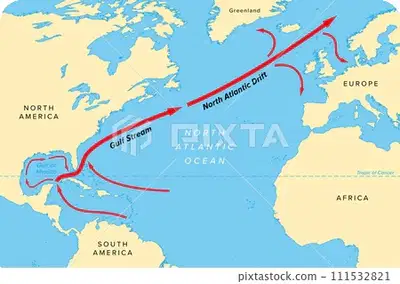
Impact of Warm Ocean Currents on Climate
Warm ocean currents from the equator carry warm water to higher latitudes.
Coasts near warm currents have warmer and moister climates.
Warm water heats the air, causing more evaporation and rain.
Example: The Gulf Stream makes Western Europe's climate milder.

26
Multiple Choice
What kind of climate do coastal regions near warm ocean currents typically experience?
Colder and drier than expected for their latitude.
Warmer and often moister than expected for their latitude.
The same climate as inland regions at the same latitude.
A climate with no seasonal changes.
27
Impact of Cold Ocean Currents on Climate
Cold currents start near poles, moving cold water.
Coastal areas near them are cooler and drier.
Cold water cools air, causing less evaporation and fog.
California Current cools the U.S. west coast.


28
Multiple Choice
A coastal area near a cold ocean current is likely to have what type of climate compared to other areas at the same latitude?
Warmer and wetter
Cooler and often drier
No different
Extremely hot
29
Energy Transfer: Ocean to Atmosphere (Warmer Water to Cooler Air)
Energy, as heat, always moves from warmer to cooler items.
Warmer oceans transfer thermal energy to the cooler atmosphere.
This process warms the air, affecting local weather and temperature.
This is common where warm currents flow into cooler regions.


30
Multiple Choice
If an ocean current is warmer than the air above it, what happens?
Energy transfers from the air to the ocean, cooling the air.
Energy transfers from the ocean to the air, warming the air.
No energy transfer occurs.
The ocean water freezes.
31
Energy Transfer: Atmosphere to Ocean
Warm air transfers thermal energy to cooler ocean water.
This process warms the ocean water and cools the air.
Cold currents meeting warmer air can cause this transfer.
Summer air over land also heats nearby cooler water.


32
Multiple Choice
What happens when the air above the ocean is warmer than the ocean water itself?
Energy transfers from the ocean to the air, warming the air further.
Energy transfers from the air to the ocean, warming the water.
The air becomes much colder.
The water salinity increases.
33
Proximity to Oceans and Climate Moderation
Oceans make nearby climates moderate.
Coastal areas: cooler summers, milder winters.
Water heats and cools slowly due to high specific heat.
Oceans buffer temperatures by absorbing and releasing heat.


34
Multiple Choice
Why do coastal areas often have milder winters and cooler summers compared to inland areas at the same latitude?
Coastal areas get more wind.
Oceans reflect all sunlight away from the coast.
Ocean water heats up and cools down much slower than land, moderating nearby air temperatures.
Inland areas have more mountains.
35
Interacting Factors Determine Climate
Many factors together determine a region's climate.
These include latitude, altitude, winds, and oceans.
Ocean currents and landforms also affect climate.
These factors create Earth's diverse climates.


36
Multiple Choice
Which of the following is an example of interacting factors determining a region's climate?
Only the amount of sunlight a region receives.
Only the type of soil in a region.
Latitude, proximity to the ocean, and nearby ocean currents all influencing temperature and precipitation.
The number of rivers in a region.
37
Ocean, Atmosphere, and Land: A Connected System
The ocean, atmosphere, and land are connected climate parts.
Sunlight gives energy. The ocean absorbs and moves this energy.
Atmosphere warms by ocean/land. Winds also drive ocean currents.
Landforms alter flow; ice reflects light. Changes in one part affect others.


38
Multiple Choice
How are the ocean, atmosphere, and land interconnected in the climate system?
They are completely separate and do not affect each other.
Only the ocean and atmosphere interact; land is not involved.
They interact through exchanges of energy and matter, influencing each other's conditions and movements.
Only land and atmosphere interact; the ocean is too large to be affected.
39
Common Misconceptions
Oceans only affect weather directly at the coast.
All ocean water is uniformly cold, especially deep down.
The Earth is heated evenly by the sun.
Ocean currents only flow horizontally.
Fact
Misconception
Oceans drive global climate, influencing weather far inland.
Ocean temperature varies by depth, latitude, and currents.
Earth's curve and tilt cause uneven heating. Equator gets more sun.
Significant vertical water movement (upwelling/downwelling) also occurs.
40
Summary
Solar energy drives Earth's climate, heating it unevenly.
Oceans absorb, store, and transport this energy using currents.
Winds and water density drive currents, shaped by Earth's rotation.
Currents and ocean-air energy transfer greatly influence regional climates.
41
Open Ended
In one or two sentences, explain how an ocean current originating near the North Pole might affect the climate of a coastal area it passes.
42
Poll
Which of these factors has the BIGGEST direct impact on causing surface ocean currents?
The Moon's gravity
Prevailing winds
Earth's internal heat
Rainfall
43
Open Ended
Describe one way the ocean and atmosphere interact to influence temperature.
44
Poll
How confident are you in explaining how ocean currents affect a region's climate?
Very confident
Somewhat confident
Not very confident
Not confident at all
45
Open Ended
What is one concept from today's review that you would like to understand better?
Ocean, Atmosphere, and Climate: Ocean Currents
Show answer
Auto Play
Slide 1 / 45
SLIDE
Similar Resources on Wayground

43 questions
Africa Facts
Presentation
•
KG
42 questions
Unit 5 review
Presentation
•
6th Grade
40 questions
European Governments
Presentation
•
6th Grade
41 questions
Motion
Presentation
•
6th Grade
39 questions
Poetry
Presentation
•
6th Grade
38 questions
VA Watersheds
Presentation
•
6th Grade
37 questions
Physical Properties of Matter
Presentation
•
6th Grade
41 questions
Economic Systems
Presentation
•
6th - 7th Grade
Popular Resources on Wayground
11 questions
Hallway & Bathroom Expectations

Quiz
•
6th - 8th Grade
10 questions
HCS SCI 03 Summer School Assessment 2
Quiz
•
3rd Grade
11 questions
Home Scope
Quiz
•
7th - 8th Grade
12 questions
2026 TAP Technology in the Classroom
Presentation
•
Professional Development
15 questions
HCS SCI 05 Summer School Assessment 2 Review
Quiz
•
5th Grade
15 questions
HCS SCI 04 Summer School Review 2
Quiz
•
4th Grade
59 questions
Geometry Unit 3 Review
Quiz
•
9th - 12th Grade
14 questions
FAST ELA READING SMAPLE TEST MATERIALS

Passage
•
3rd Grade