

Thermal Energy ISTE

Presentation
•
Chemistry
•
6th Grade
•
Practice Problem
•
Hard

Sanidhya Singh
FREE Resource
9 Slides • 5 Questions
1

Thermal Energy
2
Learning Objectives
Define thermal energy, heat, and temperature.
Explain the relationship between thermal energy, temperature, and the state of matter.
Describe how temperature is measured using the Celsius, Fahrenheit, and Kelvin scales.
Explain what happens to temperature and thermal energy during a change of state.



3
Key Vocabulary
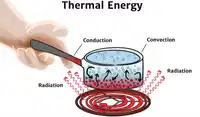
Thermal Energy
The total kinetic and potential energy of all the particles in an object.
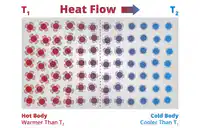
Heat
The energy that is transferred from a warmer object to a cooler object.
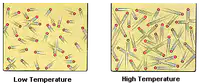
Temperature
A measure of the average kinetic energy of the particles in a substance.
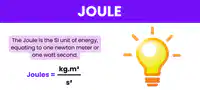
Joule
The SI unit of energy.
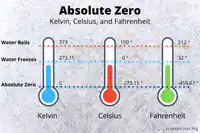
Absolute Zero
The lowest possible temperature (0 K or -273°C) where particles theoretically have no kinetic energy.
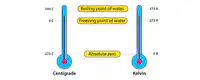
Kelvin
The SI unit of temperature, where 0 K is absolute zero.
4
Thermal Energy and Heat
All objects are made of constantly moving particles.
These particles have kinetic and potential energy.
Thermal energy is the total energy of all particles in an object.
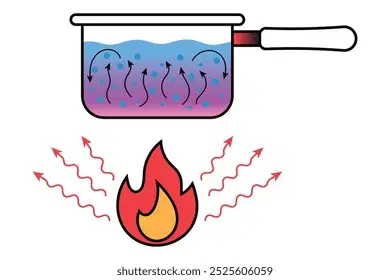
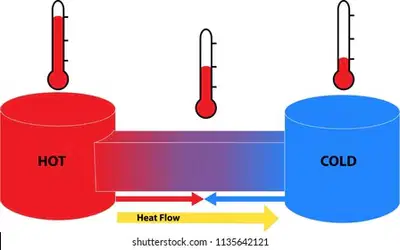
Heat is the transfer of energy from a warmer to a cooler object.


5
Multiple Choice
What is the primary difference between thermal energy and heat?
Thermal energy is the energy of motion, while heat is the energy of position.
Thermal energy is the total energy of particles in an object, while heat is the transfer of that energy.
There is no difference; the terms are interchangeable.
Heat is the total energy in an object, while thermal energy is the energy transfer.
6
Temperature and Its Measurement
Temperature is the average kinetic energy of a substance's particles.
It is measured using Fahrenheit (°F), Celsius (°C), or Kelvin (K).
Kelvin (K) is the official SI unit for temperature.
7
Multiple Choice
A scientist records a temperature increase of 5 K. How much did the temperature increase in degrees Celsius?
5°C
-268°C
278°C
It is impossible to tell.
8
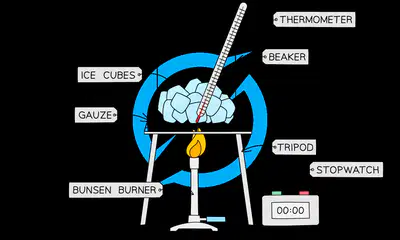
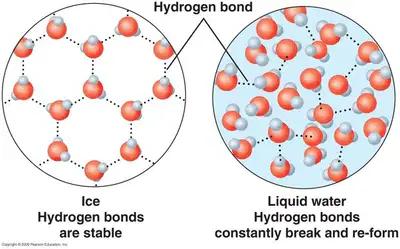
Changes of State: A Temperature Puzzle
When a substance changes state, its thermal energy increases.
Surprisingly, its temperature stays exactly the same.
Heat energy breaks molecule bonds, not speed them up.
Temperature is constant until the change is complete.


9
Multiple Choice
As a pot of water boils on a stove, what happens to its temperature?
The temperature increases as long as it is boiling.
The temperature decreases as steam is released.
The temperature remains constant at the boiling point.
The temperature fluctuates randomly.
10
Thermal Energy and Amount of Matter
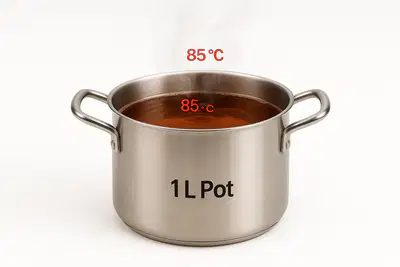
Large Pot (1L)
Has more matter, so many more particles.
Holds more total thermal energy.
Needs more heat to change temperature.
Small Cup (0.2L)
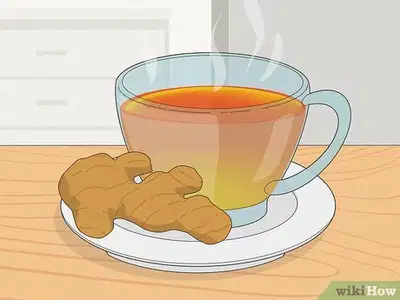
Has less matter, so fewer particles.
Holds less total thermal energy.
Needs less heat to change temperature.


11
Multiple Choice
A large iceberg and a hot cup of coffee are both measured. Which of the following is most likely true?
The coffee has a higher temperature and more thermal energy.
The iceberg has a higher temperature, but the coffee has more thermal energy.
The coffee has a higher temperature, but the iceberg has more thermal energy.
The iceberg has a higher temperature and more thermal energy.
12
Common Misconceptions
Misconception
Heat and temperature are the exact same thing.
Cold objects do not have any thermal energy.
An object's temperature will always rise when heated.
Correction
Temperature is particle energy; heat is the transfer of that energy.
All objects have thermal energy because their particles are always moving.
During a state change, temperature can stay constant even with heat.


13
Summary
Thermal Energy is the total energy of all particles in an object.
Heat is the transfer of energy from a warmer object to a cooler one.
An object's thermal energy depends on its temperature, matter, and state.
During a change of state, temperature remains constant but thermal energy changes.


14
Poll
On a scale of 1-4, how confident are you about the concepts covered in today's review?
1
2
3
4
Thermal Energy
Show answer
Auto Play
Slide 1 / 14
SLIDE
Similar Resources on Wayground

10 questions
Dividing Fractions and Mixed Numbers
Presentation
•
6th Grade
10 questions
GCF & LCM word problems
Presentation
•
6th Grade
9 questions
Parliamentary vs. Presidential
Presentation
•
6th Grade
9 questions
Proportions and Equivalent Ratios
Presentation
•
6th Grade
11 questions
Main Idea Mini Lesson
Presentation
•
6th Grade
12 questions
Elements, Compounds and Mixtures
Presentation
•
6th Grade
10 questions
Area of Triangles
Presentation
•
6th Grade
10 questions
Like Terms Introduction
Presentation
•
6th Grade
Popular Resources on Wayground
16 questions
Grade 3 Simulation Assessment 2

Quiz
•
3rd Grade
19 questions
HCS Grade 5 Simulation Assessment_1 2526sy
Quiz
•
5th Grade
10 questions
Cinco de Mayo Trivia Questions

Interactive video
•
3rd - 5th Grade
17 questions
HCS Grade 4 Simulation Assessment_2 2526sy
Quiz
•
4th Grade
24 questions
HCS Grade 5 Simulation Assessment_2 2526sy
Quiz
•
5th Grade
13 questions
Cinco de mayo
Interactive video
•
6th - 8th Grade
20 questions
Math Review
Quiz
•
3rd Grade
30 questions
GVMS House Trivia 2026
Quiz
•
6th - 8th Grade