

BL Ch 7 Periodic Properties

Presentation
•
Chemistry
•
9th - 12th Grade
•
Practice Problem
•
Hard

Connie Schaef
FREE Resource
40 Slides • 28 Questions
1

2

3

4
Multiple Choice
Who were the two scientists that independently concluded how elements should be grouped in the periodic table?
Dmitri Mendeleev and Lothar Meyer
Marie Curie and Ernest Rutherford
John Dalton and J.J. Thomson
Antoine Lavoisier and Robert Boyle
5

6
Open Ended
Why was the development of the periodic table significant in the field of chemistry?
7

8

9
Multiple Choice
Why do chemists credit Mendeleev for his work on the periodic table?
He predicted missing elements and their properties using chemical properties.
He discovered all elements.
He organized elements by atomic number.
He invented atomic theory.
10

11

12
Open Ended
How did the discovery of the atomic number change the organization of the periodic table?
13

14

15
Multiple Select
Which of the following properties are discussed as periodic properties in this chapter?
Sizes of atoms and ions
Ionization energy
Electron affinity
Boiling point
16

17

18
Fill in the Blanks
The forces an electron experiences depend on both attraction to the nucleus and
Type answer...
19

20

21
Multiple Choice
What is the formula for calculating effective nuclear charge (Z_eff)?
Z_eff = Z - S
Z_eff = S - Z
Z_eff = Z + S
Z_eff = Z / S
22

23

24
Open Ended
Based on the graph, explain how the effective nuclear charge changes as you move across a period in the periodic table.
25

26

27
Multiple Choice
Which of the following best defines the nonbonding atomic radius (van der Waals radius)?
It is the distance between the nuclei of two bonded atoms.
It is half of the shortest distance separating two nuclei during a collision of atoms.
It is the distance from the nucleus to the outermost electron.
It is the sum of the radii of two atoms.
28

29

30
Multiple Choice
How does the bonding atomic radius change as you move across a period and down a group in the periodic table?
It increases across a period and decreases down a group.
It decreases across a period and decreases down a group.
It decreases across a period and increases down a group.
It increases across a period and increases down a group.
31

32

33
Open Ended
Explain how ionic size is determined and what factors influence it.
34

35

36
Multiple Choice
Which element listed in the table experiences the largest increase in ionization energy between the removal of its last valence electron and the next electron?
Na
Mg
Al
Si
37
Fill in the Blanks
Cations are generally ___ than their parent atoms, while anions are ___ than their parent atoms.
Type answer...
38

39

40
Open Ended
Explain how the trends in first ionization energy across a period and down a group are related to atomic structure.
41
Multiple Choice
Which of the following ions in the isoelectronic series O2−, F−, Na+, Mg2+, Al3+ has the smallest ionic radius?
O2−
F−
Na+
Al3+
42

43

44
Multiple Choice
Which of the following statements about ionization energy is correct?
Smaller atoms have higher ionization energy values.
Larger atoms have higher ionization energy values.
Ionization energy does not depend on atomic size.
Ionization energy is always the same for all elements.
45
Multiple Select
Select all statements that are true about ionization energy.
Ionization energy is the minimum energy required to remove an electron from a gaseous atom or ion.
The first ionization energy is required to remove the first electron.
The higher the ionization energy, the easier it is to remove an electron.
The second ionization energy is required to remove the second electron.
46

47

48
Fill in the Blanks
Irregularities in the general trend of ionization energy occur when the added valence electron in the next element
Type answer...
49

50

51
Multiple Select
Select all correct statements about electron configurations of ions.
Cations lose electrons from the highest energy level.
Anions gain electrons to fill ns2np6.
Li+ loses a 2s electron.
Fe2+ loses two 4s electrons.
52

53

54
Open Ended
Describe why electron affinity is typically negative for most elements and what this indicates about the process.
55

56

57
Multiple Choice
Which group in the periodic table is an exception to the general trend of increasing electron affinity across a period due to a full s sublevel?
Group 2A
Group 5A
Group 8A
Group 7A
58

59

60
Open Ended
Explain how the position of an element in the periodic table influences its metallic character.
61

62
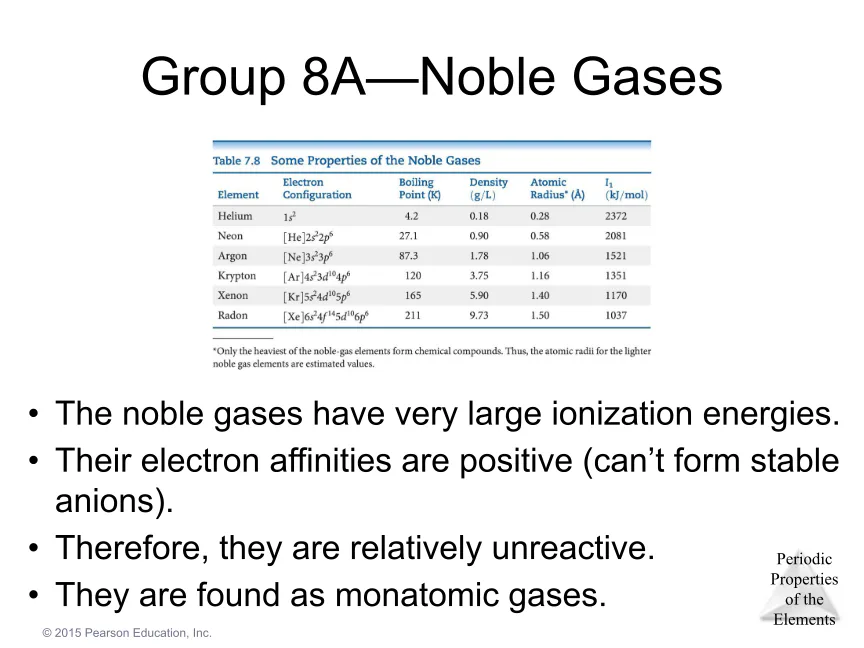
63
Multiple Select
Which of the following statements about metals and nonmetals are correct?
Metals tend to form cations.
Nonmetals tend to form anions.
Metals are found on the left side of the periodic table.
Nonmetals have low electronegativity.
64
Fill in the Blanks
Metals are generally good conductors of
Type answer...
65
Open Ended
How has your understanding of the periodic properties of elements changed after this lesson?
66
Multiple Choice
What was the significant contribution of Dmitri Mendeleev and Lothar Meyer to the development of the periodic table?
They discovered all the elements
They independently concluded how elements should be grouped
They invented the atomic model
They created the first chemical reactions
67
Multiple Choice
What type of compound is most likely formed when a metal reacts with a nonmetal?
Ionic
Covalent
Metallic
Hydrogen bond
68
Open Ended
Describe two physical properties that distinguish nonmetals from metals.
Show answer
Auto Play
Slide 1 / 68
SLIDE
Similar Resources on Wayground

64 questions
Informal Commands
Presentation
•
9th - 12th Grade
62 questions
Quadratic Basics LESSON
Presentation
•
9th - 12th Grade
65 questions
Respect Lesson - Biology class - Wayground
Presentation
•
9th - 12th Grade
66 questions
Lesson 3: Reactions | Mr.Q
Presentation
•
9th - 12th Grade
61 questions
Ionic Compounds: Formulas
Presentation
•
9th Grade - University
66 questions
Using the subjunctive in context
Presentation
•
9th Grade - University
64 questions
Unit 2 Notes: Newton's Laws of Motion
Presentation
•
9th - 12th Grade
62 questions
Binary Numbers (Binary to Dec / Hex)
Presentation
•
9th - 12th Grade
Popular Resources on Wayground
10 questions
Safety Day 2026 – Student Review

Quiz
•
9th Grade
21 questions
Continents and Oceans
Quiz
•
6th Grade
20 questions
Parts of Speech
Quiz
•
5th Grade
16 questions
Subject & Predicate
Quiz
•
5th Grade
25 questions
Multiplication Facts
Quiz
•
5th Grade
12 questions
Map Skills
Quiz
•
3rd Grade
22 questions
Continents and Oceans
Quiz
•
5th Grade
15 questions
Rounding Decimals
Quiz
•
5th Grade
Discover more resources for Chemistry
20 questions
electron configurations and orbital notation
Quiz
•
9th - 12th Grade
20 questions
Periodic Table Trends
Quiz
•
11th Grade
25 questions
Writing and Naming Binary Ionic compounds
Quiz
•
10th Grade
20 questions
COUNTING ATOMS
Quiz
•
10th Grade
50 questions
Unit 3: Atomic Assault Summative Review
Quiz
•
11th Grade
20 questions
Physical or Chemical Change/Phases
Quiz
•
8th Grade - University
15 questions
Periodicity Module Exam Practice Quiz
Quiz
•
9th - 12th Grade
20 questions
Naming Ionic Compounds
Quiz
•
10th Grade